Review finds no clear winner between two endoscopic spine surgery methods
A global surgeon survey and expert debate found continuing disagreement about benefits, risks, training, and costs.
Low evidenceReviewInterpret with caution
Medical disclaimer: This article summarizes research findings and is for informational purposes only. It is not medical advice.
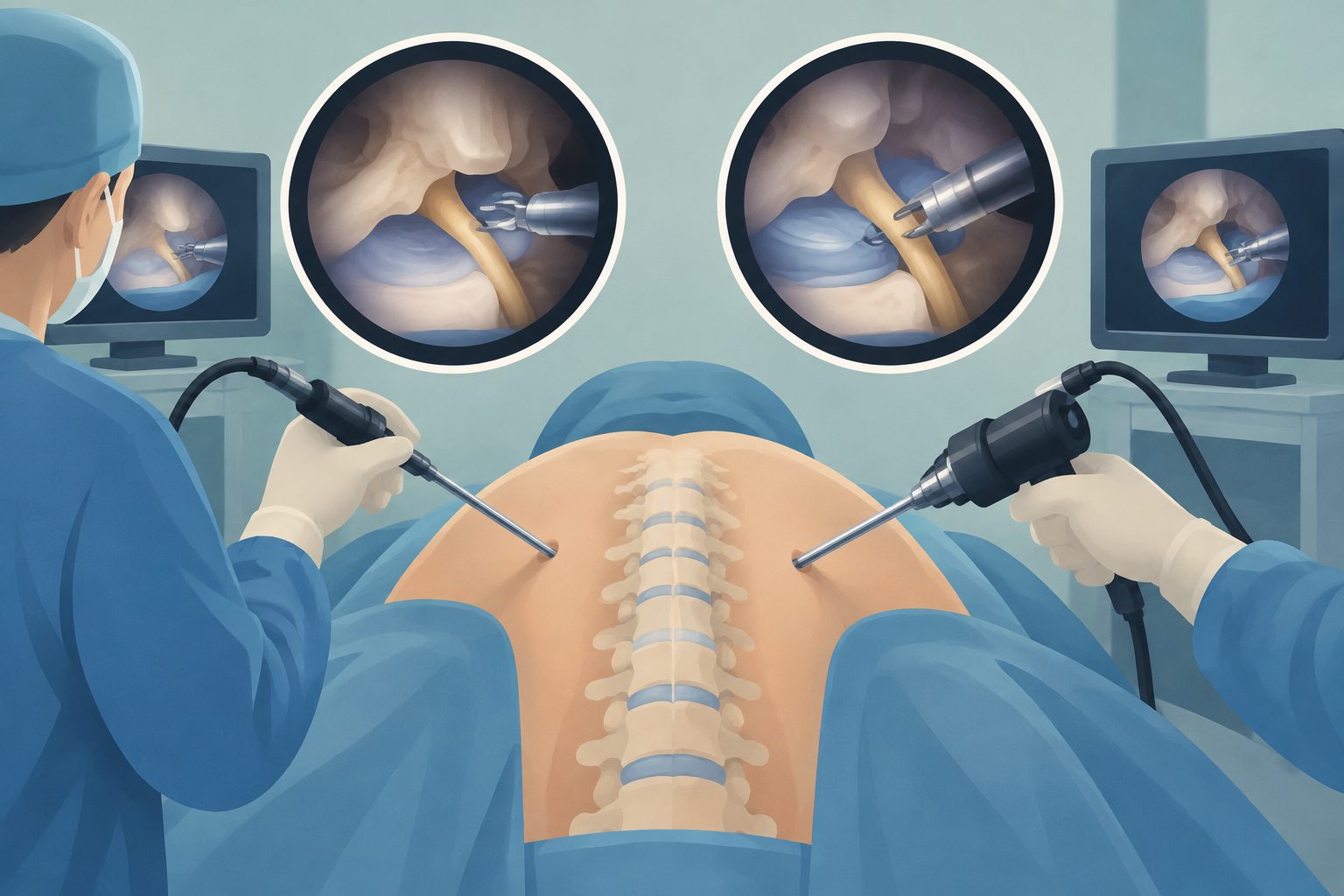
Editorial illustration — not from the study.
The authors examined two techniques for performing unilateral laminotomy with bilateral decompression. One uses a single access channel, while the other uses separate viewing and working openings. The article brought together independently written arguments for each method across areas such as training, technical use, outcomes, complications, costs, and repeat surgery.
The survey found agreement on some issues, including training, costs, and research priorities. However, surgeons continued to disagree about operating efficiency, instrument flexibility, adequacy of decompression, and long-term economic sustainability. A difference in disability scores at 12 months reported in one meta-analysis favored the biportal approach statistically, but the difference was smaller than the threshold considered clinically meaningful.
The question reviewed
Researchers examined whether uniportal or biportal endoscopic unilateral laminotomy for bilateral decompression appears preferable for lumbar spinal stenosis. The work was a debate-style expert review using a nonsystematic narrative discussion of the literature and a single-round opinion survey of 140 endoscopic spine surgeons in 39 countries across six continents, conducted from July 4 to 21, 2026. The survey used a prespecified 70% agreement threshold and included analyses by surgeons' platform experience. The abstract also refers to one meta-analysis comparing patient outcomes.
What the evidence shows
The article reports no clinically meaningful difference between the two approaches in patient-reported outcomes across validated measures. One meta-analysis found a statistically significant 12-month difference in the Oswestry Disability Index favoring biportal surgery, but the difference was below the minimal clinically important difference. The survey identified eight agreement points related to the decompression techniques, plus one agreement point involving a separate foraminal decompression scenario; nine other issues remained points of persistent debate. Agreement on training, costs, and research priorities was consistent across exposure groups, while two platform-specific items did not reach the threshold among surgeons who regularly performed both approaches. Surgeon preference appeared to track the platform they used more than the type of spinal problem.
Who this is relevant to
These findings are most relevant to researchers and clinicians comparing endoscopic spine-surgery practices and to readers seeking context about why the techniques remain debated. They do not establish that either method is preferable for a specific patient, and they may not apply to surgeons, hospitals, or patient populations with different expertise, equipment, or clinical characteristics. The article should not be interpreted as evidence that one approach will produce a particular outcome for an individual.
The significance
The work suggests that current evidence and expert opinion do not establish one of these techniques as superior overall. It may help explain why practice varies between surgeons and countries, but it does not determine which approach is appropriate for any particular patient. The survey reflects professional opinions, and the article does not provide a new randomized comparison of patient outcomes.
Limitations & evidence assessment
The literature discussion was nonsystematic, so relevant studies may not have been identified or assessed using a reproducible systematic-review method. The survey was conducted once and was an opinion survey, not a Delphi consensus; surgeon responses may not represent all practitioners. The abstract does not describe the survey response rate, participant selection in enough detail, or the full methods and quality of the cited meta-analysis. The work also reports persistent disagreement and does not provide direct long-term comparative clinical data from this article itself.
Why this evidence level: This is a nonsystematic expert narrative debate combined with a single-round survey of surgeons, rather than a systematic review or a controlled clinical study. It discusses one meta-analysis, but the abstract does not provide enough detail to judge that analysis independently.
Evidence levels are editorial estimates derived from study metadata — they are not clinical appraisals.
This systematic review and meta-analysis examined whether ultra-low-dose computed tomography (CT) can detect pulmonary, or lung, nodules while using less radiation than standard-dose CT. Across 42 studies involving 15,792 patients, pooled sensitivity for nodule detection was 91.9%, but results varied greatly between studies. The review also found that ultra-low-dose CT used an average effective dose of 0.22 millisieverts (mSv), while detection was less reliable for some small or hazy nodules and in patients with a high body mass index.
In an online randomized experiment involving 3,519 Chilean parents, researchers tested whether adding an “ULTRAPROCESSED” warning to Chile’s existing nutrient labels changed views of potato chips. The added label improved identification of ultraprocessed products and lowered reported purchase intentions and perceived healthfulness, but the effects were smaller when products already had more nutrient warnings. The study measured stated responses, not actual purchases or health outcomes.
A systematic review and network meta-analysis examined nonhormonal prescription medicines for hot flashes and related symptoms among adult women with breast cancer or a history of breast cancer. Across 19 study or substudy records involving 2,224 participants, five medicines showed statistically greater symptom improvement than placebo, but the evidence for comparing safety between medicines was limited.