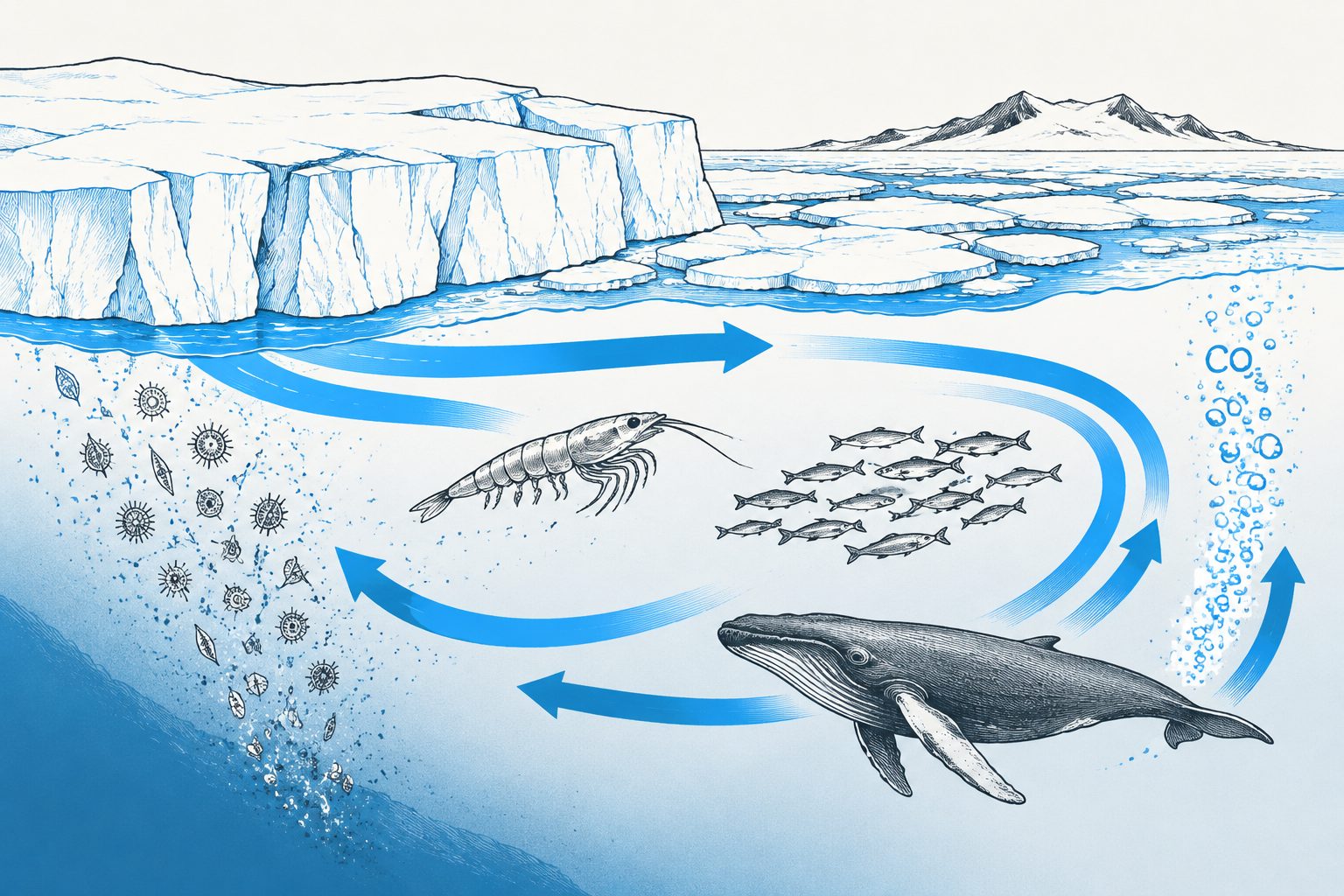
A review of evidence spanning the past 130,000 years examines how changing sea ice connects with the wider Earth system.
The review examines Antarctic sea ice over the last 130,000 years, using modern observations, models and evidence preserved in paleoclimate archives. It considers how sea ice interacts with ocean and atmospheric circulation, ice sheets and ice shelves, marine productivity, and the carbon cycle.
The authors report strong evidence from theory and models that changes in Antarctic sea ice can affect other parts of the Earth system. Paleoclimate records provide examples of sea-ice changes occurring at the same time as changes in ocean circulation, marine productivity and the carbon cycle.
What the review found
The review finds strong evidence from theory and computer models that Antarctic sea ice influences several connected parts of the Earth system, including ocean and atmospheric circulation, ice sheets and ice shelves, marine productivity, and the carbon cycle. Paleoclimate records from the last glacial cycle provide examples in which changes in sea ice co-occurred with changes in ocean circulation, marine productivity and the carbon cycle. The abstract also notes that Antarctic sea-ice cover reached historically low levels in 2023, consistent with modelled declines in sea-ice extent in response to human-caused warming.
// Source
Climate of the past · 2026 · DOI: 10.5194/cp-22-1881-2026
Authors: Zanna Chase, Karen Elizabeth Kohfeld, Amy R. Leventer, Xavier Crosta, Laurie Menviel, Helen Bostock, Matthew Chadwick, Samuel L. Jaccard, Jacob L. Jones, Alice Marzocchi, Katrin Juliane Meissner, Elisabeth L. Sikes, Louise Claire Sime, Luke Cameron Skinner
Institutions: University of California, Los Angeles, The University of Queensland, Colgate University, UNSW Sydney, University of Connecticut, University of Cambridge, Centre National de la Recherche Scientifique, Rutgers, The State University of New Jersey, Université de Bordeaux, University of Lausanne, University of Tasmania, Simon Fraser University, National Oceanography Centre, Environnements et Paléoenvironnements Océaniques et Continentaux, British Antarctic Survey, Institute for Marine and Antarctic Studies, Australian Centre for Excellence in Antarctic Science, Climate Change Research Centre, ARC Centre of Excellence for Climate Extremes