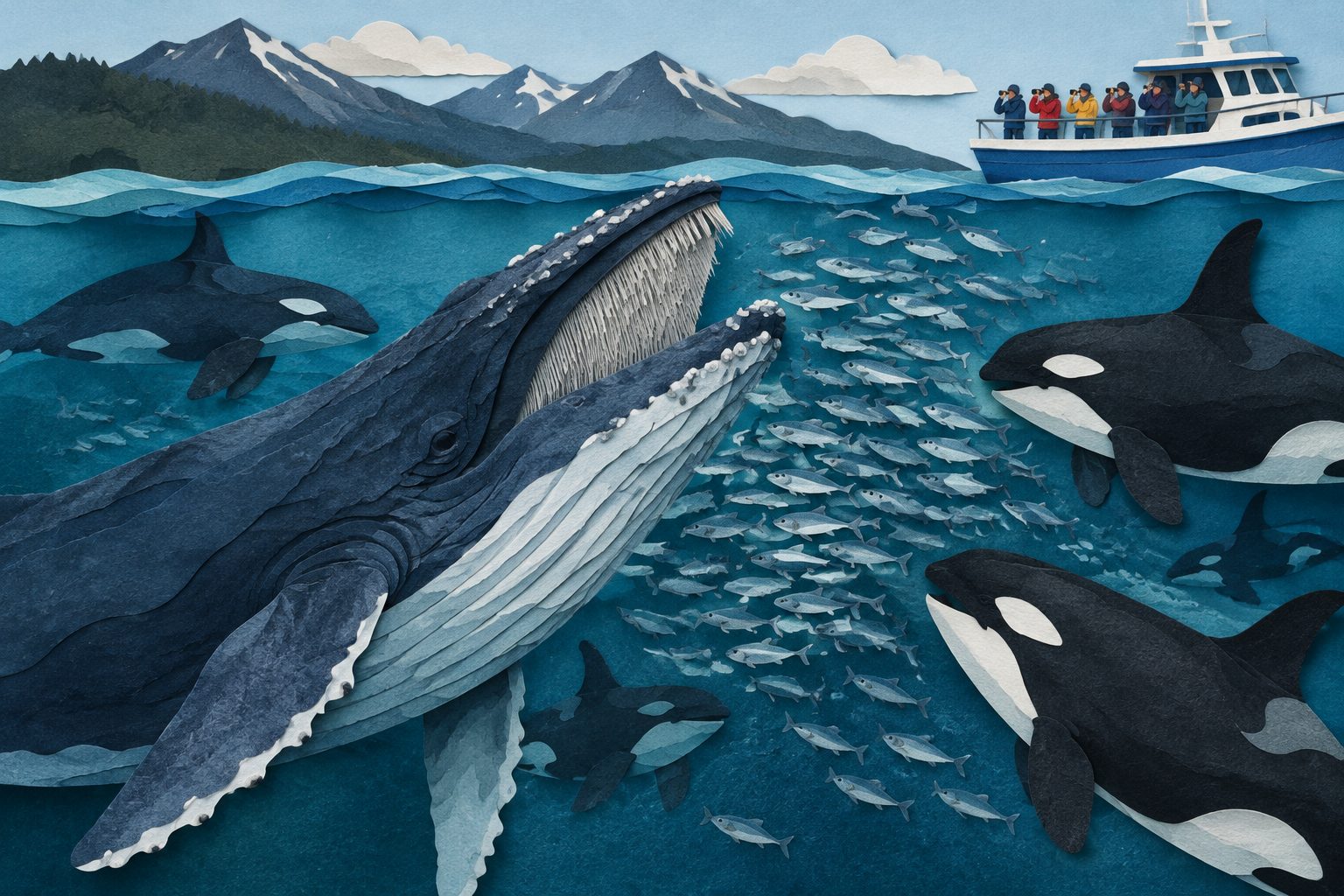
In Monterey Bay, whales feeding alongside sea lions spent less time approaching prey between lunges, without a detectable increase in the effort of each lunge.
Researchers analyzed data from 46 multi-sensor video tags placed on fish-feeding humpback whales in Monterey Bay, California, between 2014 and 2023. The tags recorded 1,808 lunge-feeding events, with deployments lasting an average of 7.4 hours.
When sea lions were present, whales had a 23% higher feeding rate and a 16% shorter interval between lunges. Their overall percentage of time spent foraging did not change, but individual approaches were shorter and faster, suggesting that sea lions may help concentrate prey during these temporary feeding gatherings.
How sea lions changed feeding
Across 1,808 lunge-feeding events, humpback whales foraging with California sea lions had a 23% higher feeding rate and a 16% shorter interval between lunges. The whales did not spend a different overall percentage of their time foraging when sea lions were present.
At the level of individual lunges, accounting for whale body size, sea lion presence was associated with a 35% shorter approach, an 8% higher average approach speed and a 25% shorter total lunge. Lunge speeds, manoeuvring measures and overall dynamic body acceleration—a measure used as an indicator of movement and energetic effort—did not differ detectably with sea lion presence.
Why the feeding groups matter
The findings support the interpretation that California sea lions can contribute to concentrating prey in multi-predator feeding groups. For humpback whales, the apparent benefit was mainly less time spent searching and approaching prey, rather than a change in how they engulf prey or an increase in the detectable energetic cost of each lunge.
The whales’ total share of time spent foraging did not change, so the results point specifically to more frequent feeding events within the observed feeding activity, not necessarily more total time devoted to feeding.
Evidence and caveats
The study used 46 multi-sensor video tags deployed on fish-feeding humpback whales in Monterey Bay from 2014 to 2023. It compared whale foraging measures during periods with and without California sea lions and analyzed both whole deployments and individual lunges.
This evidence shows associations between sea lion presence and whale foraging behavior; it does not by itself establish that sea lions caused every measured change. The tags were deployed for an average of 7.4 hours, and the study focused on fish-feeding whales in Monterey Bay, so the findings may not apply to other prey, locations or whale populations. The study also found no detectable differences in several movement and energetic measures, rather than demonstrating that the energetic cost was exactly unchanged.
// Source
Philosophical Transactions of the Royal Society B Biological Sciences · 2026 · DOI: 10.1098/rstb.2025.0344
Authors: Anna Krylova, Ashley M. Blawas, James A. Fahlbusch, John Calambokidis, Hannah M. Clayton, Ari S. Friedlaender, Alison K. Stimpert, Jeremy A. Goldbogen, David E. Cade
Institutions: Northeastern University, University of California, Santa Cruz, Pacific University, Cascadia Research Collective, Moss Landing Marine Laboratories