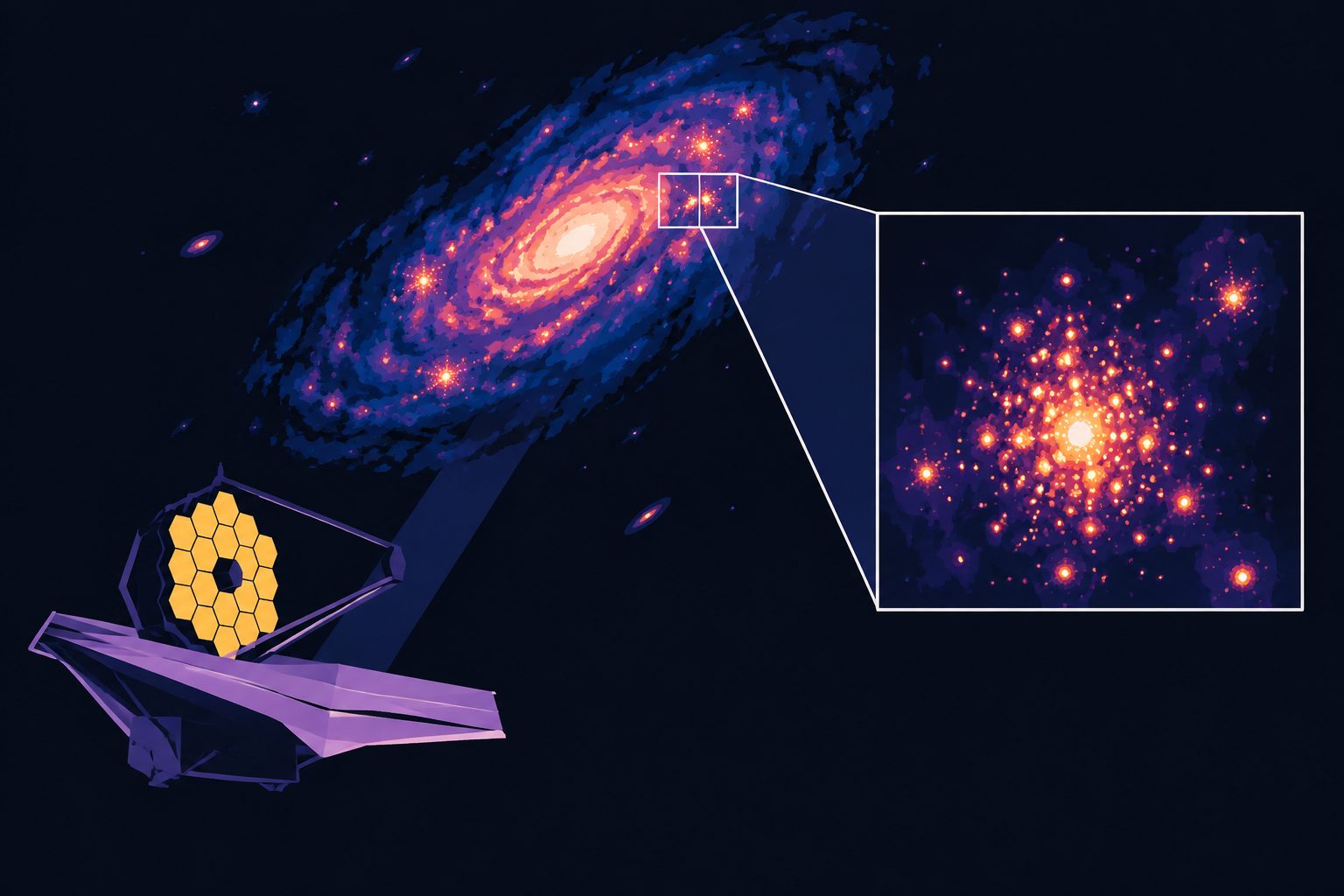
The clusters formed when the universe was about 900 million years old and are more massive and denser than local examples.
Researchers used JWST imaging and spectroscopy to study MACS0308−zD1, a strongly lensed galaxy at redshift 6.2. The observations reveal bright star-forming clumps and a tail containing three distinct star clusters that appear multiple times because of gravitational lensing.
After accounting for the lensing magnification, the clusters have effective radii of no more than about 8 parsecs, stellar masses of roughly 1 million to 10 million Suns, and high stellar mass densities. A separate analysis of the brightest clump found a compact core with intense star formation.
Dense clusters in the Cosmic Spear
The three star clusters are extremely compact, with delensed effective radii of R_eff ≲ 8 parsecs. They contain about 10⁶–10⁷ solar masses of stars and have stellar mass surface densities of at least about 2 × 10⁴ solar masses per square parsec. Their stellar populations are very young, about 6–11 million years old, while their dynamical ages exceed unity, consistent with the clusters being gravitationally bound. In comparisons with other young, distant clusters observed by JWST, they occupy a similar size–density region but are more massive and denser than local star clusters. The brightest star-forming clump contains a compact, intensely star-forming core. Its ionizing-photon production efficiency is slightly lower than in the surrounding region, which may indicate a locally higher escape fraction for hydrogen-ionizing light through channels opened by stellar feedback.
// Source
The Astrophysical Journal · 2026 · DOI: 10.3847/1538-4357/aeab99
Authors: Abdurrouf, Massimo Ricotti
Institutions: Northwestern University, Johns Hopkins University, Tufts University, University of Manchester, University of Toronto, Consejo Superior de Investigaciones Científicas, University of Copenhagen, The University of Tokyo, The University of Texas at Austin, University of Geneva, Centre National de la Recherche Scientifique, University of Maryland, College Park, Arizona State University, Ben-Gurion University of the Negev, University of Ljubljana, Stockholm University, University of California System, Oklahoma State University, Instituto de Física de Cantabria, Indiana University, California Institute of Technology, National Research Council Canada, Chiba University, Instituto de Astrofísica de Andalucía, National Institute for Astrophysics, Wellesley College, Osservatorio di Astrofisica e Scienza dello Spazio, Space Telescope Science Institute, Center for Astrophysics Harvard & Smithsonian, Herzberg Institute of Astrophysics, International Space Science Institute, Université de Lyon, Association of Universities for Research in Astronomy