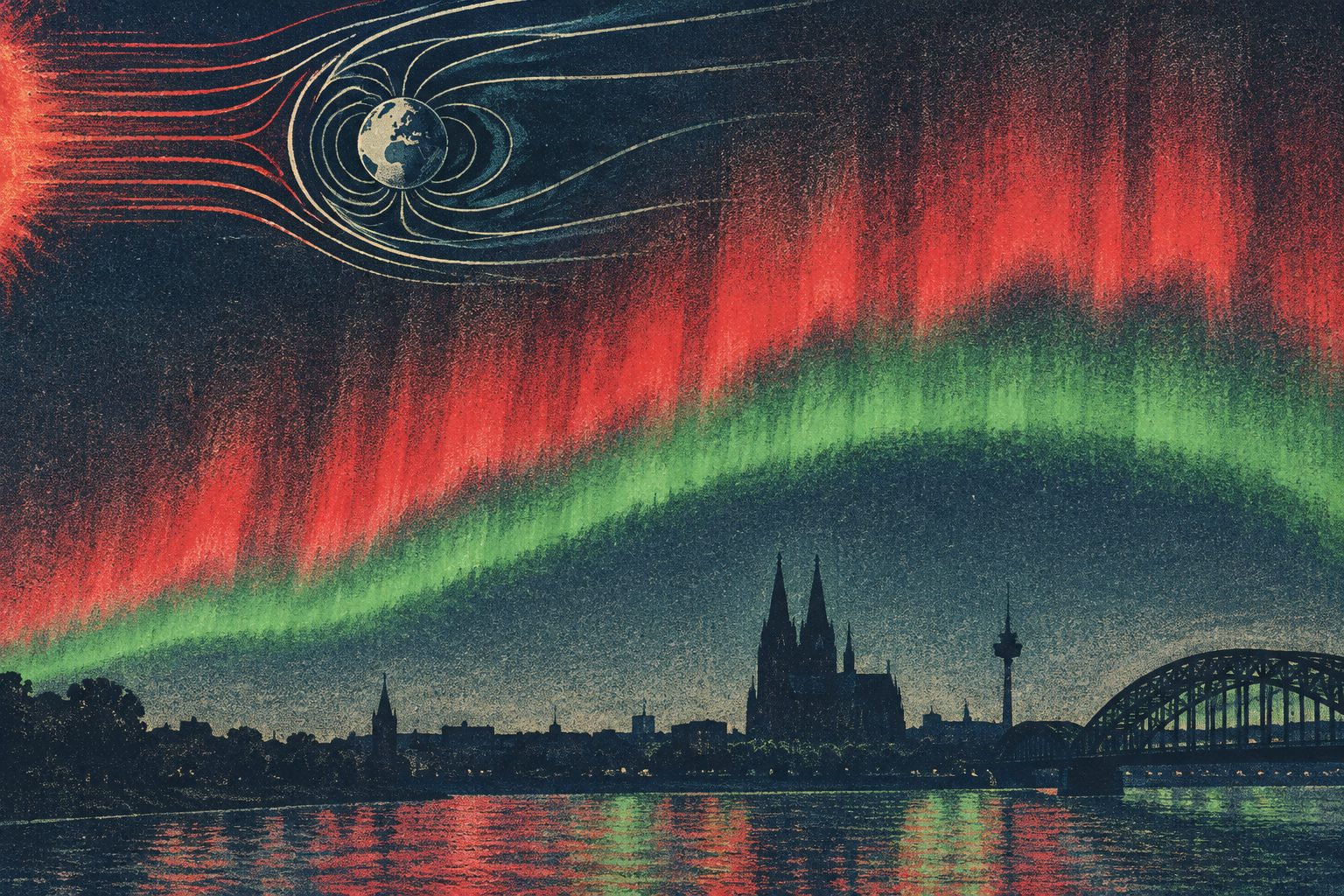
High-speed photographs from the May 2024 superstorm showed green rays continuing beneath red auroral rays.
The images were captured during intense substorms in the storm’s second main phase. They showed parallel red streaks above diffuse green auroral light, with some red and green rays forming continuous structures across the two colors.
The researchers conclude that energetic electrons moving down Earth’s magnetic field lines most likely produced both sets of rays. They suggest that instability among energetic particles trapped inside the plasmasphere, followed by interactions between particles and waves, led to the electron precipitation.
Red and green rays matched
The red and green auroras appeared over Braunschweig and Göttingen during the second main phase of the 10–11 May 2024 superstorm. The red aurora contained parallel brightness streaks, and those streaks continued into lower-altitude green streaks. Both emissions were diffuse rather than narrow curtains or draperies.
The matching structures indicate that the red and green auroras were produced by the same magnetospheric and atmospheric process. The researchers conclude that energetic electrons precipitating along Earth’s magnetic field lines were the main cause. They describe the diffuse green emission beneath the stable auroral red arcs as a new finding and name these features Stable Auroral Green, or SAG, arcs.
Why the green arcs matter
The observations add information about how stable auroral red arcs form, a question for which several mechanisms have been proposed. The continuous red-to-green rays support electron precipitation as the main process behind both emissions and argue against several explanations based on heating, ion precipitation or wave damping by other particles.
Naming the lower green emission as SAG arcs also gives researchers a way to distinguish and discuss this feature in future observations. The images link the feature to intense substorms during the 2024 superstorm, rather than showing only an isolated color change in the aurora.
Photos, not direct measurements
This study is based on high spatial- and time-resolution photographs taken over two German locations during the storm. The alignment of red and green rays provides indirect evidence for a shared source and for energetic electron precipitation, but the study did not include direct measurements of the particles or waves responsible for the auroras.
The observations were made during particular phases of one magnetic superstorm and during intense substorms. The proposed role of particle instability and wave–particle interactions is therefore presented as the most likely explanation, not as a direct measurement of those processes.
// Source
Annales Geophysicae · 2026 · DOI: 10.5194/angeo-44-1201-2026
Authors: Bruce Tsatnam Tsurutani, Gurbax Singh Lakhina, Rajkumar Hajra, Richard Bertram Horne, Masatomi Iizawa, Yasuhito Narita, Ingo von Borstel, Karl-Heinz Glassmeier, V. Bothmer, Klaus Reinsch, Sami Khan Solanki
Institutions: University of Göttingen, University of Science and Technology of China, Kyung Hee University, Technische Universität Braunschweig, Indian Navy, Max Planck Institute for Solar System Research, Jet Propulsion Laboratory, British Antarctic Survey, Indian Institute of Geomagnetism, Fraunhofer Institute for Surface Engineering and Thin Films