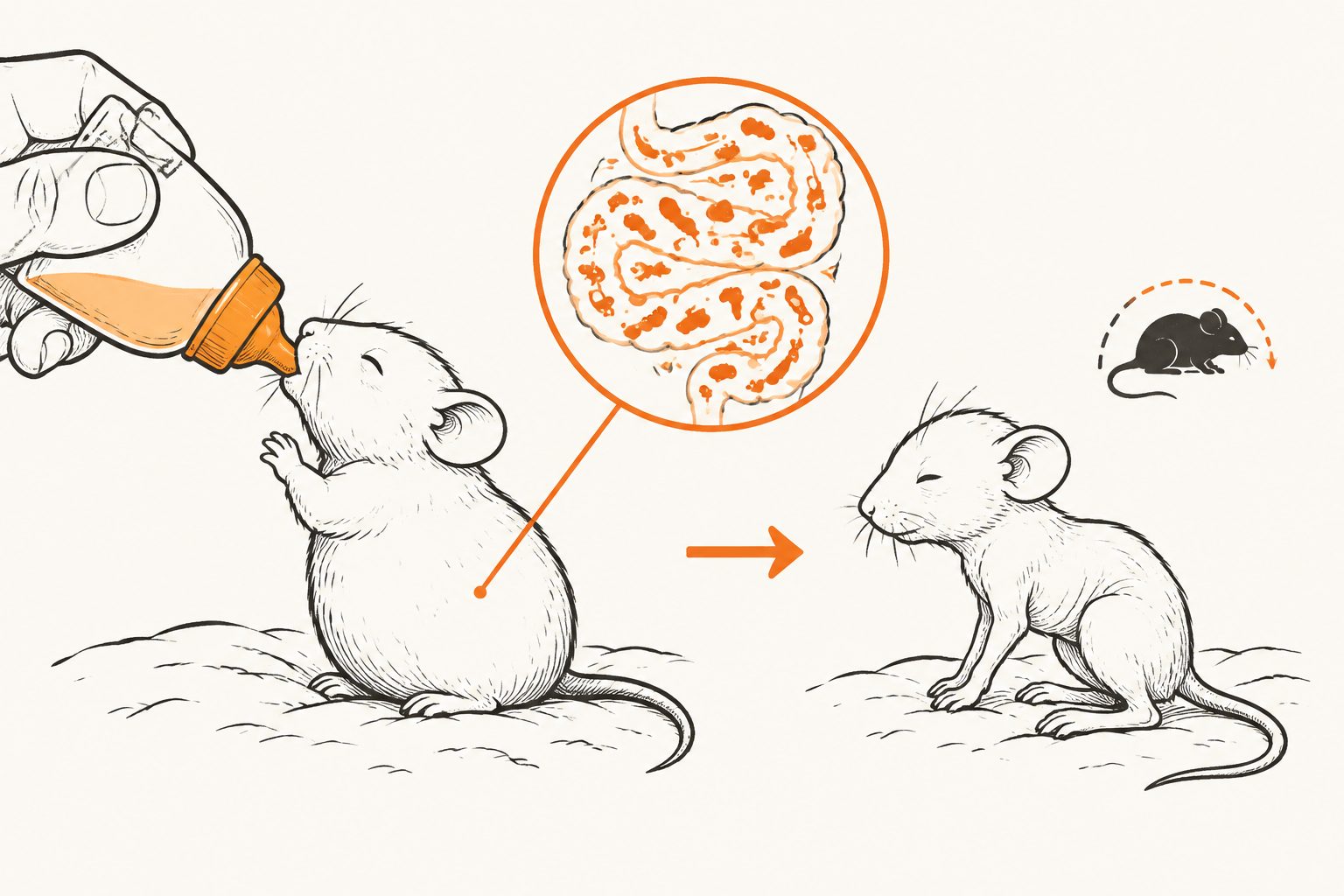
Overfed newborn mice lost muscle faster and lived shorter lives
The mice also developed lasting changes in gut mucus and microbes that were linked to muscle aging.
Editorial illustration — not from the study.
Researchers used different mouse models to study how overnutrition soon after birth affected health later in life. In both sexes, neonatal overfeeding accelerated age-related muscle loss, worsened metabolic dysfunction and shortened lifespan.
The early overfeeding also disrupted the development of mucus-producing gut cells, leaving lasting defects in the gut’s mucus barrier. Older mice had less Akkermansia muciniphila, a bacterium associated with mucus, and produced less acetate. Transferring gut microbes from affected mice passed on the muscle-loss phenotype, while restoring the bacterium or adding acetate improved muscle performance in aged mice.
What happened to the mice
Neonatal overfeeding accelerated later-life muscle loss in male and female mice, worsened metabolic dysfunction and shortened lifespan. It disrupted goblet cell development, which impaired the gut’s mucus barrier and was followed by reduced colonization by Akkermansia muciniphila during aging.
Fecal microbiota transplantation transferred the muscle-loss phenotype, implicating altered gut microbes in its spread. Loss of Akkermansia muciniphila reduced acetate production and impaired muscle mitochondrial function, at least partly through weaker signaling involving GPR43. Restoring the bacterium or supplementing acetate restored aspects of mitochondrial balance and improved muscle performance in aged mice.
Why early nutrition matters
The findings identify early-life overnutrition as a possible developmental contributor to muscle loss in later life, rather than treating sarcopenia only as a problem that begins during aging. They also point to a gut–muscle connection in mice: lasting changes in the gut mucus barrier and its microbes were associated with impaired muscle function.
Because restoring Akkermansia muciniphila or adding acetate improved muscle performance in aged mice, the study suggests that gut-related pathways may be relevant to efforts to support healthy aging. The abstract does not establish whether the same process occurs in people or whether changing early nutrition would prevent sarcopenia in humans.
Evidence and caveats
This was an animal study using different mouse models, along with fecal microbiota transplantation, bacterial reconstitution and acetate supplementation. These experiments support a causal role for altered gut microbes in the mice and indicate that acetate and GPR43 signaling contribute to the muscle effects.
The work does not provide evidence from human participants, and the abstract gives no numerical results for lifespan, muscle loss or treatment effects. The findings therefore cannot yet be assumed to apply to human childhood nutrition, aging or sarcopenia. The abstract also says that GPR43 signaling contributes to the mitochondrial effects at least in part, so it does not identify that pathway as the only mechanism.
A 20-year comparison in California’s Central Valley found that reduced tillage with cover crops produced more stable soil aggregates, greater water retention and different forms of carbon protection than standard tillage without cover crops. The conservation system also retained room for additional carbon storage, although the study measured potential rather than future gains.
Human forebrain organoids classified artificial tactile Braille signals after a sensor converted the touch data into electrical stimulation. Accuracy averaged 61% with one organoid and rose to 83% when responses from three organoids were combined.
A study in mice found that a peptide targeting the memory-related protein CPEB3 reduced the persistence of traumatic memories and anhedonia, a loss of pleasure. The findings are an early genetic preclinical test of a possible approach for PTSD, not evidence of a treatment in people.