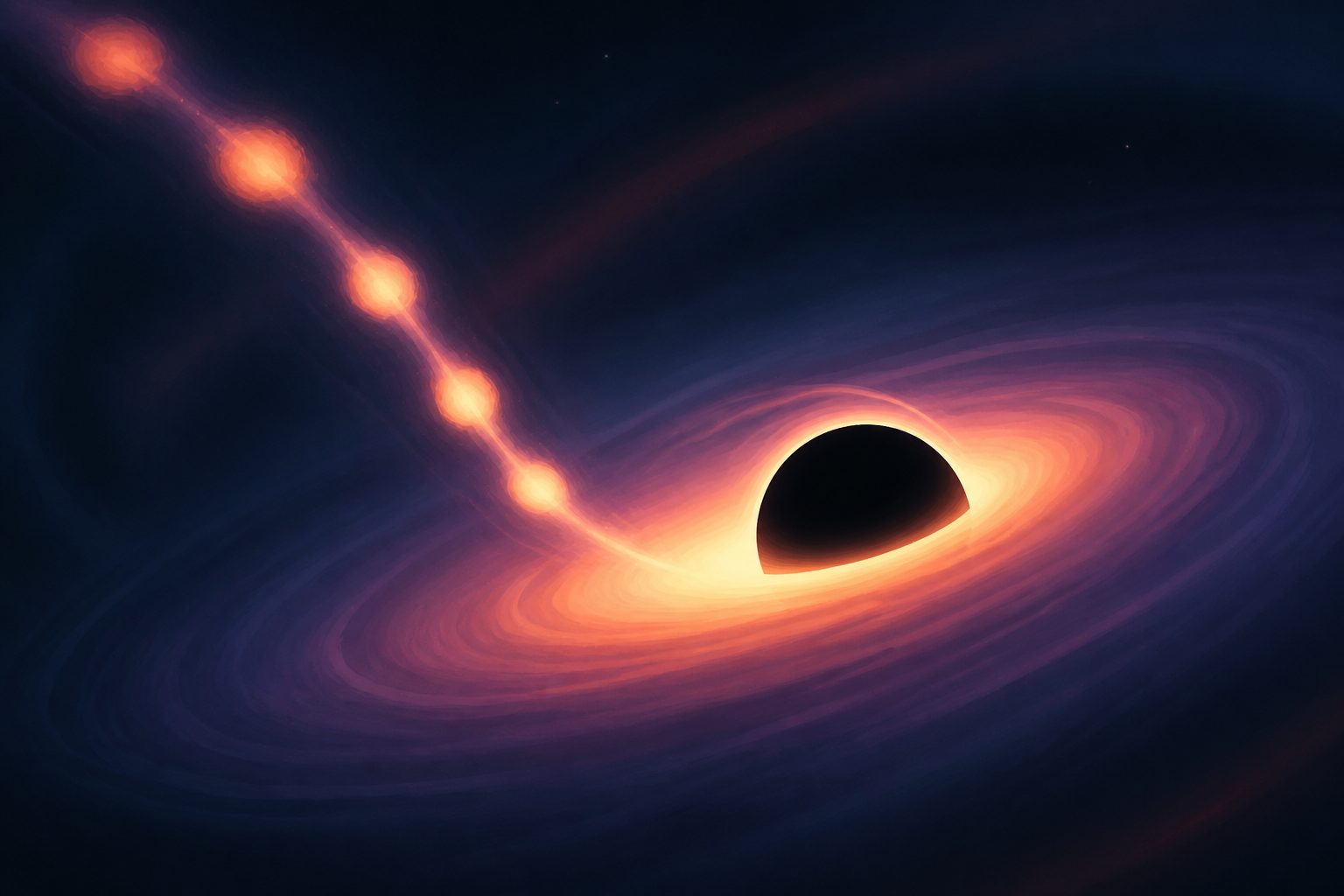
A model suggests repeated periods of unusually rapid growth could have made some young black holes larger than expected for their galaxies.
Researchers used predictions from the semi-analytical Cosmic Archaeology Tool to trace how early black holes and their host galaxies may have evolved. Their model found that both light and heavy black-hole seeds can develop large black-hole-to-galaxy mass ratios through short, repeated episodes of feeding above the usual theoretical limit, with major galaxy mergers acting as triggers.
The model places the main phase of black-hole and galaxy co-evolution at redshifts below 8, after about 30% of the final galaxy's stellar mass had formed outside the black-hole host. It also predicts that many of these early overmassive black holes are inactive today, while the active ones can be bright enough to help account for the population observed by JWST.
How early black holes grew
The model suggests that short bursts of super-Eddington accretion—feeding faster than the standard limit for a black hole—can produce the large black-hole-to-stellar-mass ratios seen in some early galaxies. The bursts are predicted to last about 0.5–3 million years and to occur during 1–4% of the time for the black holes studied.
Major galaxy mergers are identified as the triggers for these episodes. The extra brightness from rapidly feeding black holes helps the model reproduce the number of active galactic nuclei observed by JWST. At the same time, the model predicts a large population of inactive overmassive black holes with Eddington ratios below 0.05.
// Source
Monthly Notices of the Royal Astronomical Society · 2026 · DOI: 10.1093/mnras/stag1608
Authors: Alessandro Trinca, Rosa Valiante, Raffaella Schneider, Ignas Juodžbalis, R. Maiolino, Luca Graziani, Alessandro Lupi, Priyamvada Natarajan, Marta Volonteri, Tommaso Zana
Institutions: Yale University, University of Edinburgh, Sorbonne Université, University of Cambridge, Centre National de la Recherche Scientifique, Sapienza University of Rome, Istituto Nazionale di Fisica Nucleare, Sezione di Milano Bicocca, University of Insubria, Institut d'Astrophysique de Paris, Istituto Nazionale di Fisica Nucleare, Sezione di Roma I, Astronomical Observatory of Rome, Royal Observatory