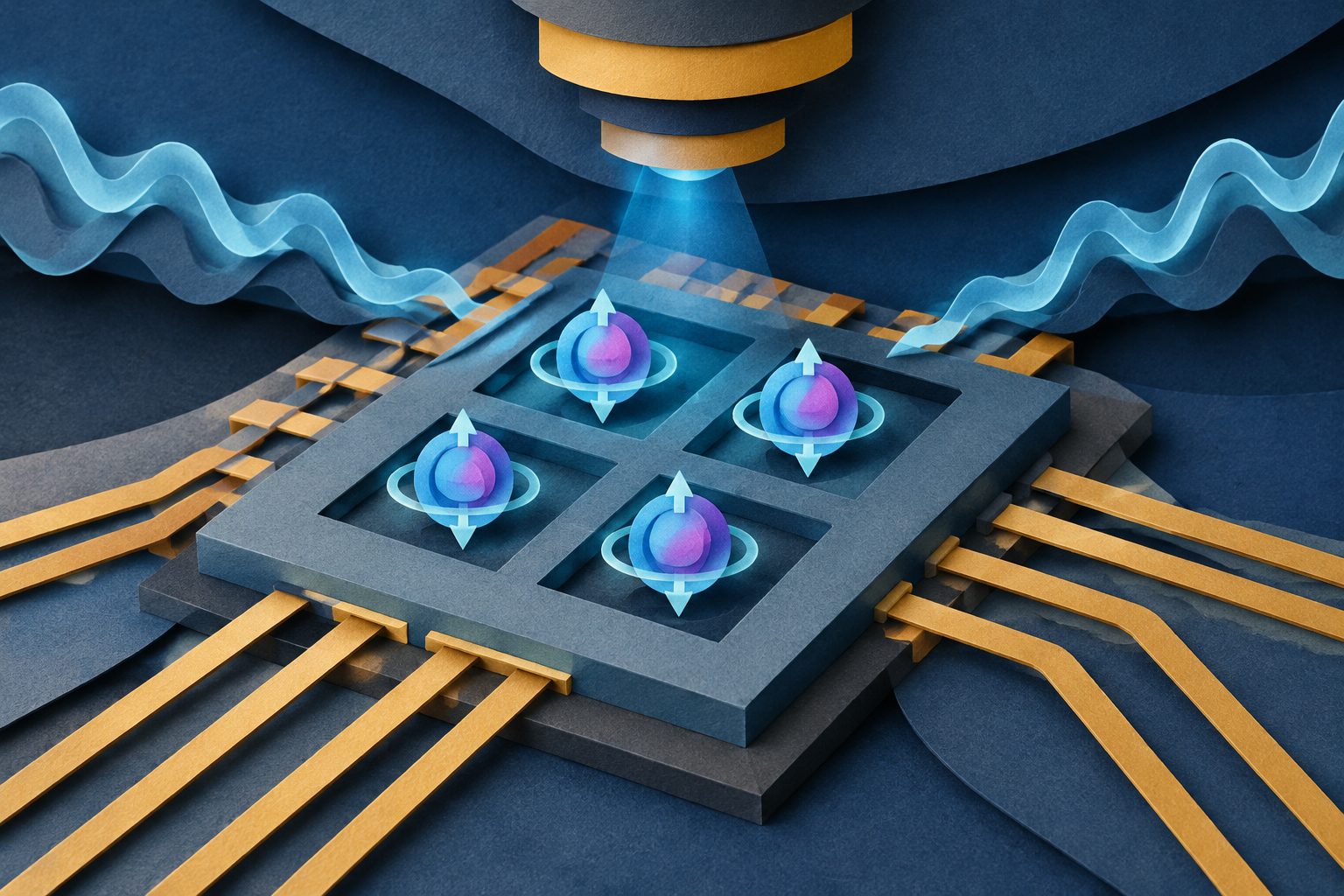
A five-qubit device maintained high-fidelity operations even when several qubits were controlled at the same time.
The study identifies microwave-drive-induced a.c.-Stark shifts—frequency changes caused by the control signal—as the main source of reduced fidelity during parallel operation in a five-qubit silicon spin array. The researchers addressed the problem with a protocol based on calibrating pairs of qubits and used tailored pulses sent through a shared control line.
Individual X and Y gates had fidelities well above 99.99%, with some approaching 99.999%. Those fidelities remained above 99.99% during simultaneous operation of up to three qubits, while five-qubit parallel operation stayed above 99.9%.
What the qubits achieved
The researchers found that microwave-control signals caused a.c.-Stark shifts that degraded gate fidelity when multiple silicon spin qubits were operated together. A mitigation protocol using pairwise phase calibrations corrected for this effect.
With tailored pulses on a shared control line, primitive X and Y gates had individual fidelities well above 99.99%, with some approaching 99.999%. Fidelity remained above 99.99% during simultaneous operation of up to three qubits and above 99.9% during parallel operation of all five qubits.