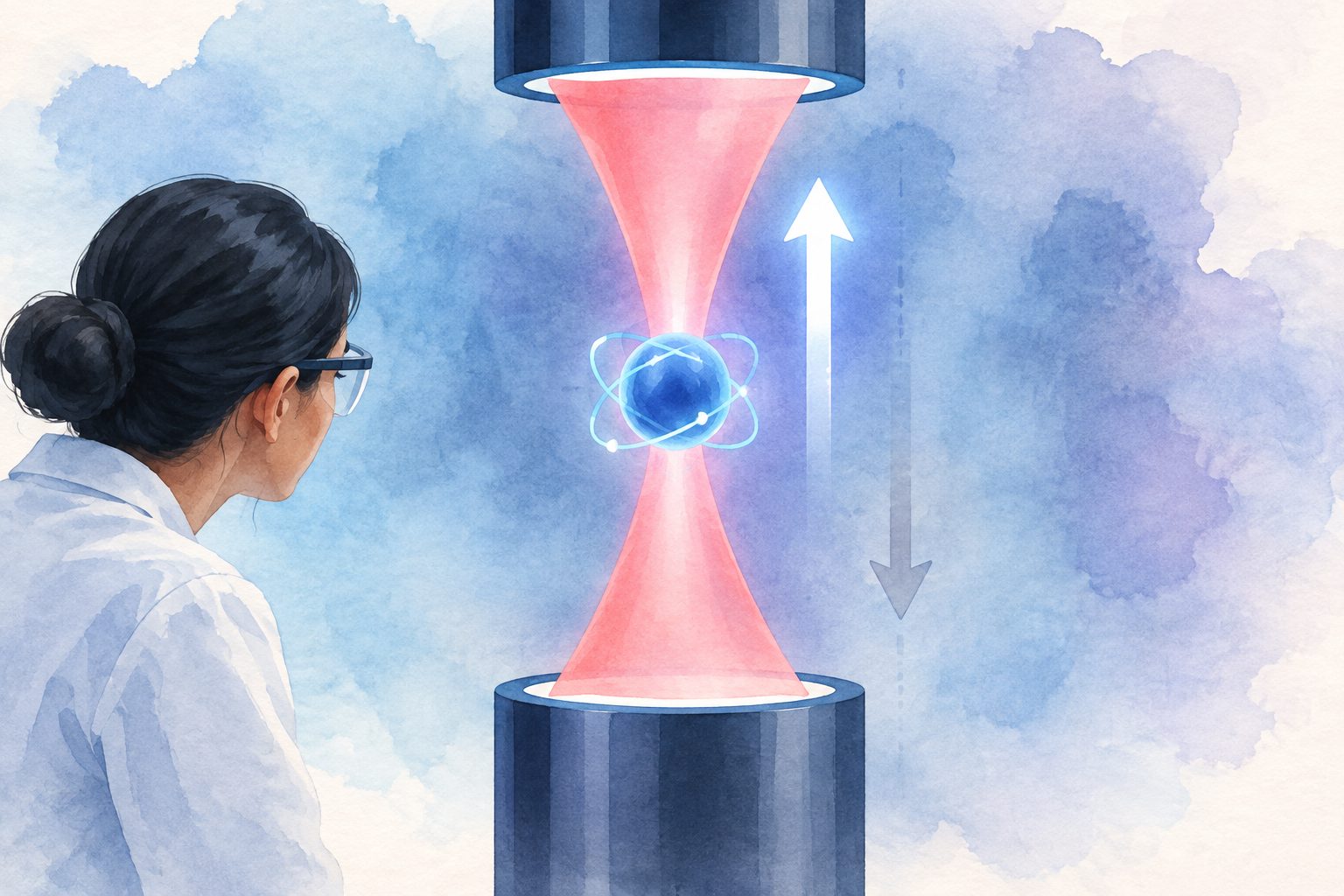
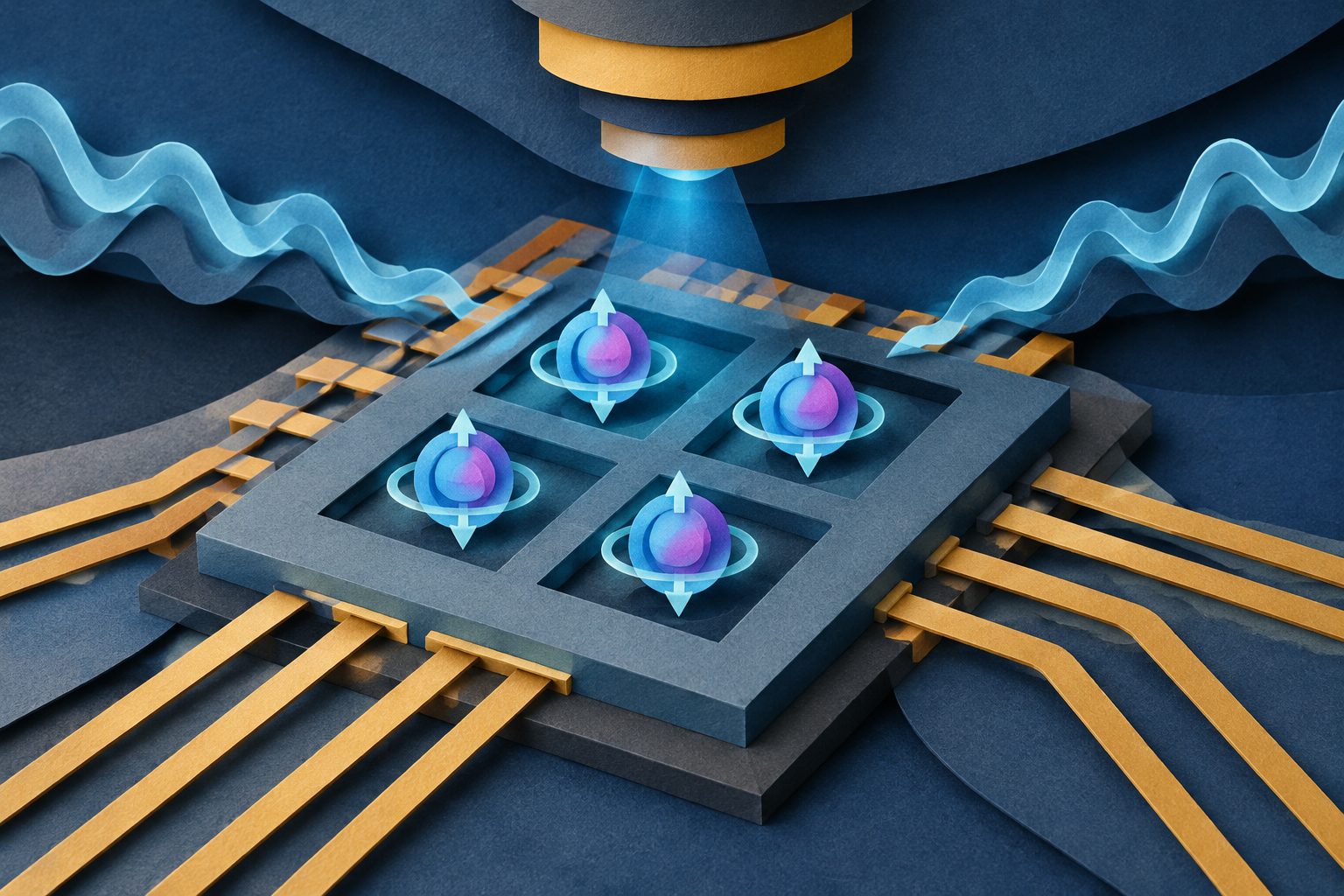
The design uses a mass in two places at once and a carefully selected measurement to produce an outward momentum in a nearby particle.
The proposal places a source mass in a superposition of two locations while a second particle serves as the probe. After the interaction, researchers would measure the source in a specially chosen state, a process known as postselection. Their calculations show that the probe could receive momentum opposite to the direction expected from either attractive gravitational force.
The authors describe the effect using both wave-based calculations and a formulation involving weak values, a way of calculating outcomes after a particular measurement result has been selected. They also estimate conditions that could make the experiment feasible, including a mesoscopic source mass, an interferometer and an atomic or condensate probe.
How gravity could appear to push
The study predicts that the two possible gravitational attractions can interfere quantum mechanically. With the appropriate postselection of the source mass, the probe’s average momentum could point away from the source, producing an effective repulsive force across many repetitions. The paper presents this as a consequence of quantum interference between distinct gravitational states, not as a classical gravitational force that has changed from attraction to repulsion.
The authors give an illustrative calculation in which the effective momentum transfer is about -10^3 times one of the individual transfers. That amplification comes with a low probability for the selected measurement outcome: about 0.8 × 10^-3 for the parameters used in the example. The proposal also considers a source mass of about 10^-14 kilograms, potentially a nanodiamond containing a nitrogen-vacancy centre, with the source locations separated by as much as hundreds of micrometres. Cesium atoms or a Bose–Einstein condensate are suggested as possible probes.
Why the test matters
An observed outward momentum in this setup would have no classical counterpart, according to the paper. It would indicate that the gravitational interaction can support quantum interference and would conflict with general relativity’s description of gravity as always attractive.
The design also aims to simplify earlier proposed tests of quantum gravity: it requires one massive particle in a spatial superposition rather than two, and it would not require directly measuring quantum correlations between the source and probe. The result would therefore offer a proposed laboratory test of whether gravity has quantum properties.
Evidence and caveats
This is a theoretical proposal, supported by calculations in the wave-function and Heisenberg-picture descriptions; the effect has not been observed in this work. The predicted repulsion depends on preparing the source mass in a spatial superposition and then selecting a particular measurement outcome. Stronger amplification makes that outcome less likely.
The weak-value calculation is valid only when the gravitational momentum transfers are much smaller than the probe particle’s initial momentum uncertainty. The feasibility discussion identifies possible source and probe systems, but the excerpts do not report an experimental demonstration or establish that the full setup has been built. The predicted effect is an ensemble-average momentum transfer after postselection, rather than a claim that an ordinary classical gravitational field can push objects apart.
// Source
Physical Review A · 2026 · DOI: 10.1103/df22-8kb6
Authors: Pablo L. Saldanha, Chiara Marletto, Vlatko Vedral