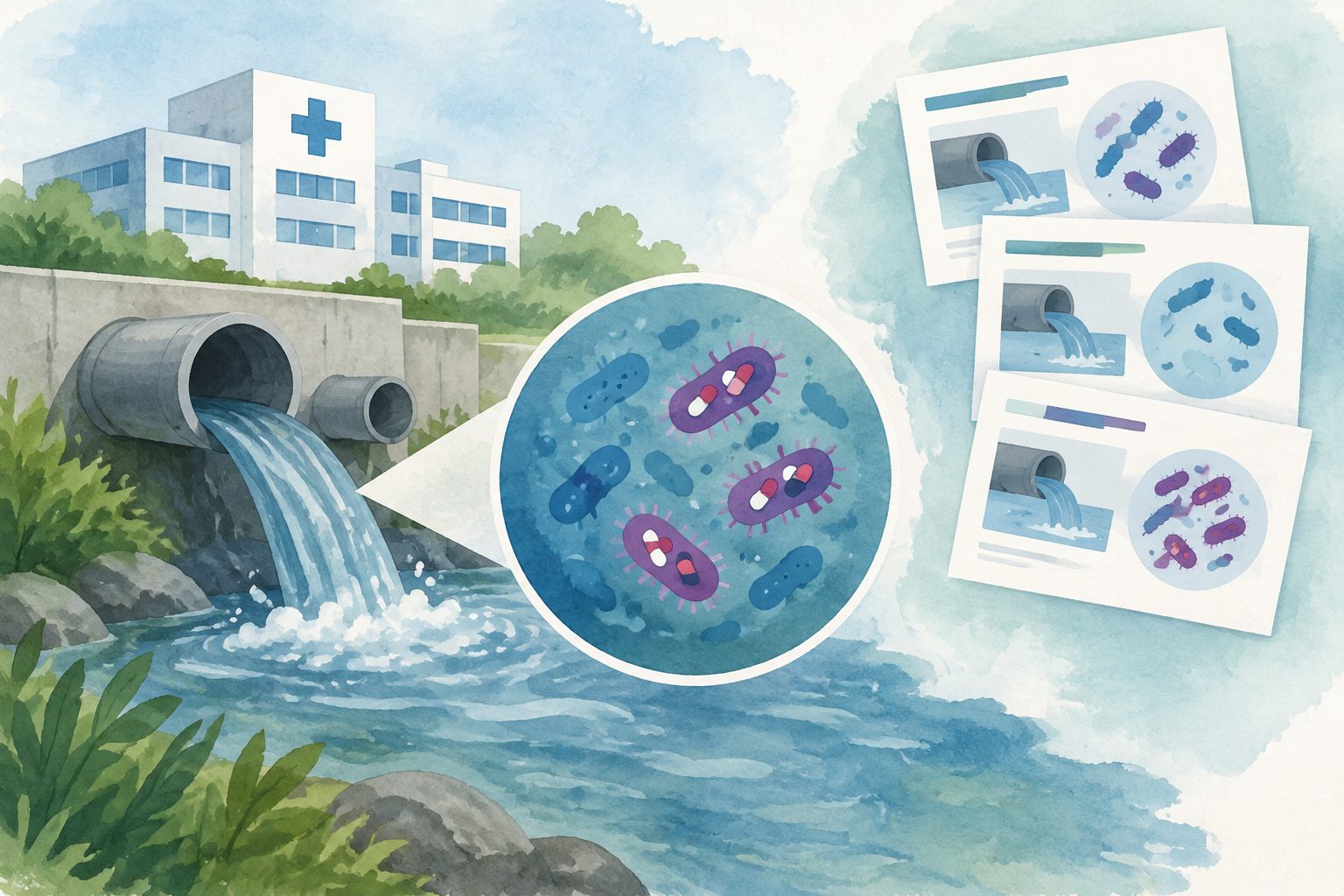
Hospital wastewater can reflect drug resistance, but studies do not line up
A review found mixed agreement with patient testing and wide differences in how hospital wastewater was collected and analyzed.
Editorial illustration — not from the study.
Researchers reviewed studies published from database inception through May 5, 2026, examining whether antimicrobial resistance detected in hospital wastewater agreed with patient-based surveillance. Of 4,695 records screened, 36 studies from 22 countries met the review criteria.
Agreement varied by organism and resistance type. The studies also used different sampling schedules, collection methods and laboratory tests, and only 39% aligned wastewater collection with clinical surveillance in time. The authors conclude that common reporting and sampling frameworks are needed before hospital wastewater can be reliably assessed as an AMR surveillance tool.
What the review found
The review found variable agreement between hospital wastewater and traditional surveillance. For extended-spectrum beta-lactamase-producing organisms, strain-level agreement occurred in 2 of 6 studies and gene-level agreement in 4 of 6. For carbapenem resistance, strain-level agreement occurred in 2 of 9 studies and gene-level agreement in 4 of 9. Agreement was reported in 2 of 3 studies of vancomycin-resistant enterococci, but was inconsistent for methicillin-resistant Staphylococcus aureus and Candida auris.
Most of the 36 studies combined culture-based testing with molecular methods. Culture was used in 89% of studies, polymerase chain reaction testing in 75%, whole-genome sequencing in 42% and metagenomic analysis in 17%. Sampling was done using single-time-point collections in 39% of studies and combined samples collected over time in 36%; the sampling method was not reported in 25%. Most studies focused on Gram-negative bacteria, which made up the target of 83% of studies. Only one study reported a statistical correlation between wastewater results and clinical data, with a Spearman correlation of 0.88.
Why consistency matters
Hospital wastewater combines material from many patients and other people and sources connected to a hospital, potentially offering a broad signal of resistance in that setting. The review indicates that this signal sometimes agrees with patient-based surveillance, but not consistently across organisms or resistance types.
At present, the evidence does not show whether hospital wastewater can provide an early warning of resistance or measure the success of an intervention. More consistent methods, better timing between wastewater and clinical sampling, and studies that connect wastewater results with patient-level information could make findings easier to compare. The authors also identify a need for more research in low- and middle-income countries, which contributed very few studies to the review.
Evidence and caveats
This was a scoping review of primary studies, not a new experiment or a pooled estimate of wastewater surveillance performance. The 36 included studies differed widely in study design, sampling locations and schedules, laboratory methods and clinical comparison data. Only 13 of 36 studies collected wastewater and clinical data concurrently, and only about one-quarter provided patient-level data. Most compared wastewater findings with laboratory detections rather than with measures of resistance burden adjusted for hospital size or patient numbers.
The evidence was concentrated in high-income and upper-middle-income countries: 53% of studies came from high-income countries, 42% from upper-middle-income countries and 5% from low-income countries. Because of these differences and gaps, the review could establish feasibility but could not determine whether wastewater reliably tracks changes in hospital-wide resistance.
// Source
Infection Control and Hospital Epidemiology · 2026 · DOI: 10.1017/ice.2026.10558
High-resolution drone maps detected early crop water stress before changes appeared in other plant measurements. The approach tracked evapotranspiration—the movement of water from soil and plants into the air—across sugar beet, potato and winter wheat fields.
A pilot-scale system removed long-chain PFAS, including PFOS and PFOA, from municipal wastewater and concentrated the compounds in a small volume of foam. Under the best-performing conditions, a subsequent treatment destroyed and removed more than 99% of measured PFAS in that concentrated foam.
Humpback whales in Monterey Bay fed more frequently when California sea lions were present. The whales appeared to spend less time searching and approaching prey, while the effort and movement of individual lunges showed no detectable increase.