Trial reports outcomes after local rectal surgery following chemoradiotherapy
Among 80 carefully selected patients with a strong treatment response, disease-free survival at three years was 84.8%, but the study had no comparison group.
Moderate evidenceHuman studyInterpret with caution
Medical disclaimer: This article summarizes research findings and is for informational purposes only. It is not medical advice.
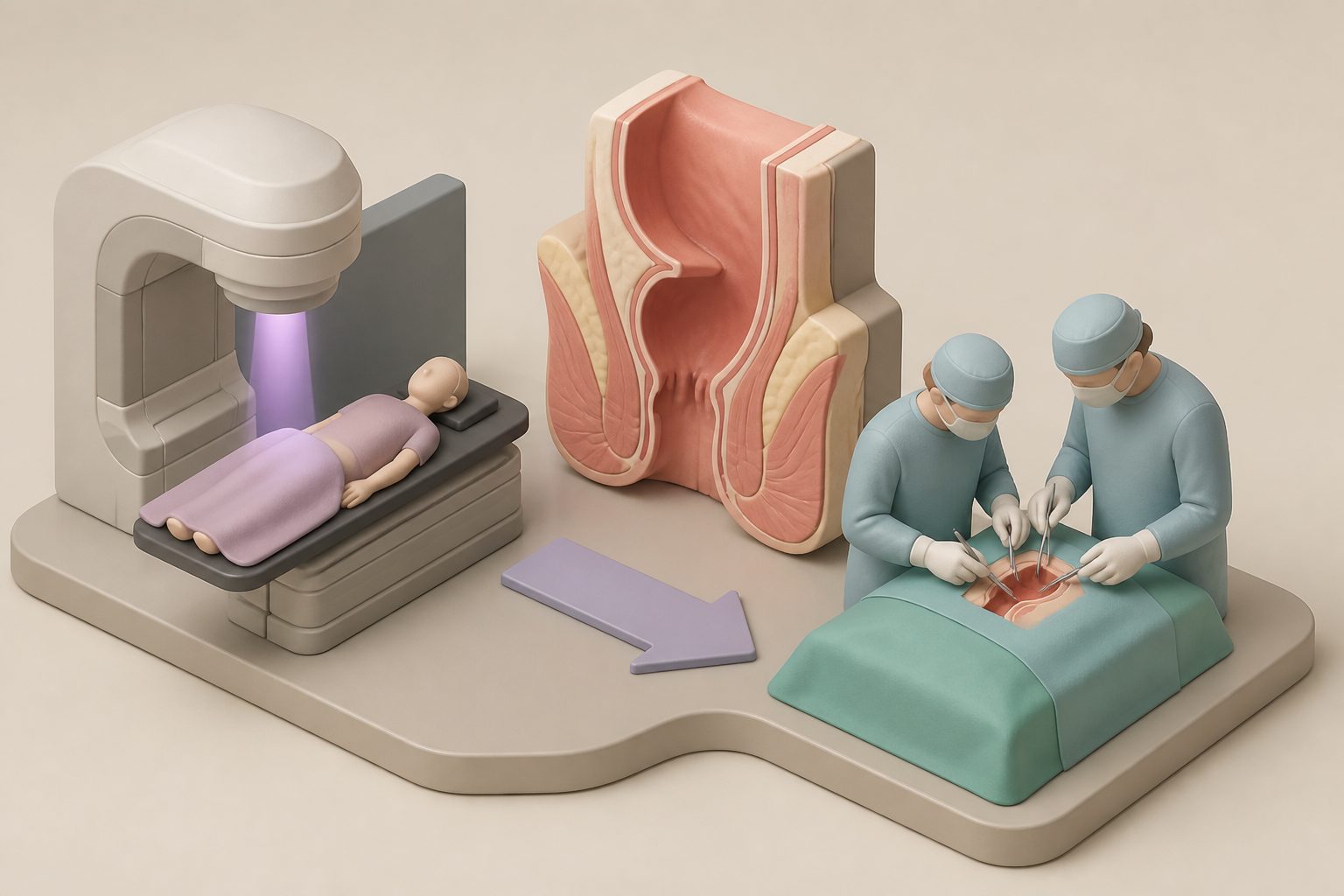
Editorial illustration — not from the study.
Researchers studied people whose rectal cancer initially appeared to be stage cT2-3N0-2M0 but was assessed after chemoradiotherapy as having no visible or only very shallow remaining tumor and no detected spread to lymph nodes or distant organs. All participants underwent full-thickness local excision through the anus. Those with no remaining tumor or only a shallow tumor and clear margins were monitored, while more extensive surgery was recommended for people with deeper residual tumors or involved margins.
The study included 80 people and followed them for a median of about 74 months. Three-year disease-free survival was 84.8% in the main analysis, with the lower end of the reported one-sided 90% confidence interval at 78.8%, above the study's predefined threshold of 77.5%. Five-year overall survival was 94.7%; local recurrence and distant metastasis occurred in 5.0% and 8.9% of participants, respectively. These results describe outcomes in this selected group, not a direct comparison with standard total mesorectal excision.
What was studied
This prospective, multicenter, single-arm phase II clinical trial evaluated local excision as an organ-preserving alternative to total mesorectal excision after chemoradiotherapy. It enrolled 80 adults with rectal adenocarcinoma that had initially been classified as cT2-3N0-2M0 and was assessed after treatment as ycT0-1N0M0. Local excision was performed 6-10 weeks after chemoradiotherapy. The primary outcome was three-year disease-free survival, defined as the time until local recurrence, distant metastasis, a second primary cancer, or death from any cause. The researchers also assessed complications, local recurrence, distant metastasis, overall survival, and patient-reported outcomes.
What the trial found
Pathology after local excision showed no tumor or a shallow residual tumor in 62.5% of participants; 37.5% had deeper residual tumors classified as ypT2-3. Three-year disease-free survival was 84.8% in the full analysis and 86.3% in the per-protocol analysis. The lower one-sided 90% confidence limit was 78.8% in the full analysis, compared with a predefined noninferiority threshold of 77.5%; this met the study's statistical criterion, but the single-arm design means there was no direct test against total mesorectal excision. At five years, overall survival was 94.7%, while cumulative local recurrence and distant metastasis were 5.0% and 8.9%. Five-year disease-free survival was 83.2% for participants with ypT0-1 disease, 88.9% for those with ypT2-3 disease who had completion total mesorectal excision, and 75.3% for those with ypT2-3 disease without completion surgery. Complications within 30 days of local excision occurred in 21.3% of participants; 3.8% had complications classified as at least grade 3.
Who this is relevant to
These findings may apply most closely to adults with rectal adenocarcinoma initially classified as locally advanced, located low enough for the described procedure, who have a strong response to chemoradiotherapy and meet similarly strict clinical and imaging criteria. They do not necessarily apply to people with different tumor stages or locations, detectable spread, poor response to chemoradiotherapy, other cancer types, or health characteristics excluded from the trial. The study also does not determine whether local excision is appropriate for any individual or whether it is equivalent to total mesorectal excision.
Why it matters
The findings suggest that local excision may be feasible for preserving the rectum in some people whose locally advanced rectal cancer responds strongly to chemoradiotherapy. The study also found that a substantial minority, 37.5%, still had deeper residual tumors on pathology despite the favorable post-treatment assessment, which highlights the difficulty of predicting the remaining cancer from treatment response alone. The results are relevant to organ-preservation research, but they do not show that local excision provides the same cancer control as total mesorectal excision because no comparison group was included.
Limitations & evidence assessment
The main limitation is the single-arm design: all participants underwent local excision, so outcomes cannot be directly compared with those after total mesorectal excision. The sample was small, with 80 participants, and the patients were highly selected based on tumor features, response to chemoradiotherapy, health status, and absence of detected spread. The subgroup results, especially for people with deeper residual tumors who did not undergo completion surgery, are based on relatively few participants and may be imprecise. The abstract and excerpts provide limited detail about the patient-reported outcome results and do not establish how outcomes would compare across hospitals or in less-selected patients. The study's noninferiority threshold was met statistically, but this does not remove the uncertainty created by the lack of a control group.
Why this evidence level: Clinical trial without confirmed randomization details in the available metadata.
Evidence levels are editorial estimates derived from study metadata — they are not clinical appraisals.
// Source
Cancer Research and Treatment · 2026 · DOI: 10.4143/crt.2026.0512
This retrospective human study compared a visual CT scoring method with an automated computer analysis for tracking fibrosing interstitial lung disease. Among 92 people followed with CT scans and lung-function tests, both approaches were associated with changes in lung function and signs of disease progression. The study does not show that either method improves treatment or patient outcomes.
A systematic review and meta-analysis examined how silver diamine fluoride affects human dental pulp cells in laboratory studies. Across seven in vitro studies, higher concentrations were associated with lower cell viability, but these findings do not show how the material affects dental pulp in people.
This systematic review examined human studies of long-term quality of life and depressive symptoms after fracture-related infection, a serious infection involving a broken bone. Across 15 studies, physical quality-of-life scores appeared lower than United States population norms, while evidence about mental quality of life and depressive symptoms was less consistent. The researchers said differences among studies and generally limited study quality prevent definitive conclusions.