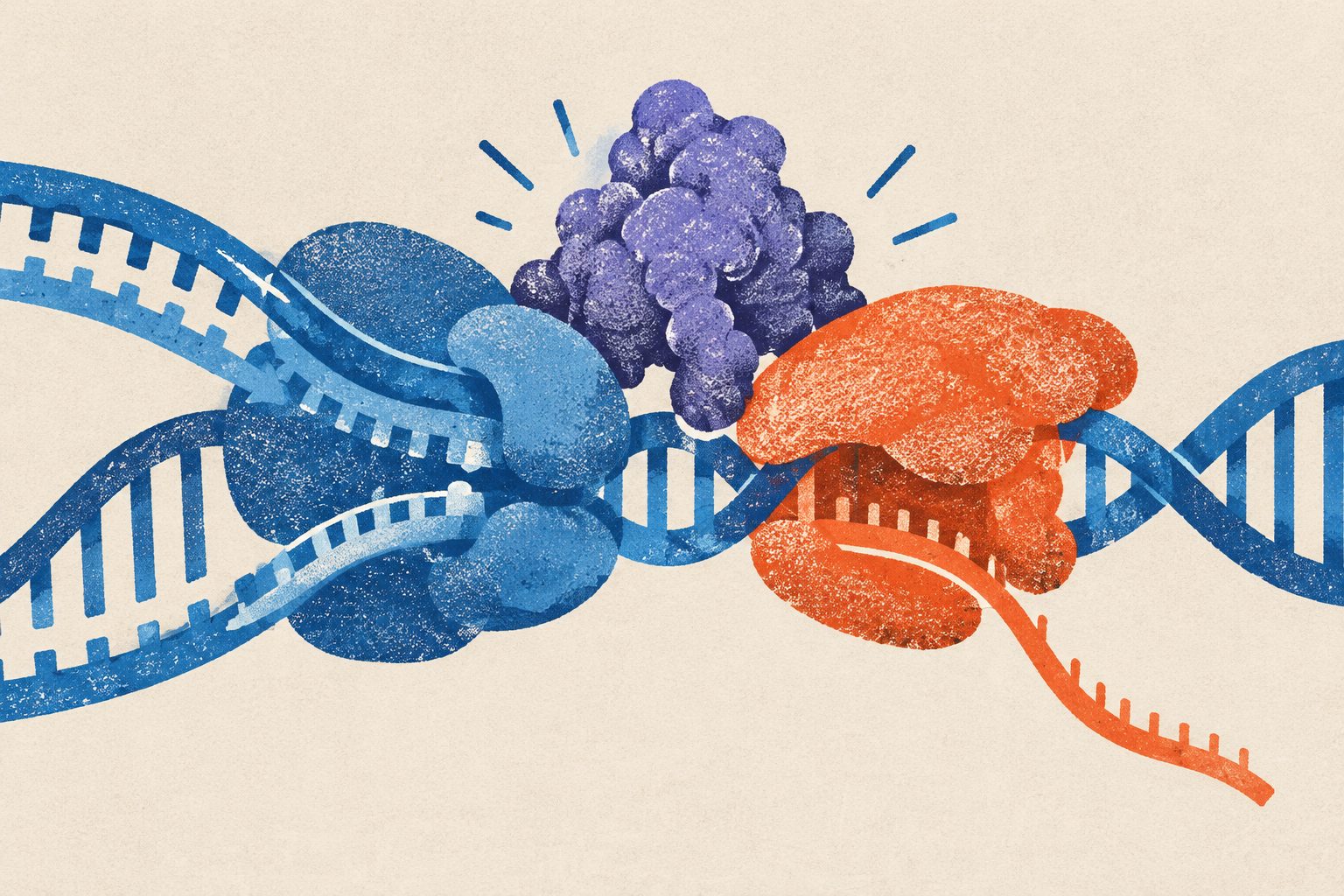
The protein helps recruit a DNA-organizing complex to vulnerable sites, supporting repair and preventing harmful DNA structures from building up.
The study found that cohesin, a protein complex best known for holding copied chromosomes together and organizing DNA, gathers at R-loops. These are structures formed when RNA remains attached to a DNA strand, leaving the other DNA strand exposed. At these sites, cohesin supports a form of DNA repair linked to active gene transcription.
SMARCA5 helps bring cohesin proteins and the repair protein RAD51 to R-loops. Its activity supports repair and the timely removal of the structures. When SMARCA5 or cohesin components were depleted, R-loops accumulated, DNA-copying machinery stalled, and collisions between transcription and replication increased, triggering cell death.
How SMARCA5 protects DNA
In laboratory tests, cohesin subunits SMC1, SMC3, RAD21 and STAG1 preferentially localized to R-loops. The researchers also detected cohesin at R-loops formed after DNA damage in cells.
A screen of chromatin-remodeling proteins identified SMARCA5 as a factor that recruits RAD21 and STAG proteins to R-loop sites. SMARCA5 binds RAD21 through a region called its SLIDE domain and is itself recruited to R-loops. Its ATPase activity helps place RAD21 and RAD51 at these sites, supporting transcription-coupled homologous recombination, a repair process that uses a matching DNA copy, and helping resolve R-loops.
Depleting SMARCA5 or cohesin core subunits caused R-loops to accumulate, slowed replication-fork progression and increased transcription-replication collision events that induced cell death. The abstract states that SMARCA5 and several cohesin components are overexpressed in a subset of cancers.
Why the finding matters
The findings identify a previously unrecognized way that SMARCA5 and cohesin cooperate to protect DNA when transcription and replication occur in the same region. Because the proteins are overexpressed in a subset of cancers and their depletion caused cancer-cell death in the reported experiments, the study points to them as possible targets for further cancer research.
The work does not establish that targeting these proteins is safe or effective as a treatment. It instead provides a mechanism that could help guide future studies of cancer cells that rely on this DNA-repair activity.
Evidence and caveats
The conclusions are based on biochemical and cell experiments, including localization tests, a chromatin-remodeler screen, protein-interaction studies and depletion of SMARCA5 or cohesin components. These experiments support a role for SMARCA5 in recruiting cohesin and RAD51 to R-loops and in limiting replication-transcription conflicts.
The abstract does not report results from animals, patients or a cancer treatment study. It also does not provide the number of cell lines tested, the cancer types involved, or quantitative effect sizes, so the findings’ relevance across cancers remains to be established.
// Source
Cell Death and Differentiation · 2026 · DOI: 10.1038/s41418-026-01888-2
Authors: Boya Gao, Elizabeth Marie Irvin, Fengqi Zhang, Parminder Kaur, Ruoxi W. Wang, Xiaofeng A. Su, Zhubing Shi, Hong Wang, Li Lan
Institutions: Duke University, Massachusetts Institute of Technology, The University of Texas Southwestern Medical Center, Duke Medical Center, North Carolina State University, Koch Institute for Integrative Cancer Research At MIT