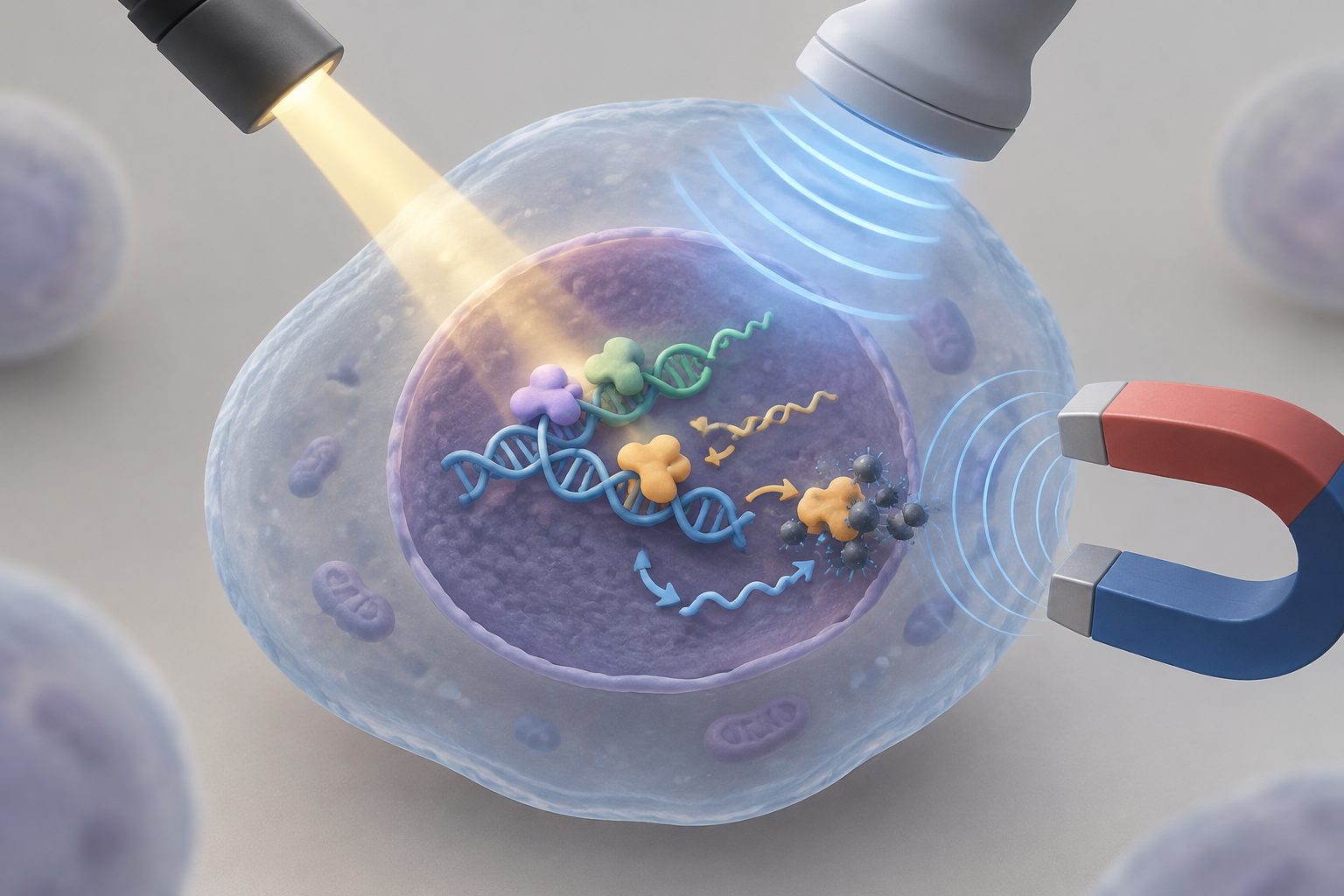
A review compares remote-controlled gene circuits and the challenges of making them work predictably inside tissues.
The review presents a common framework for studying remote-controlled genetic circuits. It separates the core circuits that regulate genes from supporting technologies used to deliver genetic cargo, help cells take it up or convert energy. It compares systems in bacteria and other cells by their design, stimulus conditions, response speed, reversibility, background activity, delivery needs and use in living organisms.
The authors describe a shift from simple on-off switches toward circuits that can respond to multiple inputs, adjust gene activity, store information and regulate themselves through feedback. They also propose a design process that links the external signal, energy-converting components, genetic circuit, delivery method and stimulation device.
How remote gene switches work
Light, ultrasound and magnetic fields offer different trade-offs in controllability, access through tissue and compatibility with biological systems. Their effectiveness depends not only on how the physical signal travels through tissue, but also on how efficiently it is converted into an internal cellular signal and then into a predictable genetic response.
The review distinguishes direct gene-regulating circuits from auxiliary platforms that mainly support delivery, cellular uptake or energy conversion. It compares reported systems across circuit design, signal conversion, stimulus settings, response range, unwanted background activity, response speed, reversibility, activity in living organisms, delivery requirements and safety. It also identifies multi-input logic, adjustable control, genetic memory and feedback as directions beyond basic inducible switches.
// Source
Advanced Materials · 2026 · DOI: 10.1002/adma.75338
Authors: Xinming Yu, Yi Lu, Xiaomiao Yu, Shang Jia, Yuru Ma, Ruicun Liu, Xin Ni Mu, Yanfang Su, Xingwen Sun, Yefeng Shen, Xin Li, Xiuyun Liu, Zhiyuan Shi
Institutions: Zhejiang University, Second Affiliated Hospital of Zhejiang University, Peking University Third Hospital, Capital Medical University, Tianjin University, Beijing Friendship Hospital, Wenzhou Medical University, Second Affiliated Hospital & Yuying Children's Hospital of Wenzhou Medical University, DWI – Leibniz Institute for Interactive Materials