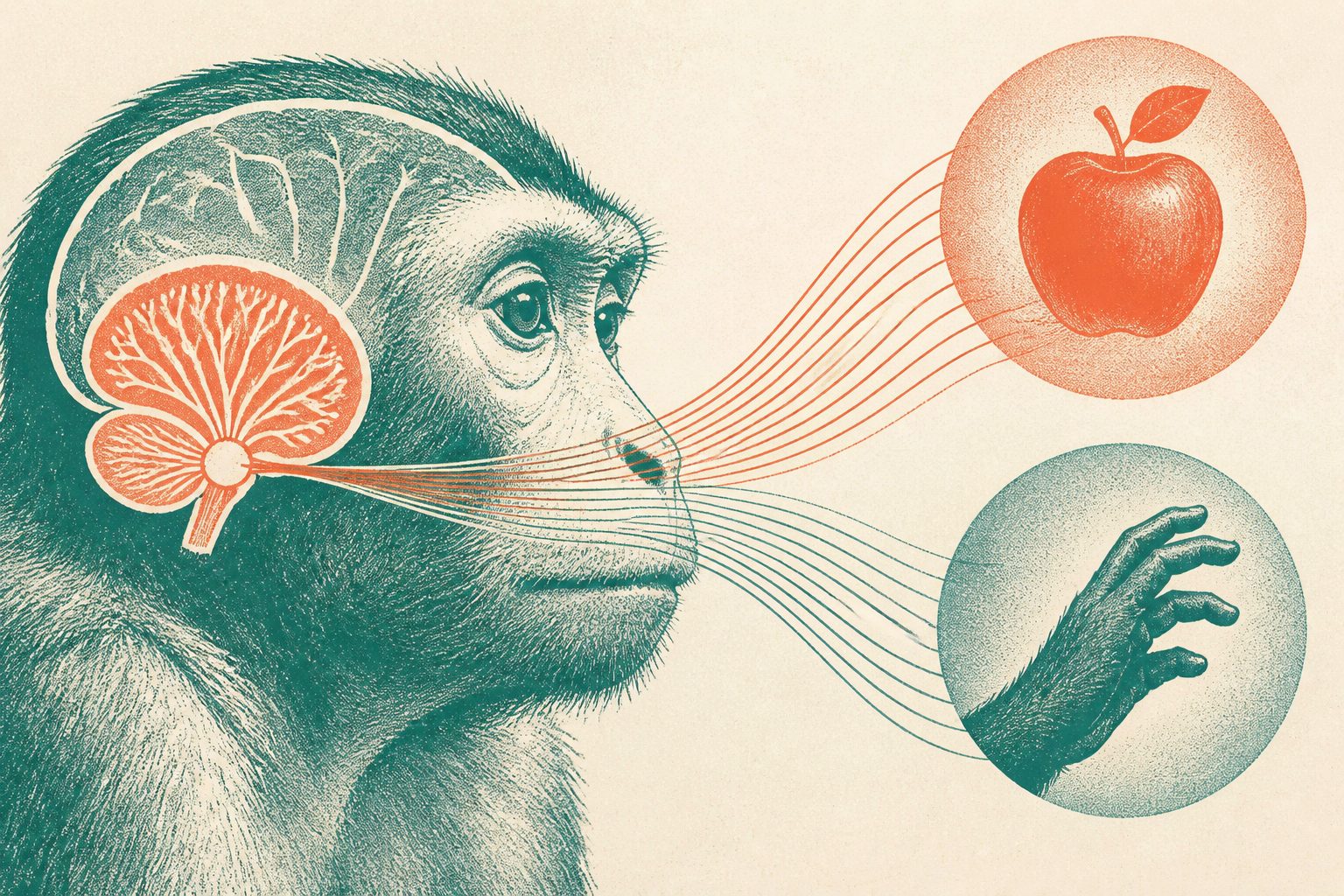
As the animals learn which hand matches each visual cue, activity in two cerebellar regions distinguishes the cue earlier than the coming movement.
Researchers recorded the simple-spike activity of Purkinje cells in Crus I and II, regions of the cerebellum, while monkeys learned to associate fractal images with left- or right-hand movements. Early in learning, most cells responded similarly to the two associations, but more cells became selective for particular cue–hand pairings as learning advanced.
A computer decoder could initially identify the visual cue only when it could also identify the upcoming hand choice. Later, it identified the visual cue earlier than the choice. A simple model reproduced the neural activity and the monkeys’ behavior at both stages of learning.
How the cells changed
Purkinje-cell activity in Crus I and II became more selective for specific visual stimulus–hand associations as the monkeys learned the task. Early in learning, most neurons responded to both associations rather than distinguishing the visual cue or associated movement. With further learning, more neurons differentiated the cue–hand pairings, and this selectivity appeared closer to the time the visual stimulus was shown.
A linear decoder found that, early in learning, the visual stimulus could be decoded only when the hand choice could also be decoded. As learning improved, the visual stimulus became decodable earlier than the choice. A simple model reproduced the observed neural signals and behavior during both early and late learning.
// Source
Journal of Neuroscience · 2026 · DOI: 10.1523/jneurosci.0082-25.2026
Authors: Anna E. Ipata, V. Fascianelli, Chris I. De Zeeuw, Naveen Sendhilnathan, Stefano Fusi, Michael E. Goldberg
Institutions: Columbia University, Erasmus University Rotterdam, Erasmus MC, Allen Institute for Brain Science, Royal Netherlands Academy of Arts and Sciences, Center for Theoretical Biological Physics