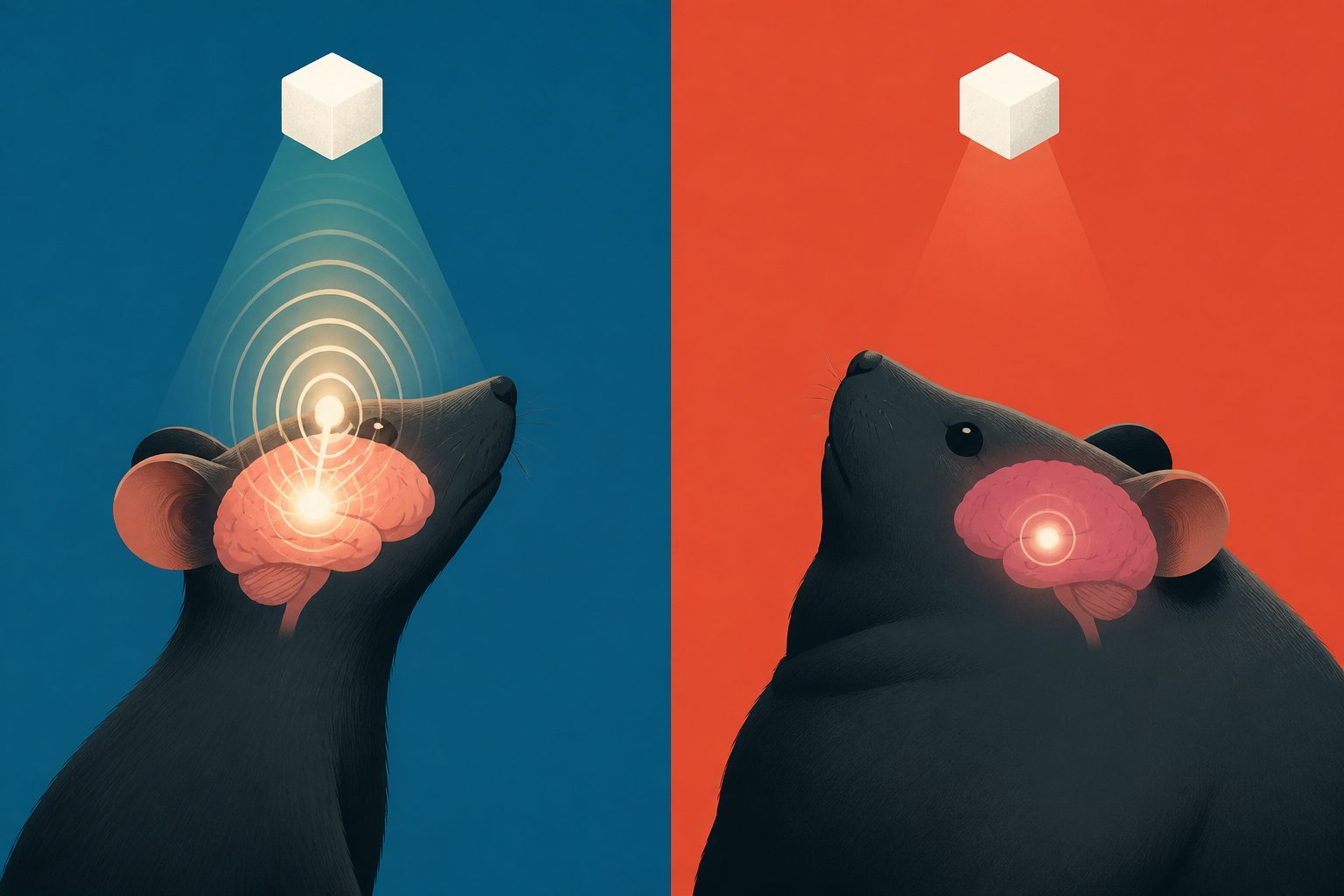
A high-fat diet largely erased or reversed gene-activity changes normally triggered by rising blood sugar in several brain regions.
Researchers analyzed gene activity in 75,787 individual cell nuclei from three brain regions involved in energy and glucose regulation: the arcuate nucleus, ventromedial hypothalamus and dorsal vagal complex. Male mice fed either a control diet or a high-fat diet received an intravenous infusion of glucose or saline before the analysis.
In control-diet mice, high blood sugar produced shared gene-expression responses in support cells called astrocytes and oligodendrocytes, as well as in Ghrh neurons. These responses were largely absent or reversed in mice fed the high-fat diet. The study also found that genes active in both mouse and human GHRH neurons were located in regions of the genome linked to human blood-sugar traits.
What changed in the brain
The high-fat diet broadly altered gene expression across cell types, including Th/Slc6a3, Agrp, Ghrh and Trh/Cxcl12 neurons. In control-diet mice, intravenous glucose triggered gene-expression changes across several brain regions in astrocytes and oligodendrocytes, plus a response in Ghrh neurons that was consistent with reduced neuronal activity. After the high-fat diet, these responses to high blood sugar were largely missing or reversed. Genes enriched in mouse and human GHRH neurons overlapped with genome regions linked to human glycemic traits.
// Source
Nature Communications · 2026 · DOI: 10.1038/s41467-026-77116-9
Authors: Jenny M. Brown, Marie A. Bentsen, Anja Moltke Jørgensen, Thomas S. Nielsen, Dylan M. Rausch, Din Selmanovic, Oksana Dmytriyeva, Charlotte Høy Kruse, Nadia N. Aalling, Dana C. Schwalbe, Oliver Knights Møller, John N. Campbell, Anna Secher, Michael W. Schwartz, Tune H. Pers
Institutions: University of Washington, Harvard University, University of Virginia, University of Copenhagen, Novo Nordisk Foundation, Novo Nordisk (Denmark)