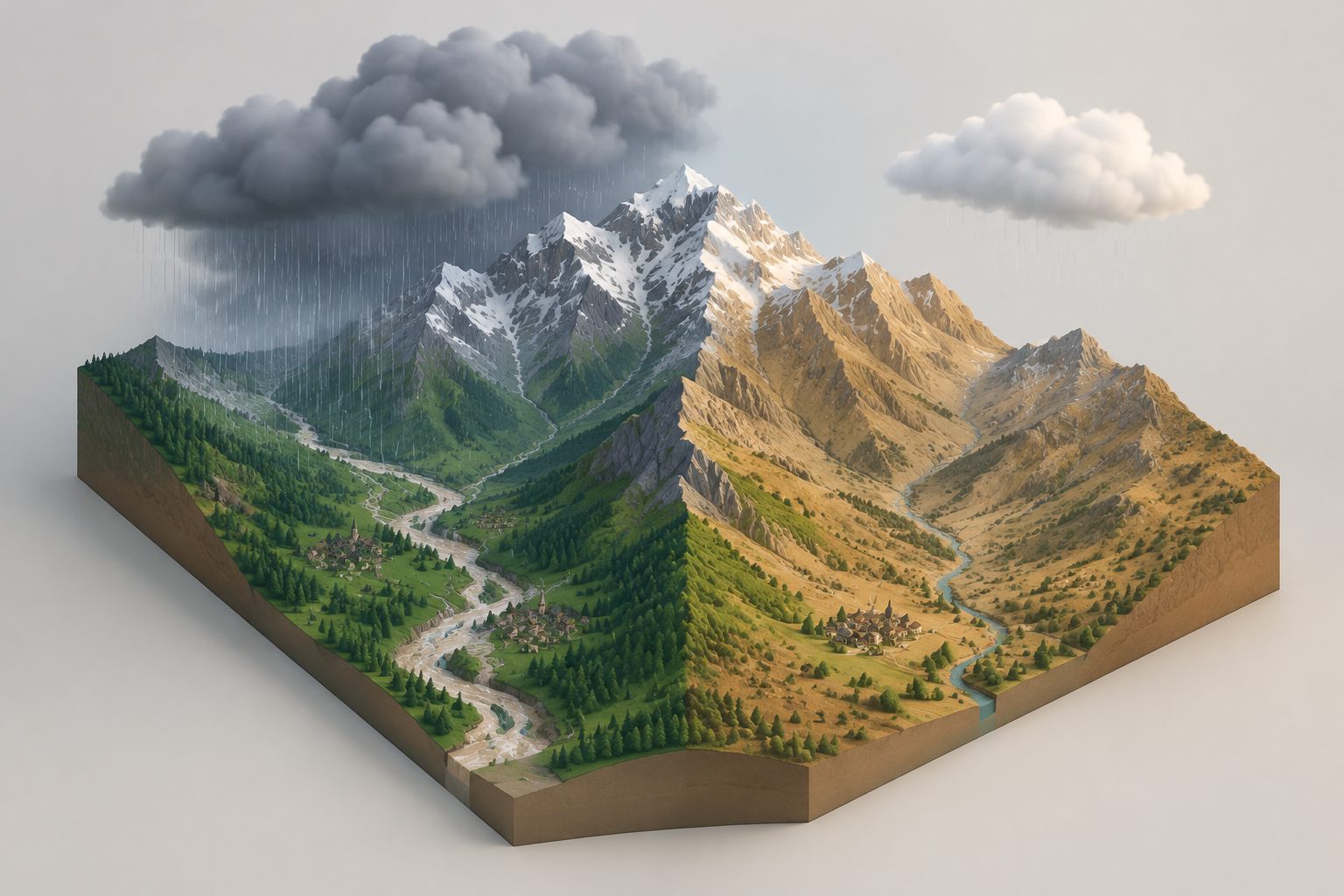
Daily rainfall extremes are rising in the southern Alps but declining in the north, while hourly trends are less clear.
Researchers used extreme-value statistics to examine very rare rainfall events in the French Alps, comparing daily and hourly observations across months and seasons. They defined an extreme event using the rainfall intensity expected once every 20 years and also examined the weather patterns linked to precipitation maxima.
The results show a strong north–south contrast for annual daily extremes, with increases in the south and decreases in the north, driven mainly by autumn changes. Hourly extremes show a different pattern: most annual trends are not statistically significant, with increases in the high Alps and decreases in the pre-Alps forming more of an east–west divide.
Where extremes are changing
The study provides a detailed picture of daily and hourly extreme precipitation in the French Alps. The researchers found strong differences between the northern and southern Alps and between seasons, with weather patterns helping shape when and where the largest rainfall events occur.
For annual daily rainfall extremes, the study found strong positive trends in the south and negative trends in the north. These differences were driven mostly by changes in autumn. Annual hourly extremes generally showed no statistically significant trend. Where a regional pattern appeared, hourly extremes tended to increase in the high Alps and decrease in the pre-Alps.
Evidence and caveats
The findings come from statistical analysis of long time series of measurements made at weather stations, using extreme-value theory. The study compares daily and hourly observations and examines both monthly and seasonal patterns, focusing on 20-year return levels—rainfall intensities expected, under the model, to occur once in 20 years.
The abstract does not report the number of stations, the length of each record, or the size of the estimated trends. It also reports that hourly annual trends are mostly not statistically significant, so the evidence for a broad change in hourly extremes is limited and varies by region. The results describe observed regional patterns; they do not by themselves identify the causes of those patterns or establish future changes.
// Source
Hydrology and earth system sciences · 2026 · DOI: 10.5194/hess-30-6421-2026
Authors: Sebastian Berghald, Juliette Blanchet, Antoine Blanc, David Penot
Institutions: KU Leuven, Université Grenoble Alpes, Institut National de Recherche pour l'Agriculture, l'Alimentation et l'Environnement, Centre National de la Recherche Scientifique, Institut de Recherche pour le Développement, Institut polytechnique de Grenoble, Institut des Géosciences de l'Environnement, Office National des Forêts, Électricité de France (France)