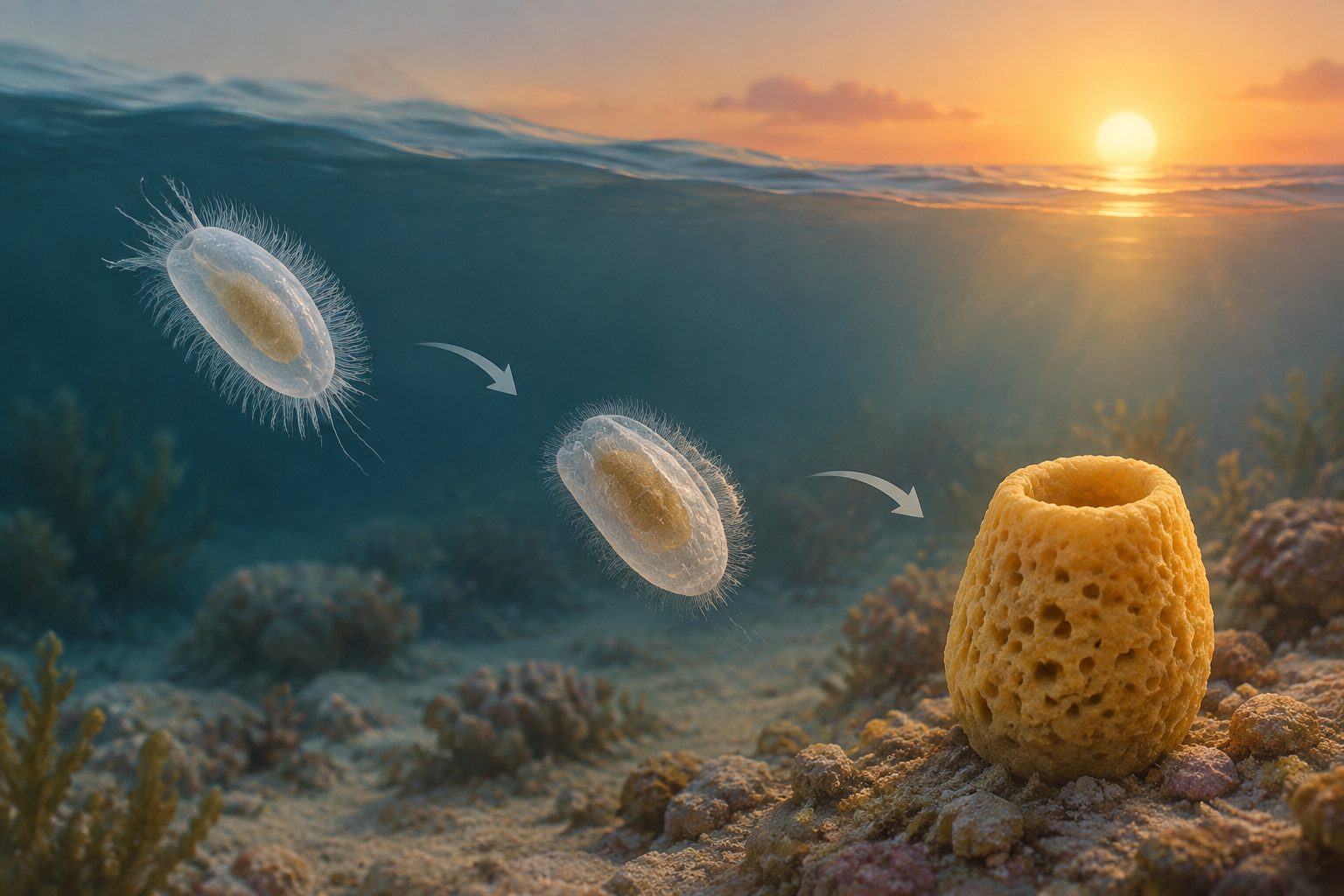
In Amphimedon queenslandica, fading light reshapes DNA packaging before an alga triggers settlement and metamorphosis.
Researchers tracked gene activity and chromatin accessibility—the openness of DNA regions that help control genes—in Amphimedon queenslandica larvae as they became ready to settle, settled, and began metamorphosis. They found extensive chromatin changes around sunset even though gene activity changed only modestly at that stage.
When exposed to a coralline alga, the larvae rapidly and temporarily activated many conserved transcription factors, including members of the AP-1/bZIP family. Larvae kept under constant light failed to settle and developed a different pattern of gene activity and chromatin accessibility, suggesting that the light cycle helps prepare them for the environmental signal that triggers metamorphosis.
How light prepares the larvae
Diminishing light at sunset was associated with extensive chromatin remodeling in swimming larvae before settlement, while changes in gene expression were relatively modest. After exposure to a coralline alga, metamorphosis involved the rapid, temporary activation of many deeply conserved transcription factors. Binding sites for AP-1/bZIP proteins were enriched in newly accessible DNA-regulatory regions near genes whose activity changed.
Larvae kept in constant light failed to settle. Instead, they adopted a different gene-activity and chromatin state marked by widespread loss of DNA accessibility and reduced activity of competence-associated transcription factors, including the circadian regulator CLOCK and other bHLH-PAS factors.
Evidence and caveats
The study combined time-resolved measurements of gene activity and chromatin accessibility across larval competence, settlement, and early metamorphosis, along with a constant-light comparison and environmental induction by a coralline alga. The results support an association between sunset-related light changes, chromatin state, and readiness to metamorphose, while the light manipulation shows that constant light changes settlement and the associated molecular state.
The abstract reports results from the marine sponge Amphimedon queenslandica and does not provide sample sizes or the full experimental details. It also does not establish that the proposed chromatin-priming mechanism operates across other sponge species or animal life cycles.
// Source
eLife · 2026 · DOI: 10.7554/elife.111060.3
Authors: Huifang Yuan, Oceane Board, Zac Pujic, Bernard M. Degnan
Institutions: The University of Queensland