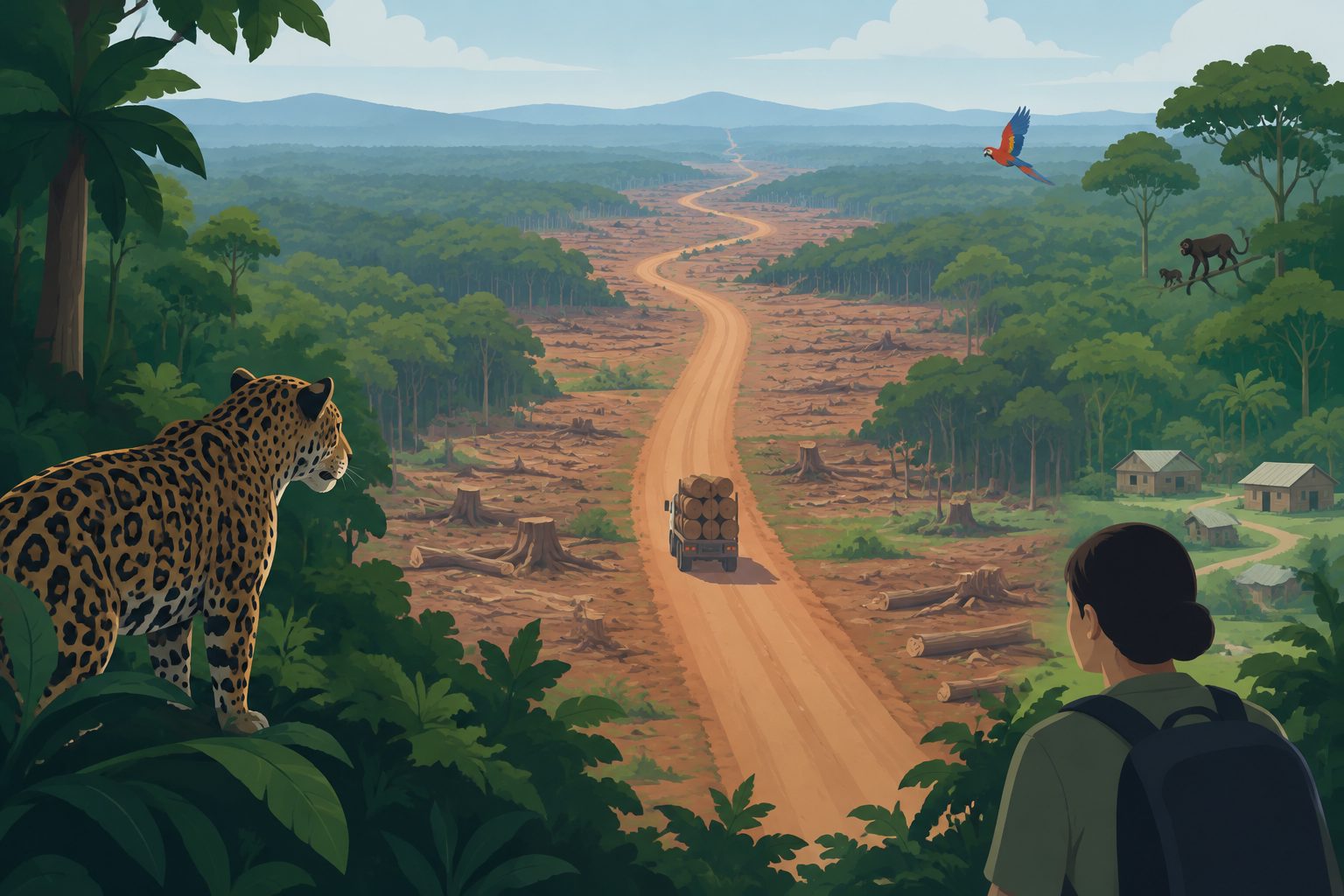
A review finds roads also reshape forest edges, kill wildlife and restrict animal movement across shorter distances.
The review examined research on roads built for highways, logging, plantations and unmapped access in tropical forests. Forest loss was greater near roads, in areas with more or longer roads, and after road construction or completion; one study in New Guinea found loss extending 17.7 kilometres from secondary roads.
Roads also created shorter-range ecological effects. Structural changes at forest edges reached 34 metres at a logging road and 350 metres at a highway. Reptiles and amphibians were the most common roadkill group in seven surveys covering all vertebrate classes, while paved roads reduced crossings by elephants and gibbons and were linked to genetic differences in some animals.
How roads affect forests
The review included 65 studies: 19 on forest loss, 47 on ecological effects and six on mitigation. Most came from Malaysia, Indonesia and Thailand.
Nine studies found greater forest-cover loss closer to roads, where road density or length was higher, or after construction or completion; no study found less loss. In New Guinea, loss associated with secondary roads extended as far as 17.7 kilometres. Structural edge effects reached 34 metres at a logging road and 350 metres at a highway, while soil effects remained largely on the road surface.
Reptiles or amphibians led roadkill counts in all seven surveys that recorded every vertebrate group. Deaths were concentrated on short road sections near water. Paved roads reduced crossings by elephants and gibbons and were linked to genetic differentiation in some species. Mammals and a large snake used crossing structures, but these findings came from single spatial comparisons. No study reported a human health outcome; fire, landslides and water quality were not measured.
Evidence and gaps
This was a systematic review of English-language journal articles published from 2015 onward, identified through Scopus, PubMed and OpenAlex. Two reviewers independently screened the records and full texts, and the evidence was assessed with established appraisal and certainty frameworks. The review included 65 studies, but the evidence was uneven: forest-loss and ecological findings generally had moderate confidence, while evidence for mitigation rested on single spatial comparisons and was rated very low. Most studies came from Malaysia, Indonesia and Thailand. The review found no human-health studies and no measurements of fire, landslides or water quality, so it cannot establish the effects of roads in those areas.
// Source
F1000Research · 2026 · DOI: 10.12688/f1000research.192732.1
Authors: Dennizza Arsya Fisara, Octari Permata Ully Rajagukguk, Miftahul Jannah, Jeffrey Willfred Poa, Muhammad Zaril Gaffar, Zahrani Afma Putri, Gabriel Honoratio Arifandy Ranta, La Rahman, Yamin Lakule, Is Rahman Usemahu, Akhip Nugroho, Ahmad Iqra Insani Mukamil Raupelu
Institutions: Yogyakarta State University, University of Indonesia, Universitas Gadjah Mada, Diponegoro University