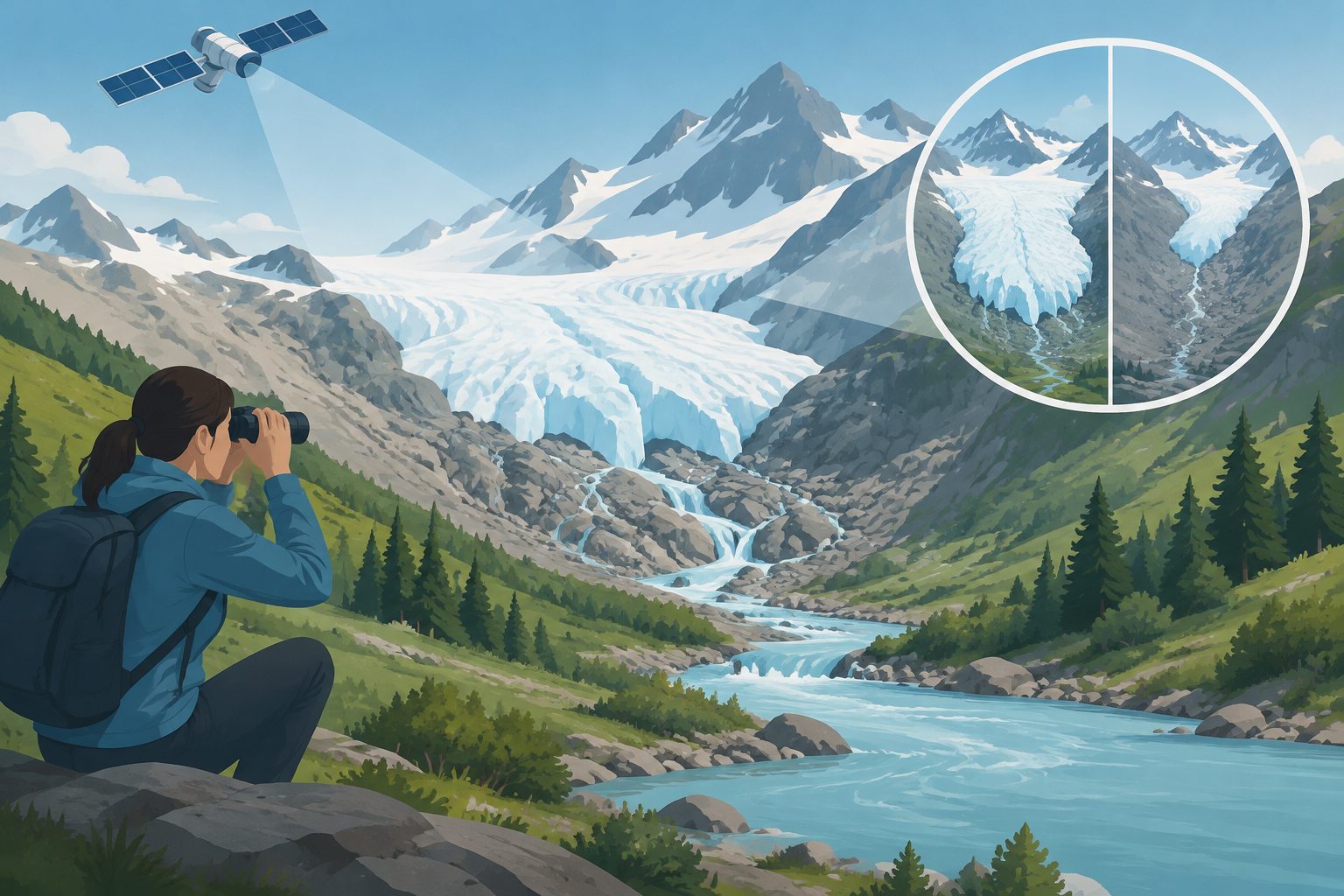
A study of 14 Swiss catchments found that glacier constraints gave a clearer picture of snow and glacier melt, even when streamflow scores were lower.
Researchers combined a hydrological model with a global glacier model and a system for representing snow moved by gravity. They tested the approach in 14 glaciated headwater catchments in Switzerland using streamflow records, snow-water-equivalent data and glacier melt estimates based on observed mass balance.
Adding snow redistribution reduced unrealistic snow buildup at high elevations. The glacier-constrained model produced melt contributions consistent with observations and made the separate snow and glacier contributions easier to identify, although versions without the glacier model performed better on streamflow metrics.
What the models found
The snow redistribution algorithm prevented the model from building up unrealistically large snow stores at high elevations and improved its simulation of catchment-average snow-water equivalent.
Models without the glacier component scored better against streamflow observations. But in some catchments, they achieved that performance by simulating glacier melt at rates two to three times higher than estimates from the global glacier model and observed glacier storage changes. The results suggest that these models can use excessive glacier melt to compensate for biases in precipitation data.
Among the best-performing parameter sets, estimated glacier melt contributions differed by nearly an order of magnitude. When the researchers coupled the hydrological model with the global glacier model and calibrated it with glacier-specific measurements of long-term mass change, the simulated glacier melt agreed with observations and the separate snow and glacier contributions became substantially easier to identify.
Why the source of melt matters
Streamflow alone may not reveal whether a model has assigned water to the right source. A model can reproduce river flows while misrepresenting glacier melt, which matters when glacier and snow melt change over time under a changing climate.
Constraining glacier melt with observations can reduce these compensating errors and provide a more dependable basis for estimating how much water comes from snow and ice in mountain catchments. That information is relevant to projections of future melt contributions and water availability.
Evidence and caveats
The study used simulations for 14 glaciated headwater catchments in Switzerland. Researchers compared them with observed streamflow, gridded snow-water-equivalent data and glacier melt data derived from observed mass balance. The analysis directly tested the effects of adding snow redistribution and coupling the hydrological model to a global glacier model.
The results are based on these Swiss catchments and model comparisons, so they do not establish that the same approach will perform identically elsewhere. The coupled model had lower streamflow performance metrics than the uncoupled versions, and glacier melt estimates still depended strongly on parameter choices in the unconstrained models. The researchers say that testing future climate scenarios and adding further constraints, including snow observations, could improve projections.
// Source
Hydrology and earth system sciences · 2026 · DOI: 10.5194/hess-30-6511-2026
Authors: Justine Berg, Pascal Horton, Martina Kauzlaric, Alexandra von der Esch, Bettina Schaefli
Institutions: University of Bern, Oeschger Centre for Climate Change Research, ETH Zurich, Swiss Federal Institute for Forest, Snow and Landscape Research, Laboratory of Hydraulics, Hydrology and Glaciology