Flood research in Ghana links local partnerships to more usable risk plans
A study of a flood project in Ghana finds that shared decision-making, trust and local knowledge can help turn research into practical risk-management action.
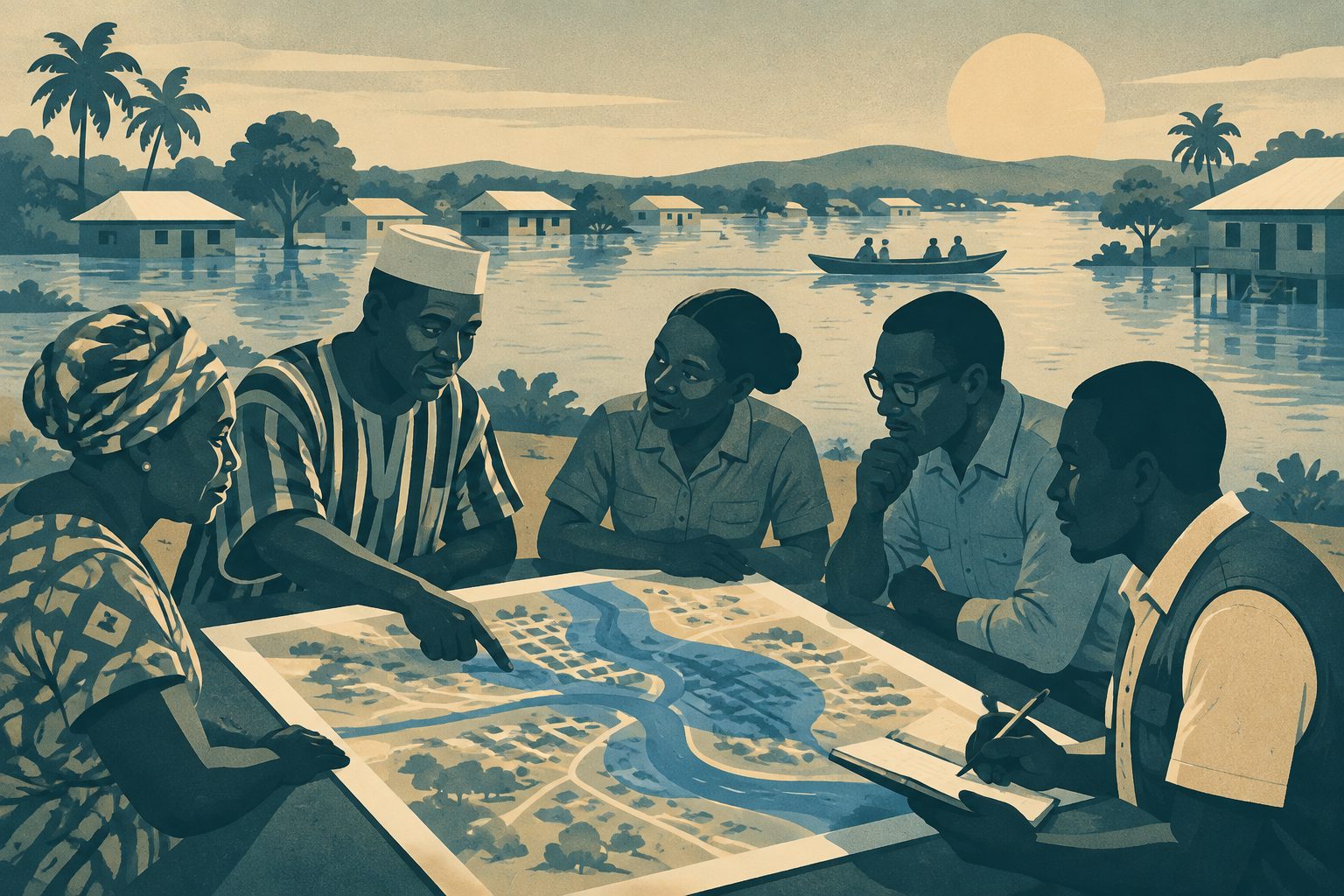
Editorial illustration — not from the study.
The study examined how research and society can work together to address flood risk, using experiences from the PARADeS project in Ghana. The project brought multiple stakeholders together to study flood drivers and governance, develop scenarios and action plans, and identify feasible prevention and preparedness measures.
The researchers describe four connected stages: agreeing on the problem and local context, combining evidence and knowledge, designing measures together, and embedding the results in institutions. They argue that knowledge production, shared learning and greater capacity have more practical impact when supported by joint research design, trust, shared ownership and continued institutional involvement.
How shared flood planning works
The researchers found that flood-risk research should be collaborative, adaptable and sensitive to local conditions. Its methods need to bring together different types of knowledge and support interaction among researchers, public institutions and other stakeholder groups.
In the Ghanaian case, the researchers identify three ways such projects can generate impact: producing knowledge, enabling people and organizations to learn together, and building their ability to manage flood risk. They also identify three conditions that help those effects lead to practical use: developing research questions and plans jointly, building trust and a sense of ownership, and securing institutional support for the results.
The study concludes that flood management cannot depend only on technical expertise or stand-alone scientific findings. It says participatory work must also address power, governance, vulnerability and differences in what counts as valid knowledge. For collaborations between higher-income and lower-income countries, the researchers emphasize fair partnerships and close attention to local circumstances.
Why local knowledge matters
Flood risk is shaped by interacting physical and social factors, so plans based on only one type of expertise may not fit the conditions in which they are meant to work. The study suggests that involving local stakeholders in setting questions, interpreting evidence and designing measures can help produce knowledge that is more socially robust and more useful for action.
Its broader message is that the value of flood research lies not only in understanding floods, but also in building shared learning, ownership and lasting links between research and institutions. These lessons may also inform flood planning in other settings, including collaborations between institutions in the same region.
Evidence and caveats
This is a conceptual and case-based study. The researchers develop a framework for flood-risk research and reflect on empirical experiences from the PARADeS project in Ghana, which used a four-stage, multi-stakeholder approach. The excerpts do not report a controlled comparison, numerical evaluation or measured reduction in flood losses, so they do not establish that the approach itself reduces flooding or damage.
The findings are grounded primarily in one project and one national context. The paper argues that some lessons can extend to other settings, but applying them elsewhere would require attention to local institutions, power relationships, vulnerabilities and forms of knowledge.
// Source
Natural hazards and earth system sciences · 2026 · DOI: 10.5194/nhess-26-5853-2026
Images from the European Space Agency’s JUICE mission show that small volcanic or subvolcanic features on a lunar highland are distributed in ways consistent with control by impact-generated and regional fractures. The same observations also reveal mafic, or iron- and magnesium-rich, material inside Langrenus crater, although its exact minerals remain uncertain.
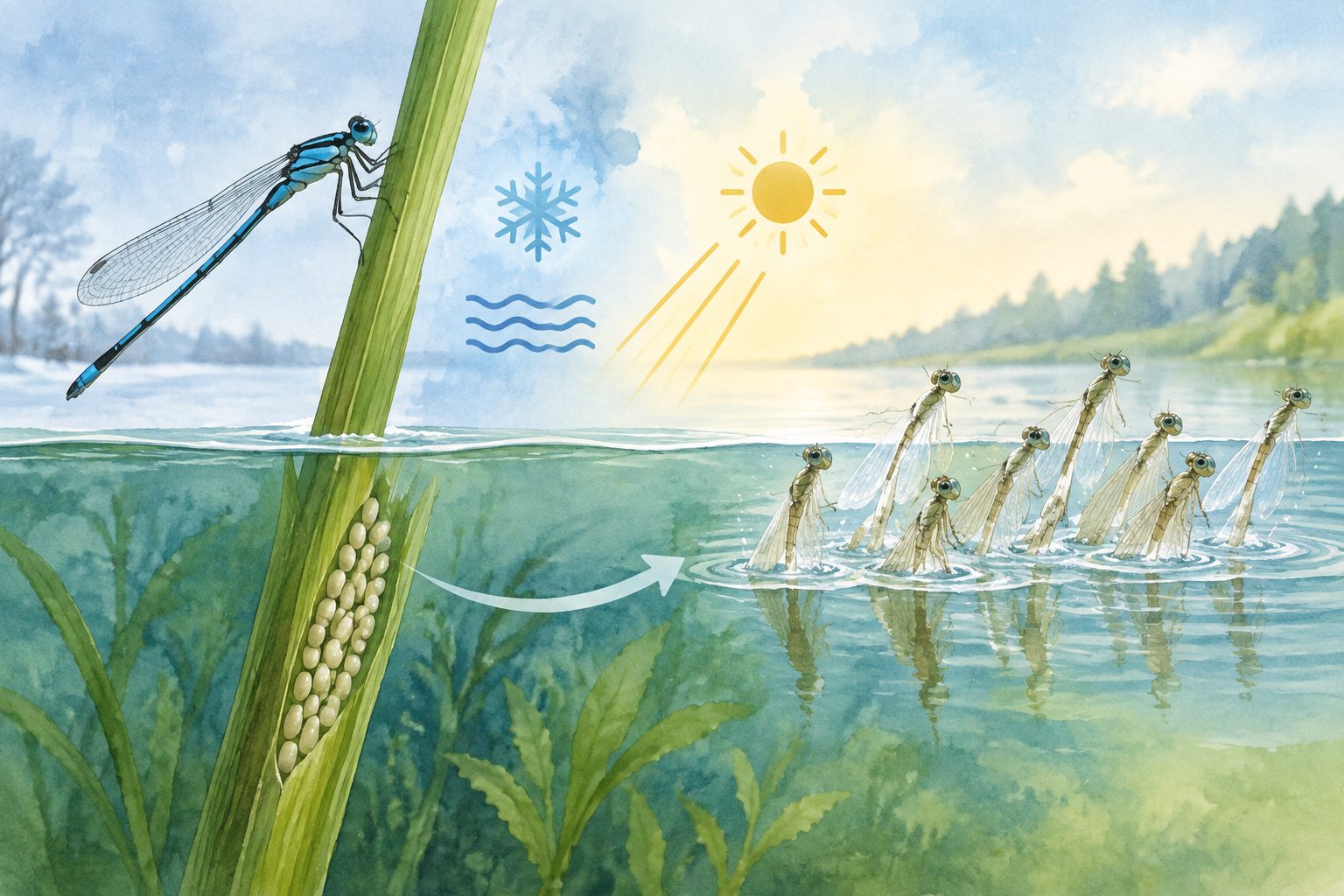
Damselfly eggs from different latitudes responded to winter cold and day length in ways that helped time hatching for spring. The eggs could hatch at 5 °C, and newly hatched larvae survived two weeks near 0 °C, suggesting that warmer winters could allow some hatching during winter.
A new ensemble forecasting system improved large-scale weather predictions and tropical cyclone track forecasts by combining an AI model with a physics-based weather model. The hybrid forecasts did not degrade predicted storm intensity or the spread used to represent uncertainty.