Damselfly eggs use cold and daylight to time a synchronized spring hatch
Experiments show that winter chilling, long days and rising temperatures work together to end the eggs’ dormant period.
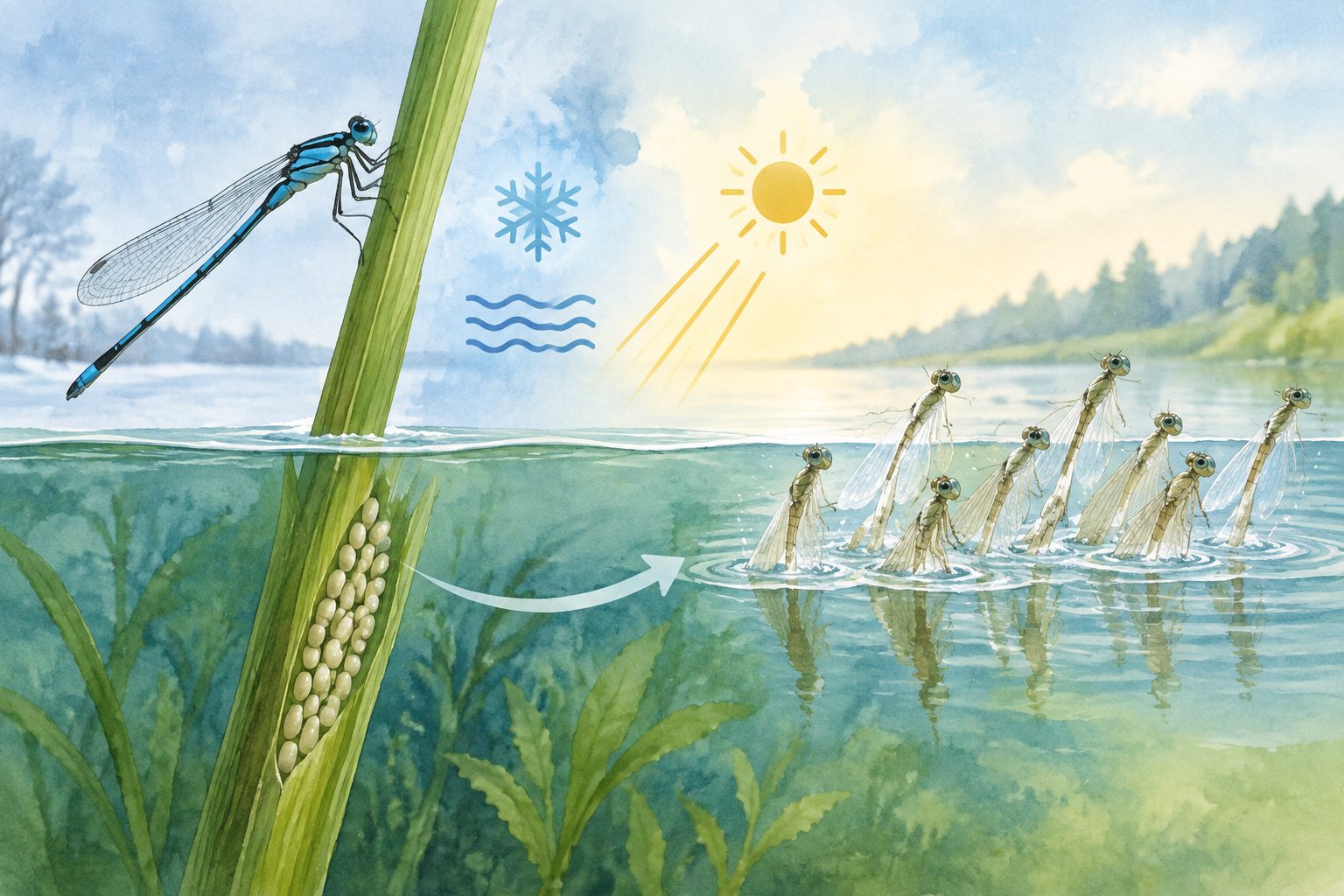
Editorial illustration — not from the study.
Researchers studied eggs of the one-generation-per-year damselfly Lestes sponsa, mainly using eggs from southern Sweden. They tested how different periods of cold, temperatures and day lengths affected the end of embryonic diapause—the dormant state that allows the eggs to survive winter.
Longer chilling made long days and warmer temperatures more effective at ending diapause, producing faster and more synchronized hatching. Eggs from Poland and northern Sweden had different day-length thresholds, with weaker diapause in the northern population, indicating that the timing system varies with latitude.
How the eggs time hatching
Diapause development was fastest at 10 °C, slower at 5 °C and slowest at 20–21 °C, where it may have stopped. Longer chilling strengthened the effects of long days and warm temperatures, leading to faster and more synchronized hatching.
Without chilling, a solstice-like day length of 19.5 hours of light and 4.5 hours of darkness led to hatching beginning 1–2 weeks after diapause began, but hatching continued for weeks. Exposure to shorter days before warming improved synchrony. A day length of 18 hours was only weakly effective without chilling.
After 19–21 weeks at 5 °C, virtually all eggs hatched within 2–4 days, regardless of day length. At 10 °C after chilling, development was faster and fewer eggs hatched unusually late, although day length still influenced timing. Post-diapause development was 3–3.5 times slower at 10 °C and about 20 times slower at 5 °C than at 21 °C.
Hatching was successful at 5 °C, and larvae survived for two weeks near 0 °C. Eggs from Poland and northern Sweden differed in the day length needed to end diapause, with weaker diapause in the northern Swedish eggs.
Why seasonal timing matters
The results describe a timing system that can prevent premature hatching during short-day, warm periods while helping eggs hatch rapidly and together when winter has passed. The latitude-related differences suggest that populations are adjusted to local seasonal conditions.
Because eggs hatched at 5 °C and larvae survived near 0 °C, the findings suggest that winter hatching could become possible under warmer conditions. The study does not establish how often this happens in the wild or what consequences it would have for damselfly populations.
Evidence and caveats
The study used controlled laboratory experiments on damselfly eggs, mainly from southern Sweden, with additional eggs from Poland and northern Sweden. Researchers varied chilling duration, temperature and day length, then recorded hatching and larval survival.
The experiments included relatively few mothers—no more than seven in the main groups—and eggs from different females had to be mixed. Collection dates and the numbers of eggs contributed by each female also varied. These factors limit the study’s ability to measure family-level differences. The researchers also note that the exact timing of diapause ending and hatching in the field remains uncertain, and field data on hatching synchrony are limited.
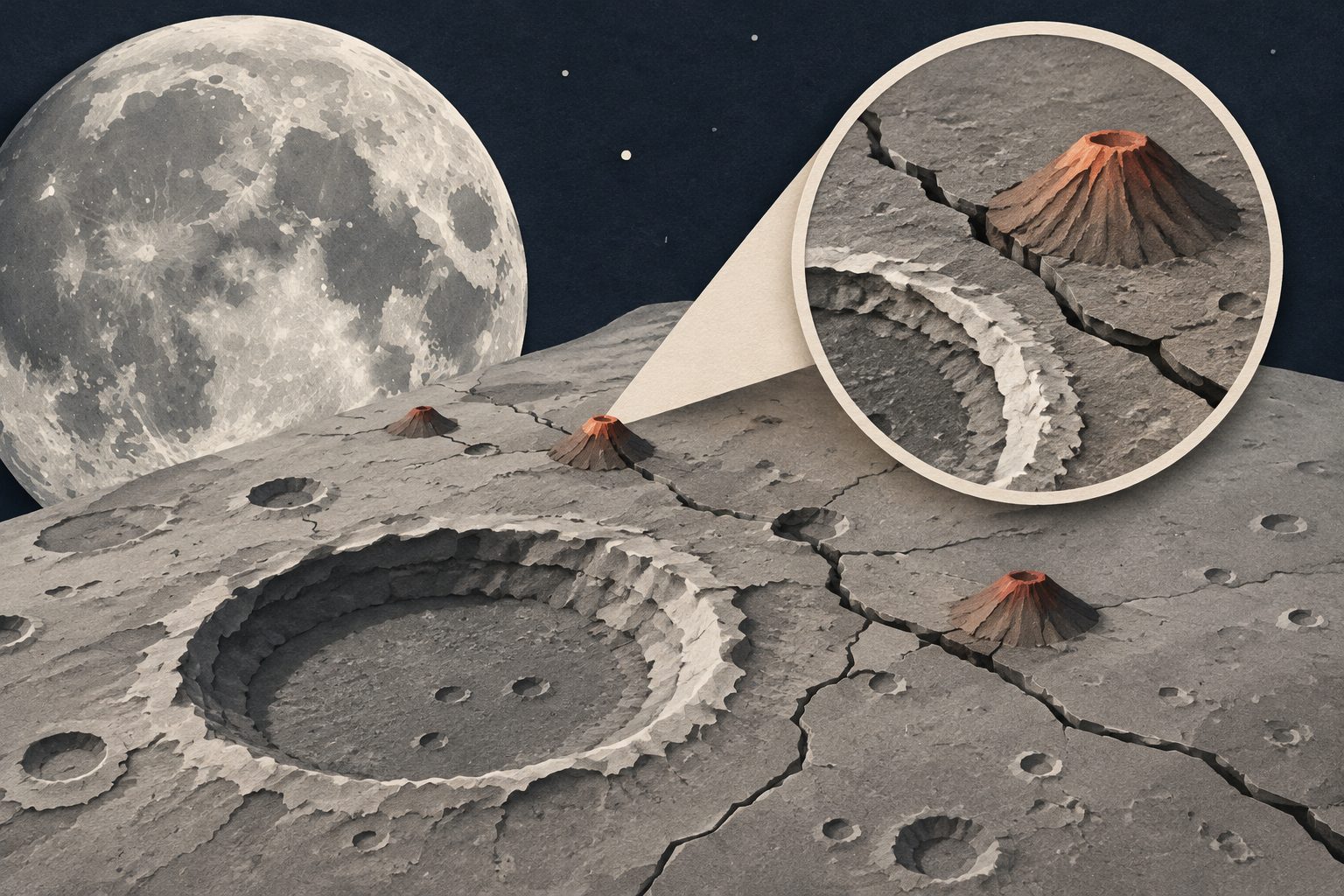
Images from the European Space Agency’s JUICE mission show that small volcanic or subvolcanic features on a lunar highland are distributed in ways consistent with control by impact-generated and regional fractures. The same observations also reveal mafic, or iron- and magnesium-rich, material inside Langrenus crater, although its exact minerals remain uncertain.
A study of the PARADeS flood-risk project in Ghana argues that effective flood planning needs more than technical analysis. It finds that working with communities and other stakeholders through shared research, trust-building and long-term institutional support can produce knowledge that is more socially grounded and actionable.
A new ensemble forecasting system improved large-scale weather predictions and tropical cyclone track forecasts by combining an AI model with a physics-based weather model. The hybrid forecasts did not degrade predicted storm intensity or the spread used to represent uncertainty.