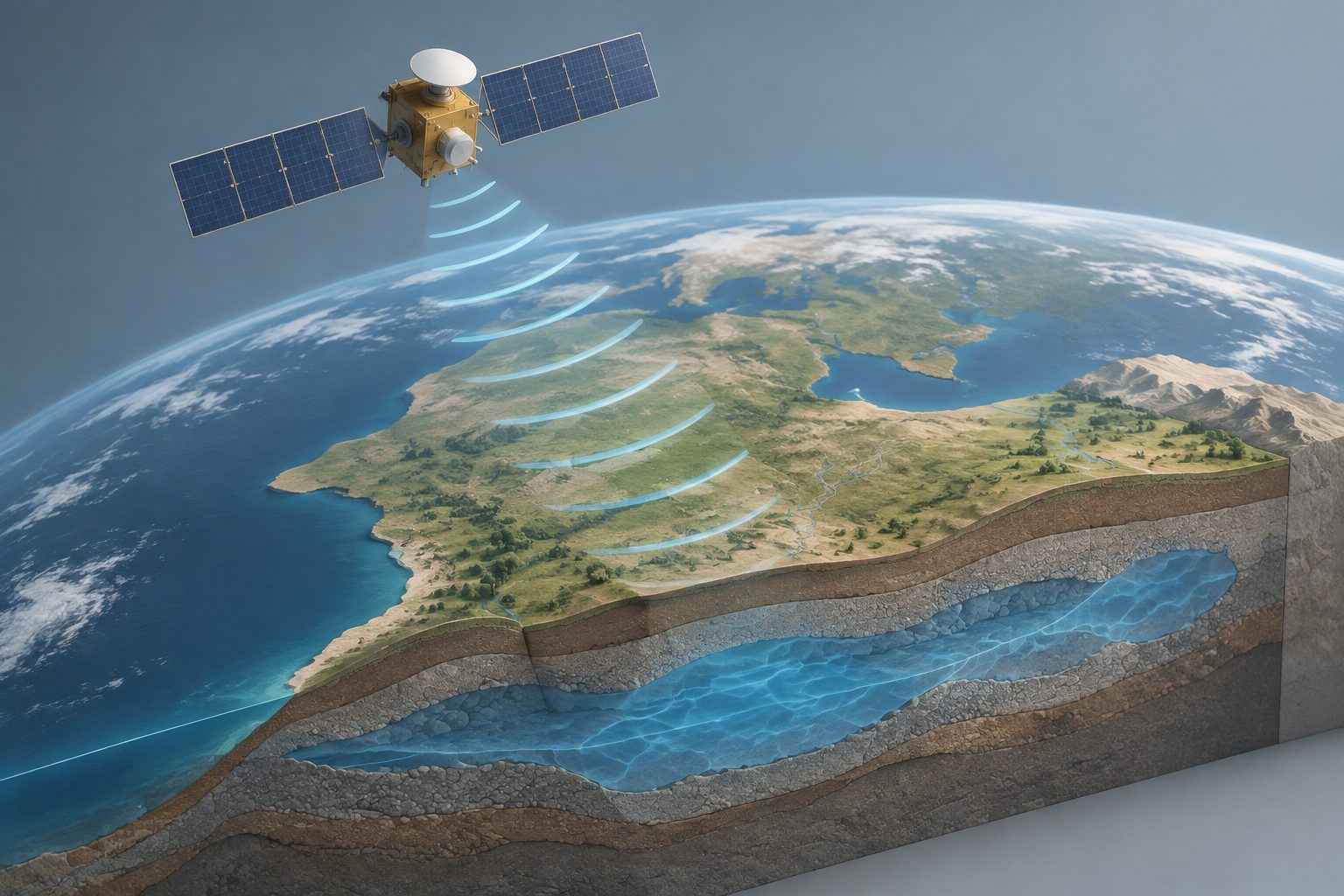
A new dataset tracks monthly changes in groundwater storage across the world from 2002 to 2023.
The Global Gravity-based Groundwater Product, or G3P, combines measurements from the GRACE and GRACE Follow-On satellites with observations and models of snow, soil moisture, glaciers and surface water. Removing those other forms of stored water from the satellites’ measurements of total water storage produces estimates of groundwater changes.
The dataset provides monthly results on a global grid with cells about 0.5 degrees across. The researchers describe the processing methods, show examples of groundwater changes over time and space, and compare the results with ground-based observations from three large aquifer systems.
Evidence and limits
This is an observation-based dataset built from satellite gravity measurements, ground and satellite observations, and models. The groundwater estimates are derived indirectly: changes in snow, root-zone soil moisture, glacier mass and surface water are removed from measurements of total land water storage. The contributing datasets are spatially filtered to match the satellites’ resolution, so G3P describes large-scale rather than local groundwater changes. The abstract reports example evaluations against observations from three large aquifer systems, but it does not give their results or establish how well the product performs in all regions. G3P is a prototype rather than a fully operational service.
// Source
Earth system science data · 2026 · DOI: 10.5194/essd-18-7787-2026
Authors: Andreas Güntner, Ehsan Sharifi, Julian Haas, Eva Boergens, Feifei Cao, Christoph Dahle, Neda Darbeheshti, Henryk Dobslaw, Inés Dussaillant, Wouter Arnoud Dorigo, Frank Flechtner, Adrian Jäggi, Miriam Kosmale, Martin Lasser, Kari Luojus, Ulrich Meyer, Adam Pasik, Wolfgang Preimersberger, Claudia Ruz Vargas, Michael Zemp
Institutions: University of Bern, TU Wien, University of Zurich, University of Potsdam, Karlsruhe Institute of Technology, GFZ Helmholtz Centre for Geosciences, Universidad Adolfo Ibáñez, Finnish Meteorological Institute, Geoscience Australia