Review traces the development of image-guided thyroid treatments
A historical analysis describes how several minimally invasive techniques developed, while noting that direct comparisons remain limited.
Low evidenceReviewSome caution advised
Medical disclaimer: This article summarizes research findings and is for informational purposes only. It is not medical advice.
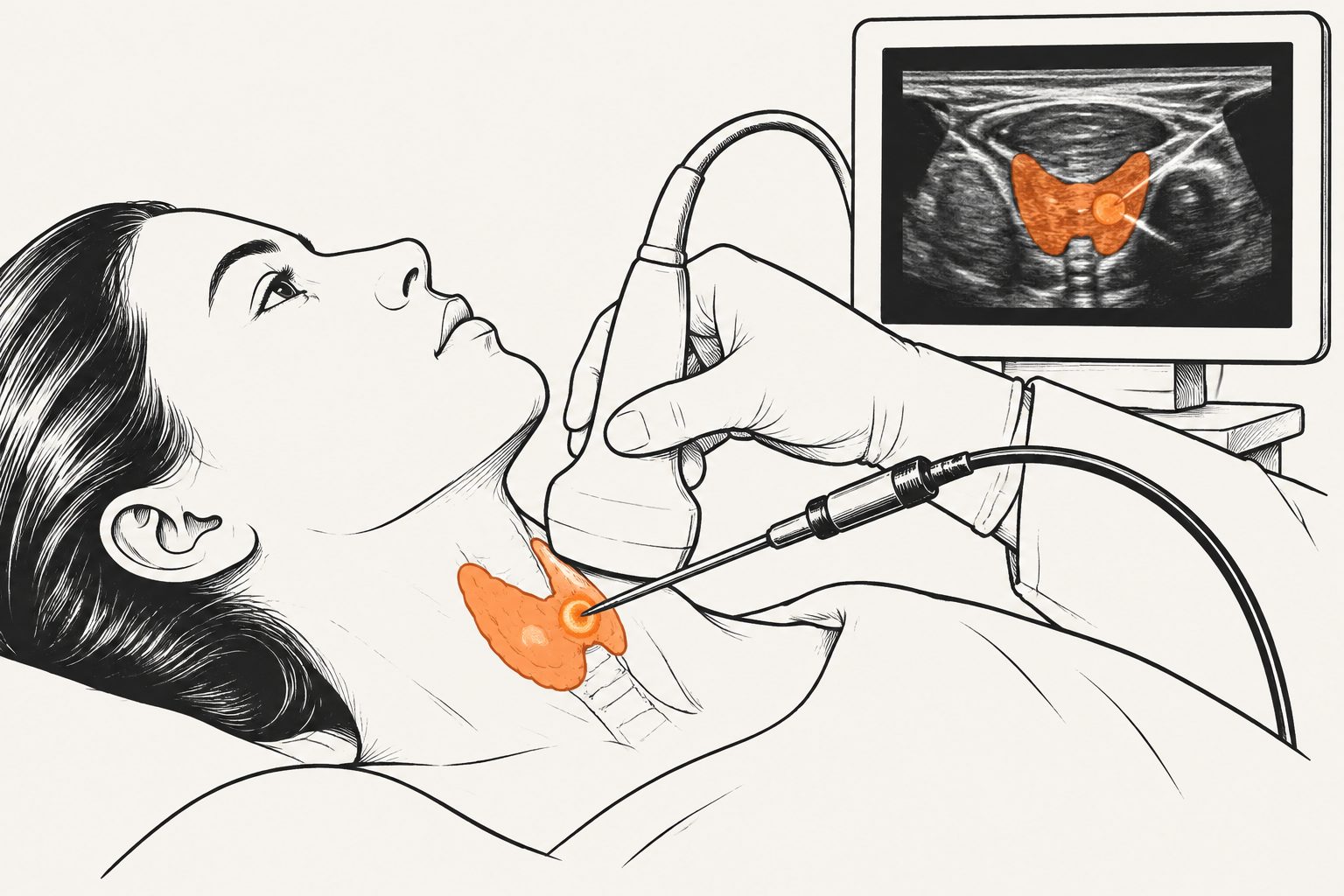
Editorial illustration — not from the study.
The authors reconstructed the history of image-guided thyroid ablation using a structured PubMed search and predefined criteria. They looked for early descriptions, first human clinical uses, technical developments, comparisons, guidelines and influential long-term follow-up studies. Of 1,922 records initially identified, 43 papers were chosen for qualitative historical analysis.
The review divides the field into five periods, from early ethanol injection to later use of thermal techniques and guideline development. It reports that long-term studies have described durable nodule reduction or control in selected settings, including benign nodules and low-risk papillary thyroid microcarcinoma. However, the review also says that direct comparisons between techniques are limited and that no technique has consistently shown clear superiority.
What the review covered
The researchers asked how image-guided ablation for thyroid disease developed and which publications marked important changes in the field. They searched PubMed using terms related to ethanol, laser, radiofrequency, microwave and high-intensity focused ultrasound. Two authors independently screened the records and selected papers that met at least one predefined milestone criterion, such as describing a technique for the first time, reporting an early human clinical application, introducing an important technical change, comparing treatments, publishing guidance or reporting influential long-term follow-up. The final review included 43 papers: 3 on percutaneous ethanol injection, 10 on laser ablation, 15 on radiofrequency ablation, 7 on microwave ablation and 8 on high-intensity focused ultrasound.
Key conclusions
The review describes five stages in the field's development: conceptual work from 1985 to 1999; the emergence of thermal procedures from 2000 to 2006; methodological standardization from 2007 to 2012; increased use and comparison of ablation for benign and selected malignant disease from 2013 to 2018; and guideline endorsement and longer-term follow-up from 2019 to 2025. It reports that recent 10-year follow-up studies have described durable results for benign nodules and continued cancer control in selected patients with low-risk papillary thyroid microcarcinoma. These are findings reported in the reviewed literature, not results from a new group of patients enrolled in this review. The authors state that the different thermal methods generally appear to have comparable outcomes in appropriately selected patients, but direct comparisons are limited and no method has consistently shown clear superiority.
Who this may apply to
The review may be relevant to discussions of image-guided thyroid ablation in patient groups similar to those represented in the underlying studies, including selected people with benign nodules or low-risk papillary thyroid microcarcinoma. It does not establish applicability to all thyroid nodules, all thyroid cancers, or all thyroid disorders. The review itself does not provide individualized clinical conclusions, and its historical selection process means that its findings should not be read as a direct comparison of options for any particular person.
The significance
The review helps explain how thyroid ablation moved from early experimental and clinical work toward more standardized procedures and international guideline recognition. It also shows that the evidence base includes different techniques, patient groups and study types, so the reported results should not be treated as applying equally to every thyroid disorder or every patient. Because this was a historical review rather than a formal comparison of treatments, it cannot establish that ablation is better than surgery, observation or another option.
Limitations & evidence assessment
Choosing which papers counted as historical milestones involved subjective judgment, even though the authors used predefined criteria. The review was intended to reconstruct history, not to combine results statistically, so it did not include a formal assessment of study quality or a meta-analysis. Some included reports had small sample sizes or preliminary designs. The abstract and excerpts do not provide enough detail to determine how many patients were represented across the 43 papers, how consistently outcomes were measured, or how the included patient groups differed. The review's conclusions therefore depend on a selected set of publications and may be affected by differences in study design, follow-up and patient selection.
Why this evidence level: This is a historical review of selected milestone publications, not a new clinical trial or a quantitative systematic review. The authors did not formally assess study quality or perform a meta-analysis, and some included reports were small or preliminary.
Evidence levels are editorial estimates derived from study metadata — they are not clinical appraisals.
// Source
La radiologia medica · 2026 · DOI: 10.1007/s11547-026-02296-9
Researchers combined genetic data from more than 1 million human participants to study factors associated with endometriosis. They identified 58 genomic regions, including 27 not previously reported, and used additional molecular analyses to implicate 314 genes. These findings point to possible biological pathways for further research, but they do not establish causes or demonstrate that any treatment will work.
Researchers systematically reviewed laboratory studies of how temperature affects the time it takes arboviruses to become transmissible inside mosquitoes. Across 53 studies covering 17 viruses, higher temperatures were generally linked with greater transmission efficiency and a shorter time to infectiousness for Zika and West Nile viruses, while results for several other viruses were unclear.
This systematic review and meta-analysis examined whether ultra-low-dose computed tomography (CT) can detect pulmonary, or lung, nodules while using less radiation than standard-dose CT. Across 42 studies involving 15,792 patients, pooled sensitivity for nodule detection was 91.9%, but results varied greatly between studies. The review also found that ultra-low-dose CT used an average effective dose of 0.22 millisieverts (mSv), while detection was less reliable for some small or hazy nodules and in patients with a high body mass index.