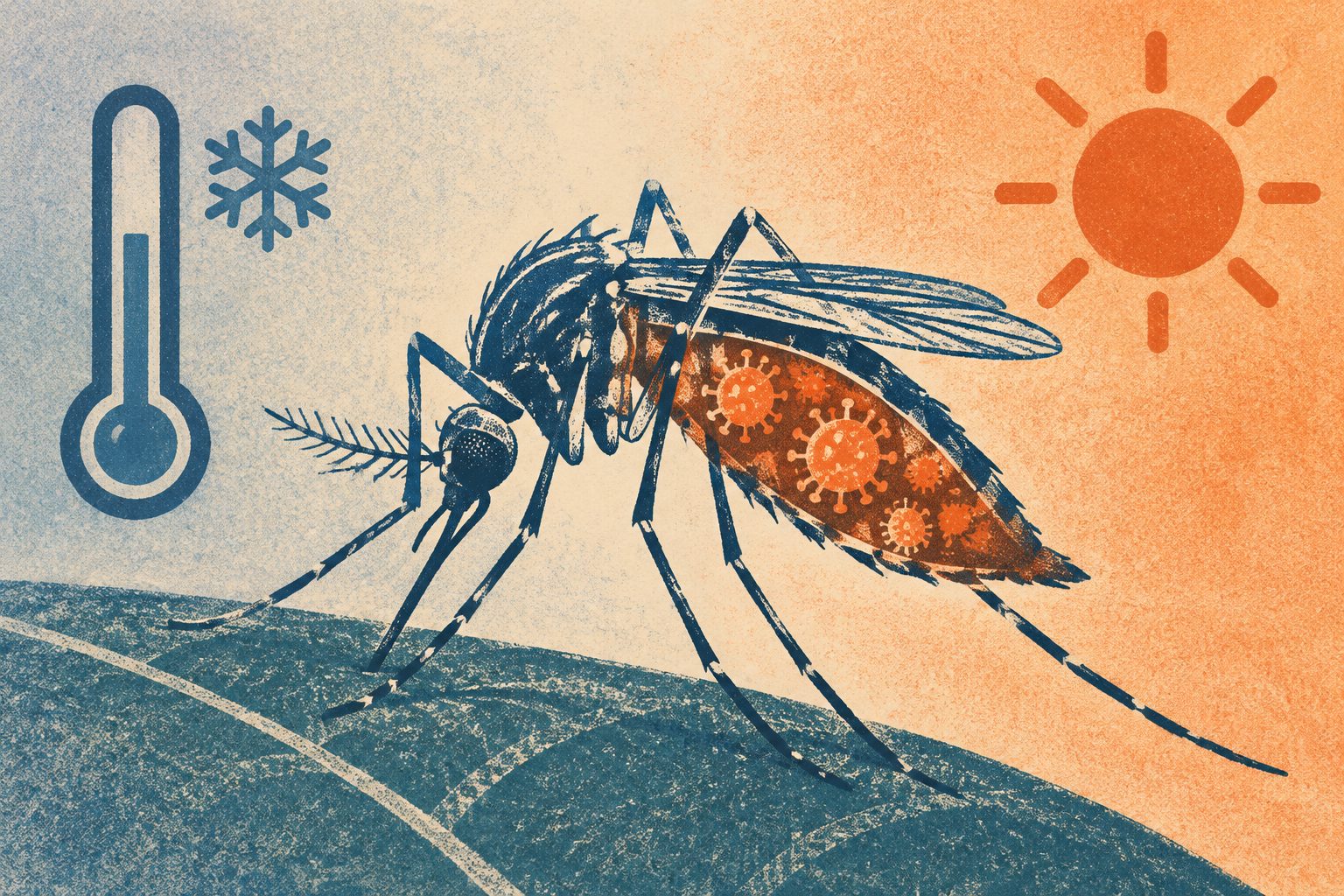
Review examines how temperature affects viruses in mosquitoes
The analysis found clearer temperature-related patterns for Zika and West Nile viruses than for several less-studied viruses.
High evidenceReviewInterpret with caution
Medical disclaimer: This article summarizes research findings and is for informational purposes only. It is not medical advice.
Editorial illustration — not from the study.
The review examined data from laboratory experiments involving mosquitoes that had taken an infectious blood meal. The researchers estimated the median extrinsic incubation period, meaning the time after infection until half of the infected mosquitoes were estimated to be capable of transmitting the virus through saliva.
The findings differed widely across viruses, mosquito species, temperatures and experimental methods. The review provides information for disease-transmission models, but it does not show how temperature affects illness or infection risk in people under real-world conditions.
The question reviewed
This systematic review searched three databases and citation lists for laboratory studies examining temperature, mosquitoes and arboviruses. It included 53 studies covering 17 arboviruses and extracted measures of mosquito infection and transmission efficiency. A statistical model was used to estimate the median time to infectiousness when the available data allowed it. The work studied mosquito laboratory models, not human participants.
What the review concluded
Temperature effects on transmission efficiency varied substantially across the evidence. For Zika and West Nile viruses, higher temperatures generally coincided with greater transmission efficiency and a shorter extrinsic incubation period. Comparable patterns were not clear for several other viruses, including Sindbis and chikungunya viruses, because data were limited or reported at too few time points. Results also varied among different mosquito vectors carrying the same virus, reflecting biological differences and differences in experimental methods.
Where this may apply
The findings apply most directly to the laboratory mosquito-virus combinations and experimental conditions represented in the 53 included studies. They may help researchers assess temperature-related assumptions in transmission models, but they do not directly apply to a particular human population, individual patient or specific location. Real-world conditions, including fluctuating temperatures and other environmental factors, were not fully represented, so the laboratory findings should not be treated as direct estimates of human transmission risk.
What this could mean
The time a virus takes to become transmissible inside a mosquito is one factor used in models of mosquito-borne disease spread. This review identifies some temperature-related patterns that may help inform such models, especially for Zika and West Nile viruses, while showing that evidence is insufficient for several other viruses. Because the evidence came from laboratory mosquito experiments, it does not directly establish changes in human infection, illness or transmission under environmental conditions.
Limitations & evidence assessment
The underlying studies used widely different mosquito-rearing conditions, viral doses, virus strains, temperature ranges, testing schedules, outcome definitions and laboratory assays, making direct comparisons difficult. Data were much more extensive for Zika and West Nile viruses than for viruses such as Sindbis, chikungunya, Mayaro and Murray Valley encephalitis viruses; some studies had only two temperature points, low transmission efficiency or sparse sampling. Some experiments used mosquito species that may not be primary vectors, which adds uncertainty when relating the results to real-world transmission. The review used saliva as its main transmission-related endpoint because it was reported most consistently, but this measure may not represent transmission equally well for every virus-vector pairing. As with systematic reviews generally, relevant studies may have been missed because of database coverage, indexing, language, publication or reporting limitations.
Why this evidence level: Systematic review aggregating primary studies with explicit methodology.
Evidence levels are editorial estimates derived from study metadata — they are not clinical appraisals.
Researchers combined genetic data from more than 1 million human participants to study factors associated with endometriosis. They identified 58 genomic regions, including 27 not previously reported, and used additional molecular analyses to implicate 314 genes. These findings point to possible biological pathways for further research, but they do not establish causes or demonstrate that any treatment will work.
This systematic review and meta-analysis examined whether ultra-low-dose computed tomography (CT) can detect pulmonary, or lung, nodules while using less radiation than standard-dose CT. Across 42 studies involving 15,792 patients, pooled sensitivity for nodule detection was 91.9%, but results varied greatly between studies. The review also found that ultra-low-dose CT used an average effective dose of 0.22 millisieverts (mSv), while detection was less reliable for some small or hazy nodules and in patients with a high body mass index.
In an online randomized experiment involving 3,519 Chilean parents, researchers tested whether adding an “ULTRAPROCESSED” warning to Chile’s existing nutrient labels changed views of potato chips. The added label improved identification of ultraprocessed products and lowered reported purchase intentions and perceived healthfulness, but the effects were smaller when products already had more nutrient warnings. The study measured stated responses, not actual purchases or health outcomes.