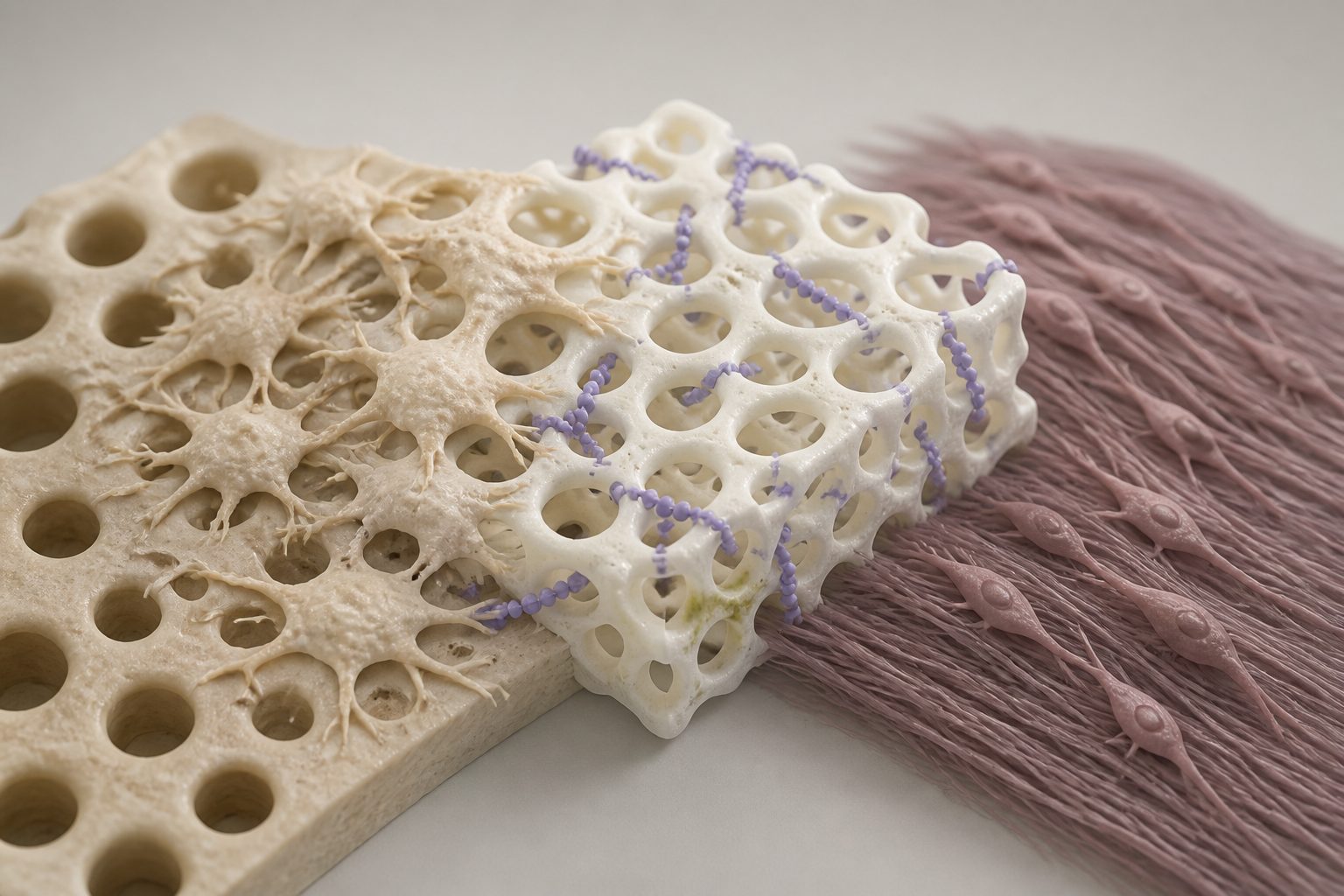
The modified biodegradable material performed better than plain chitosan in cell tests and showed a combined benefit in vivo.
Researchers attached two synthetic peptides to chitosan, a biodegradable material, and used the modified material to make six porous scaffolds. One peptide was intended to support osteoblast attachment and movement; the other was based on part of a bone-growth protein and was intended to promote the development of bone-forming cells.
In laboratory tests, the modified scaffolds improved adhesion, growth and mineralization of human jaw-derived osteoblasts compared with unmodified chitosan. In vivo, scaffolds carrying both peptides showed a combined effect, with more cells colonizing the material and a thinner fibrotic capsule around it.
What the scaffolds did
The researchers covalently attached two peptides to chitosan: a fragment of human vitronectin called HVP, which has been shown to enhance osteoblast adhesion and migration, and GBMP1α, a 22-amino-acid fragment of BMP-2 that increased the bone-forming differentiation of mesenchymal stem cells. They used an aqueous, mild-condition reaction to anchor the peptides to chitosan.
Six porous scaffold designs were made from unmodified chitosan, separately functionalized chitosan, and chitosan carrying both peptides. Compared with pristine chitosan, the functionalized scaffolds produced significantly better adhesion, proliferation and mineralization in human jaw-derived osteoblasts. Their compressive modulus and maximum stress could also be varied through the scaffold composition. In vivo, scaffolds carrying both peptides showed significant synergistic effects: greater cellular colonization and reduced fibrotic capsule thickness.
Evidence and caveats
This was a laboratory materials study combining cell tests, chemical and structural analyses, mechanical measurements, and an in vivo assessment. The cell experiments used human jaw-derived osteoblasts, while the abstract does not identify the in vivo animal model or provide numerical results. The work tested six porous scaffold designs, but it does not establish how the materials would perform in people or whether they lead to better bone repair over the long term.
// Source
Cellulose · 2026 · DOI: 10.1007/s10570-026-07175-0
Authors: Annj Zamuner, M. Zoboli, Elena Zeni, Teresa Russo, Ignazio Castagliuolo, Andrea Porzionato, Francesca Ravanetti, Antonio Cacchioli, Gabriella D’Auria, Lucia Falcigno, Chiara Battocchio, Giovanna Iucci, Martina Marsotto, Antonio Gloria, Paola Brun, Monica Dettin
Institutions: University of Padua, University of Parma, Federico II University Hospital, University of Naples Federico II, University of Rome Tor Vergata, Roma Tre University, Institute of Polymers, Composites and Biomaterials