A space telescope finds a rotating galaxy from the universe’s first 1.5 billion years
Observations of DLA0817g1 show that its ionized and cooler gas share nearly identical rotation at redshift 4.26.
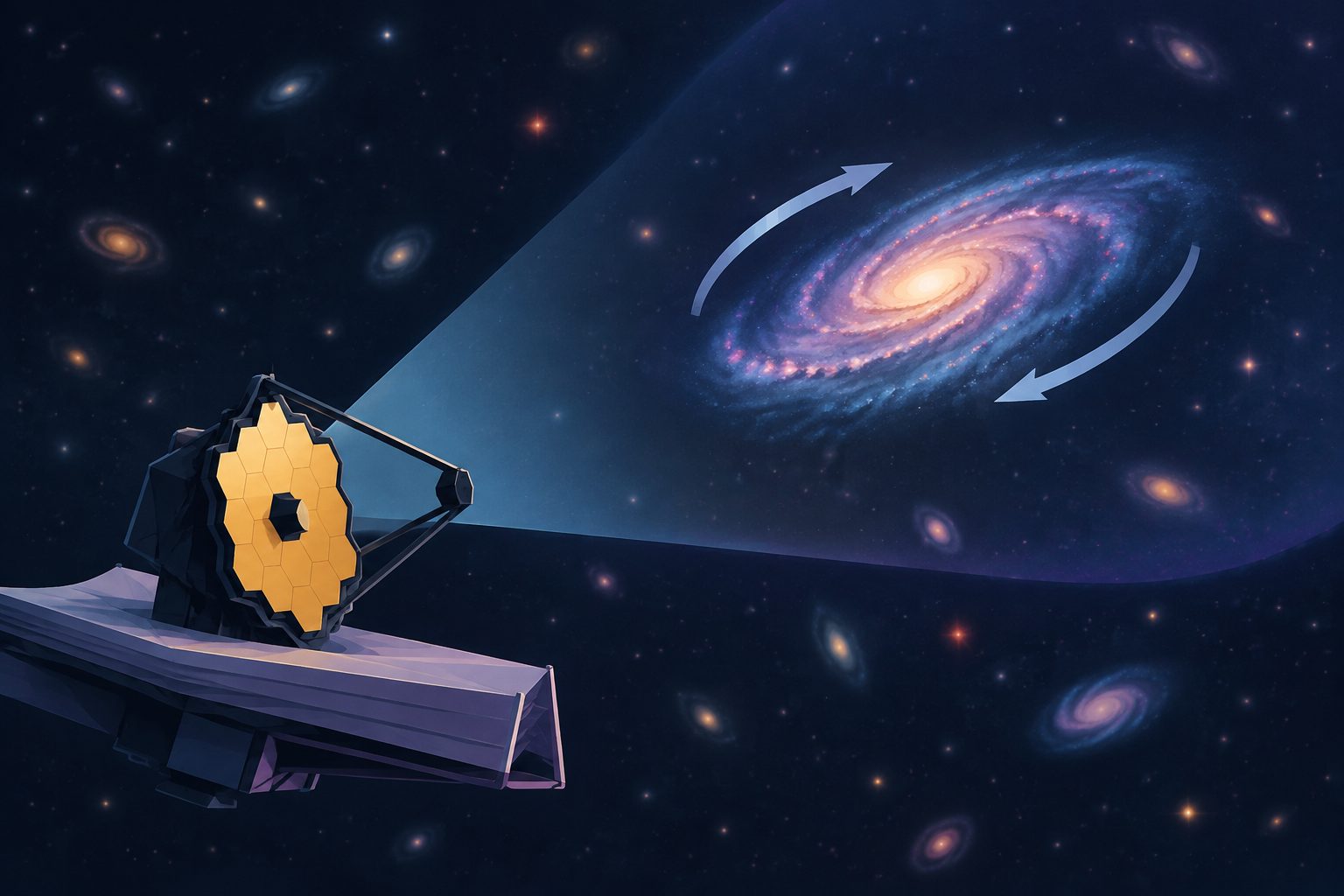
Editorial illustration — not from the study.
Researchers used the James Webb Space Telescope’s near-infrared spectrograph to study DLA0817g1, a galaxy at redshift 4.2603, and combined those data with earlier observations from the Atacama Large Millimeter/submillimeter Array. The two data sets trace different forms of gas, allowing the team to compare the galaxy’s structure and motion across its interstellar medium.
The galaxy’s ionized hydrogen and carbon-bearing gas show nearly identical rotation. Its gas has a metallicity of about 0.8 times the Sun’s, while line ratios indicate relatively low ionization and a large fraction of star formation hidden by dust. The researchers interpret the galaxy as a post-burst system that is currently forming stars at a more ordinary main-sequence rate.
An orderly early disk
DLA0817g1 is at redshift 4.2603, placing it in the early universe. Modeling of hydrogen-alpha and carbon-ion emission found nearly identical rotational motion in the two gas phases, although the hydrogen-alpha gas has a higher velocity spread. The measured gas-phase metallicity is 0.8 ± 0.2 times the solar value, high for this redshift. The observations also indicate a high fraction of dust-obscured star formation and a relatively low level of ionization compared with other high-redshift galaxies observed with the James Webb Space Telescope. The data show no significant evidence for an active galactic nucleus, although that result is not proof that one is absent.
Using the metallicity estimate with earlier carbon-ion and carbon-monoxide measurements, the researchers estimated a molecular-gas mass of about 20% of the galaxy’s dynamical mass. They suggest that past high star formation enriched the gas and contributed to substantial dust, while the galaxy’s current activity is lower and does not show signs of a present starburst.
Why this galaxy matters
Few galaxies beyond redshift 4 have been confirmed to contain such orderly rotating gas disks. DLA0817g1 therefore provides a detailed example of how gas, chemical enrichment, dust, star formation and organized motion could coexist less than 1.5 billion years after the beginning of the universe.
The revised molecular-gas estimate also leaves room in the galaxy’s mass budget for a substantial stellar component and a dark-matter halo, rather than having the molecular gas account for most of the dynamical mass. The result helps researchers study an early disk galaxy across multiple phases of its interstellar medium.
Evidence and caveats
The study is based on new James Webb Space Telescope near-infrared integral-field observations combined with archival Atacama Large Millimeter/submillimeter Array data. The researchers used emission-line ratios to estimate gas conditions and metallicity, and three-dimensional dynamical modeling to compare rotation traced by hydrogen-alpha and carbon-ion emission.
This is a detailed study of one galaxy, so it cannot establish how common ordered disks were at this time. The active-galactic-nucleus conclusion is limited to a lack of significant evidence in the available diagnostics, not proof that no such nucleus exists. The molecular-gas mass is an estimate based on metallicity-dependent conversion factors. The researchers also describe the post-burst, main-sequence interpretation as a synthesis of the evidence, and note that properties such as the stellar mass and any possible active nucleus require further study.
// Source
Monthly Notices of the Royal Astronomical Society · 2026 · DOI: 10.1093/mnras/stag2229
Researchers used machine learning to design germanium structures with localized silicon features that could improve quantum-dot spin qubit performance. The proposed structures increased spin–orbit interaction by up to three orders of magnitude and produced quality factors up to 100 times higher than those of current materials in the study’s calculations.
Researchers developed AgentRivet, an automated system that reads particle-physics publications and writes Rivet routines for recreating their analyses in code. Tests on two recent measurements found few syntax errors, although the accuracy of the physics implementation varied between tasks and language models.
Researchers have built a perovskite circuit that combines polariton lasing, amplification and nonlinear phase control on one chip. The device operates at room temperature and uses integrated gratings to guide and control light.