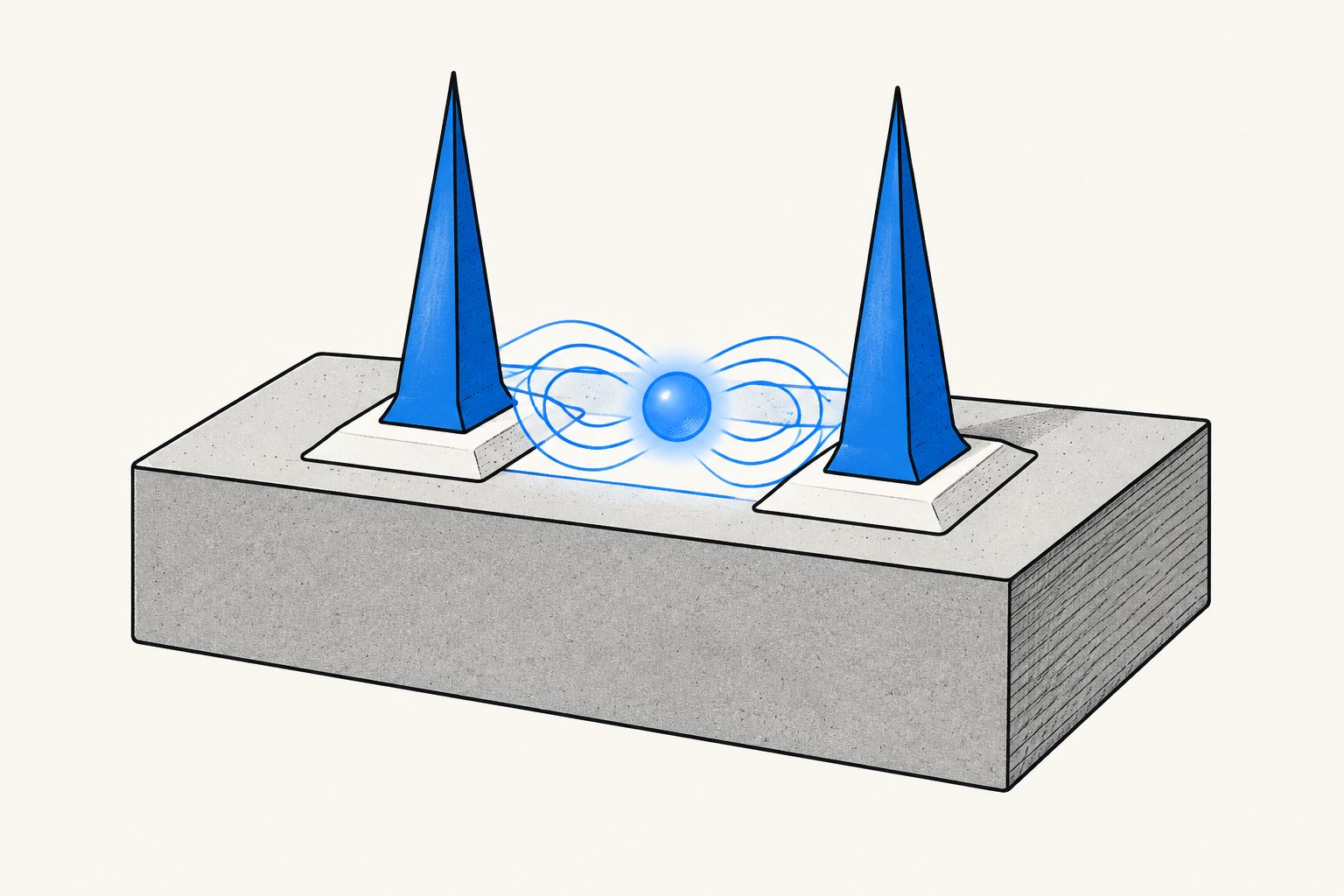
Computer-designed changes to germanium structures greatly increased spin–orbit interaction in simulations.
The study examines germanium quantum wells, which can host spin qubits and connect with superconducting components but have relatively weak spin–orbit interaction in leading designs. The researchers proposed adding localized, strained silicon features to otherwise unstrained germanium channels: either a smooth silicon bump or two sharper silicon spikes.
They used multi-objective Bayesian optimization, a machine-learning approach for searching many possible designs, to choose silicon concentration profiles that increased spin–orbit interaction while remaining compatible with current growth methods and tolerant of realistic growth variations. In simulations, the spikes increased spin–orbit interaction by about 15 times relative to unstrained germanium and by three orders of magnitude relative to the state-of-the-art strained germanium structures described in the study. The optimized designs also produced up to two orders of magnitude higher quantum-dot spin qubit quality factors and GHz-scale spin splittings for hybrid superconducting Andreev spin qubits.
What the silicon features do
The researchers found that localized silicon features can substantially increase spin–orbit interaction in unstrained germanium channels. Their optimized smooth silicon bump increased this interaction by about two times, while two sharp silicon spikes increased it by about 15 times compared with unstrained germanium. The resulting spin–orbit interaction was up to three orders of magnitude larger than in the strained germanium structures described as state of the art.
In the study’s simulations, the engineered structures produced quantum-dot spin qubit quality factors up to two orders of magnitude higher than those of state-of-the-art materials. The researchers also predicted spin splittings in the GHz range for hybrid superconducting Andreev spin qubits.
Why stronger spin control matters
Spin–orbit interaction allows electrical control of spin, which is important for manipulating spin qubits. The proposed silicon concentration profiles offer a way to strengthen that interaction without relying on more complex device designs for fast control.
The designs were optimized with current epitaxial growth processes and tested for robustness against realistic variations in growth parameters, according to the study. If these structures perform as predicted, they could support the development of scalable quantum and spintronic devices, including both semiconductor spin qubits and hybrid devices connected to superconductors.
Evidence and open tests
The findings come from six-band quantum-mechanical modeling and computer simulations combined with multi-objective Bayesian optimization. The algorithm searched possible silicon concentration profiles for designs that simultaneously improved the target properties, and the study compared the predicted performance with existing germanium heterostructure designs.
The provided material describes proposed structures and simulated results; it does not report experimental fabrication or measurements of the optimized devices. The reported quality-factor improvements and GHz-scale spin splittings are therefore predictions that will need to be tested in working heterostructures and qubits.
// Source
Physical Review Applied · 2026 · DOI: 10.1103/r1v9-mff5
Authors: Patrick Del Vecchio, Kevin Rossi, Giordano Scappucci, Stefano Bosco