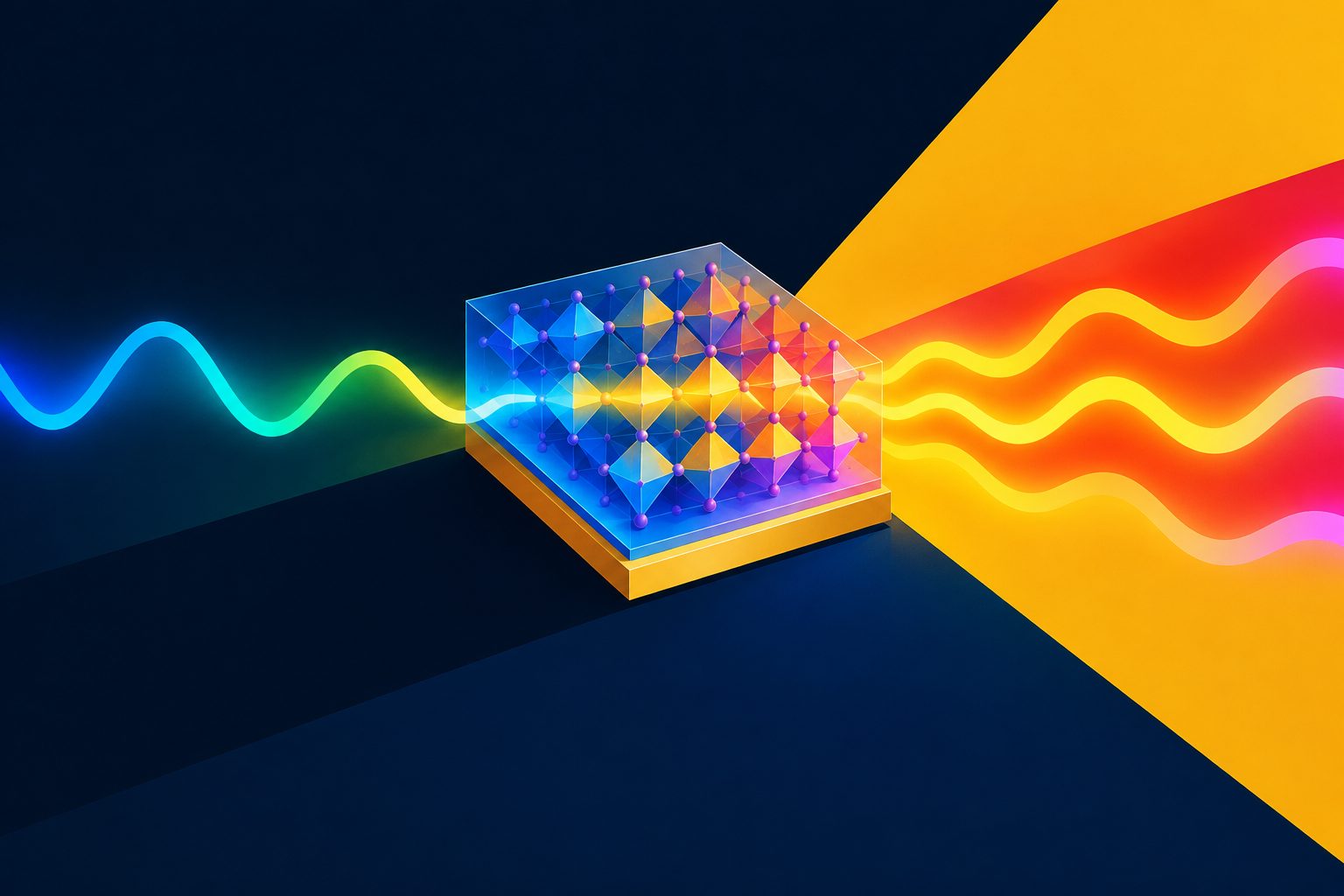
The single-step-grown circuit combines a light source, signal amplifier and nonlinear control of light’s phase at room temperature.
The circuit was made in a single fabrication step, with waveguides and gratings formed in the active perovskite material. The gratings serve as both light couplers and reflectors, creating in-plane cavities that support coherent polariton lasing at a geometry-defined wavelength.
The same architecture also amplified guided polariton signals by nearly two orders of magnitude and produced phase shifts greater than π. In an integrated Mach–Zehnder interferometer, the researchers used this phase control to convert changes in phase into changes in light intensity.
What the chip can do
The researchers demonstrated a room-temperature perovskite polariton circuit with three functions in one on-chip architecture: coherent in-plane polariton lasing, amplification of guided polariton signals and nonlinear control of the light’s phase. The gratings built into the circuit act as couplers and reflectors, forming in-plane Fabry–Pérot cavities and selecting the lasing wavelength through the device geometry.
Guided polariton signals were amplified by nearly two orders of magnitude. The circuit also produced nonlinear phase shifts exceeding π, and the researchers used this effect in an integrated Mach–Zehnder interferometer to turn phase modulation into intensity modulation.
Why one circuit matters
Integrated optical circuits need compact ways to generate, amplify and manipulate light. Combining these functions in one perovskite-based architecture could support active and interferometric circuits that process optical signals without relying on separate components for each task.
The reported fabrication method uses surface-tension-guided assembly and microfluidics to make active waveguides and grating couplers in a single step. The researchers describe this as a potentially scalable and cost-effective route to more complex polaritonic circuits, while the demonstrated room-temperature operation avoids the cryogenic conditions used in some earlier polariton phase-control work described in the paper.
Evidence and open questions
This is a journal article reporting device fabrication and optical demonstrations, including lasing, signal amplification, phase shifts exceeding π and operation of an integrated interferometer. The provided abstract and excerpts do not give detailed measurement conditions, long-term stability data, fabrication yield or results from larger circuit networks. They also demonstrate the component functions in the reported architecture rather than showing a finished information-processing system in practical use.
// Source
Nature · 2026 · DOI: 10.1038/s41586-026-11299-5
Authors: Antonio Fieramosca, Vincenzo Ardizzone, Rosanna Mastria, Eugenio Maggiolini, Laura Polimeno, Umberto Dellasette, A. Notargiacomo, Marialilia Pea, Raffaella Polito, Rughianah Gohar Ashfaq, Fabio Bruni, Elisa Fardelli, Simona Sennato, Francesco Todisco, Dario Gerace, Milena De Giorgi, Dario Ballarini, Lorenzo Dominici, Ilenia Viola, D. Sanvitto