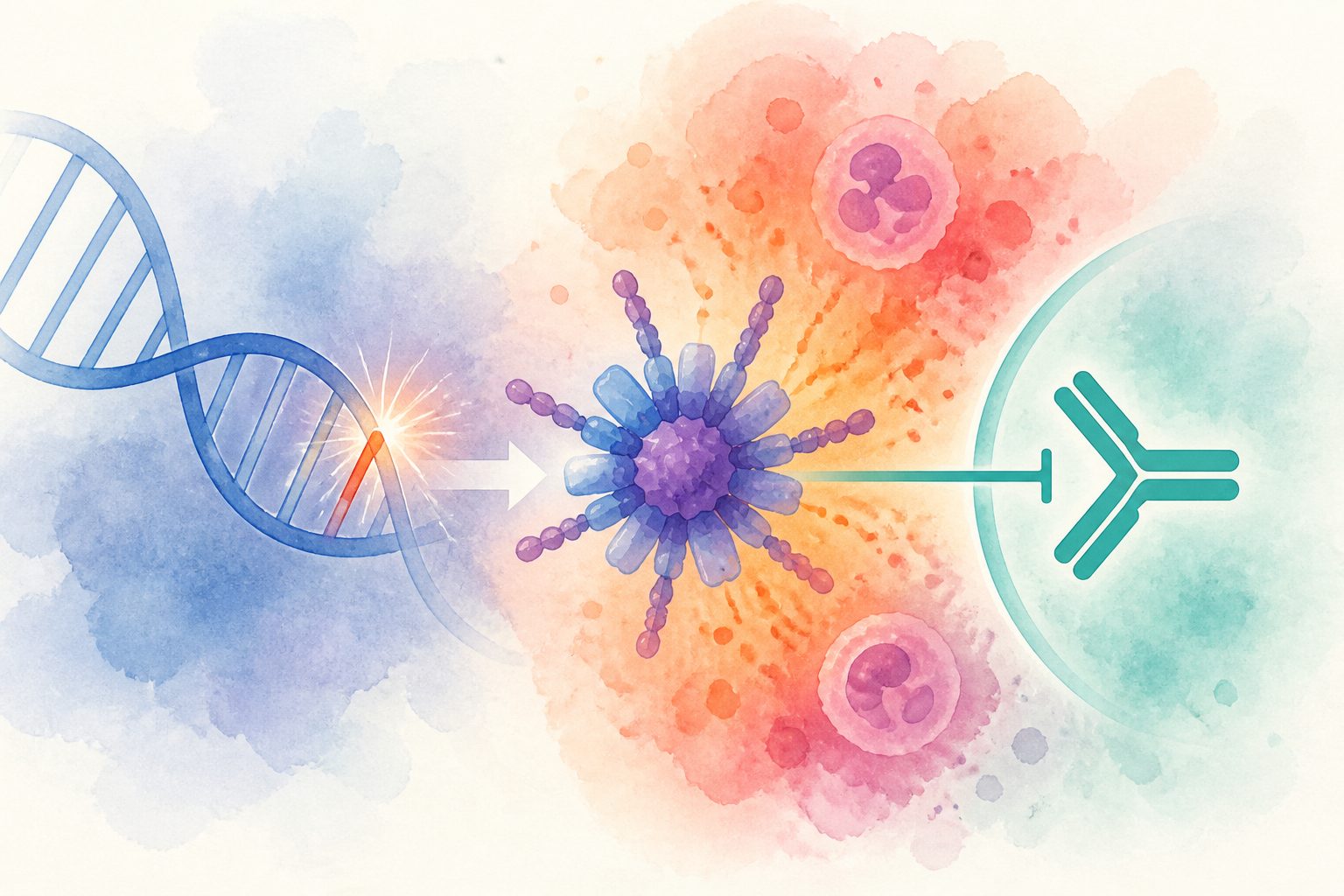
Experiments suggest the altered protein starts inflammation by binding to pyrin and activating an immune complex.
Researchers identified a previously unrecognized inflammatory condition linked to a change in the CDC42 gene, called M45L. The change promoted activation of pyrin, a protein complex involved in inflammation, and affected individuals had very high levels of the immune signal interleukin-18 in their blood.
Laboratory experiments and structural models suggested that the altered CDC42 protein binds more strongly to pyrin, helping start the inflammatory process. Blocking the inflammation-related signal interleukin-1 was therapeutically effective when tested in people with this CDC42-related condition.
How the gene change acts
The researchers identified the CDC42 M45L variant as the cause of a previously unrecognized autoinflammatory condition and confirmed its disease-causing activity by showing that it promotes activation of the pyrin inflammasome, an immune protein complex that drives inflammation. All affected individuals had highly elevated circulating interleukin-18.
Protein-interaction experiments showed that CDC42 binds to two parts of pyrin: the PYD and B30.2 domains. The M45L variant greatly increased the interaction with the B30.2 domain. Structural models placed CDC42 methionine-45 in a hydrophobic pocket of B30.2, and replacing it with a negatively charged amino acid prevented CDC42 and pyrin from colocalizing.
Together, the results support a model in which CDC42 first gathers pyrin through the B30.2 domain. Once enough of this interaction occurs, the PYD becomes available to activate the pyrin inflammasome. Blocking the inflammasome-associated cytokine interleukin-1 was therapeutically effective when tested against this CDC42 M45L condition.
// Source
Science Immunology · 2026 · DOI: 10.1126/sciimmunol.adz8733
View paper (DOI)Published 2026-08-07 Authors: Shouya Feng, Thomas Reygaerts, Klara Kong, Matthew C Wierzbowski, Dhanya Lakshmi Narayanan, Paul J. Baker, Imogen Bishop, Maria Zyulina, Katherine Rosevear, Madeline L. Cleveland, Tim Hewitt, T. Daniel Andrews, Davide Randazzo, Peter Steinbach, Jae Jin Chae, Hyeonji Kim, Daniel L. Kastner, William D Renton, Samar Ojaimi, Wonyong Lee, Seth L. Masters
Institutions: The University of Melbourne, Monash University, Australian National University, University of Bonn, Monash Health, Royal Children's Hospital, National Institutes of Health, Hudson Institute of Medical Research, Walter and Eliza Hall Institute of Medical Research, Hallym University, National Institute of Arthritis and Musculoskeletal and Skin Diseases, National Institute of Allergy and Infectious Diseases, National Human Genome Research Institute, Institute for Basic Science, Monash Children’s Hospital