Experiments in human neural cells point to ZFX as a regulator that could buffer the effects of some autism-linked gene changes.
Autism is linked to changes in hundreds of genes, but it has been unclear how such diverse disruptions can lead to shared features. In experiments using human neural progenitor cells, researchers separately perturbed 18 autism-linked genes and found common changes in gene expression, including reduced activity in many other autism-linked genes.
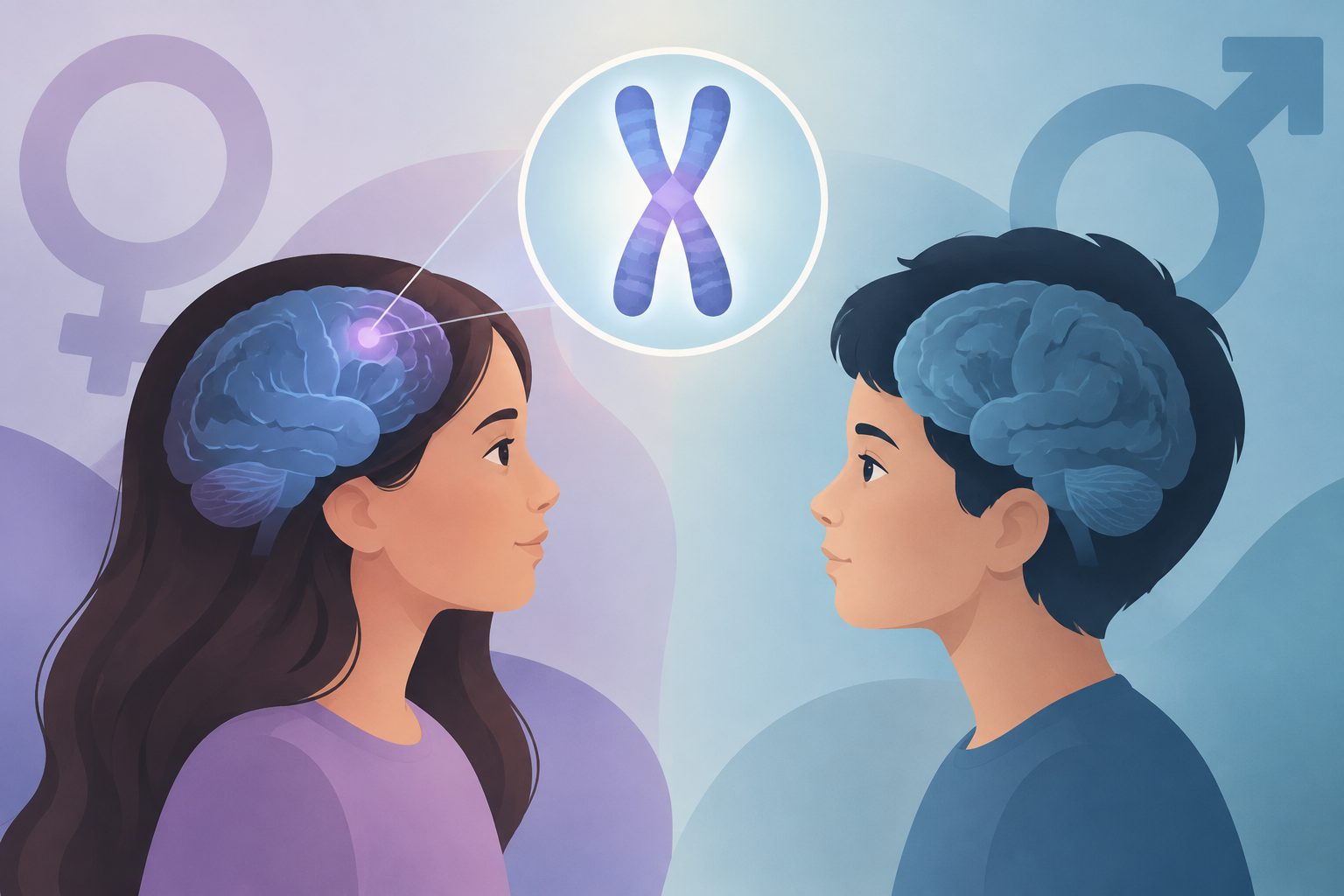
The team reconstructed a network of gene regulation to identify genes that may coordinate these effects. Alongside the known autism-associated regulator CHD8, the analysis highlighted REST and the X-linked transcription factor ZFX. Because ZFX is active from both X chromosomes in females and is more highly expressed in female brain tissue, the researchers propose that it may help buffer harmful changes in other autism-linked genes.
Shared gene changes
Perturbing each of 18 autism-linked genes in human neural progenitor cells led to shared changes in gene activity. These included widespread downregulation, or reduced activity, of other autism-linked genes.
A reconstructed gene-regulation network identified central regulators involved in this convergence. CHD8, an established autism-associated gene, and REST emerged as regulators, while ZFX appeared to activate many autism-linked genes. ZFX is expressed from both the active and inactive X chromosomes in females, and its higher expression in female brain tissue led the researchers to propose that it could help buffer damaging mutations in diverse autism-linked genes. This may contribute to the female protective effect, in which autism is three- to four-fold more common in males and autistic females tend to carry more autosomal risk alleles than autistic males.
A possible sex difference
The findings offer a possible molecular explanation for why females may be less vulnerable to some autism-linked genetic changes. They also suggest that disruptions in many different genes may converge on a smaller set of gene-regulation pathways, including pathways involving ZFX, CHD8 and REST.
If the proposed role of ZFX is confirmed, it could help clarify how sex-related differences in gene activity shape autism risk. The study does not, by itself, establish that ZFX prevents autism or determine how the proposed mechanism affects people.
Evidence and caveats
The evidence comes from experiments in human neural progenitor cells, combined with analysis of gene-regulation networks and comparisons with brain gene-expression data. The researchers directly observed shared gene-expression changes after perturbing 18 autism-linked genes, but the role of ZFX in buffering those changes is presented as a proposal based on the results.
The abstract does not report a direct test of whether changing ZFX alters autism-related traits in people or in a living nervous system. Neural progenitor cells also represent only one laboratory model of human brain development, so the findings do not by themselves establish how broadly the mechanism applies to autism.
// Source
Nature · 2026 · DOI: 10.1038/s41586-026-11236-6
Authors: Rebecca Andersen, Maya Talukdar, David Exposito-Alonso, Janet H. T. Song, Xuyu Qian, Seungil Lee, Ryan Nicholas Delgado, Sijing Zhao, Gwenyth C. Eichfeld, David C. Page, Christopher A. Walsh
Institutions: Colgate University, Harvard University, Massachusetts Institute of Technology, University of California, Berkeley, Whitehead Institute for Biomedical Research, Broad Institute, Boston Children's Hospital, Howard Hughes Medical Institute, University of Massachusetts Boston, Manton Center for Orphan Disease Research