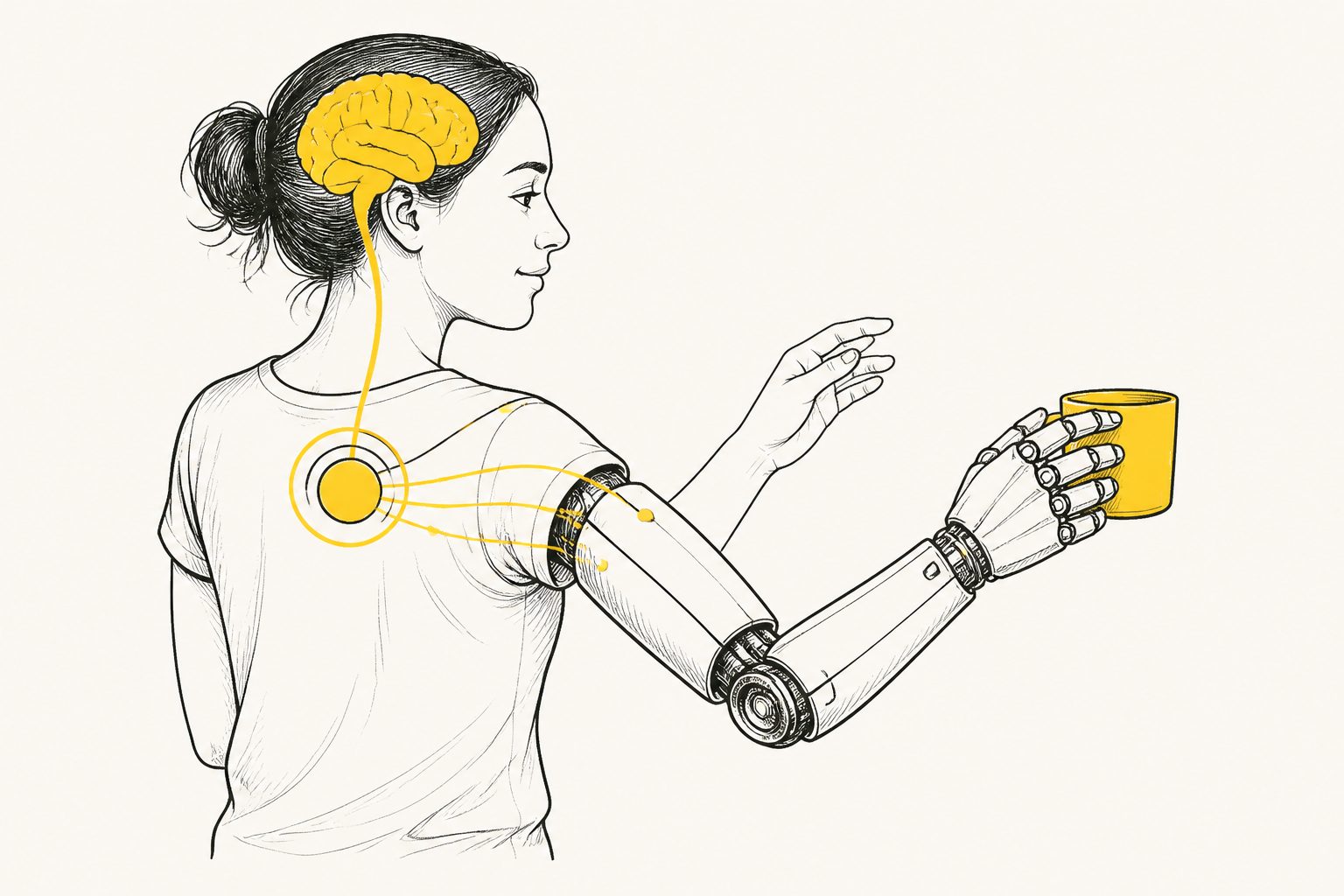
Simulations suggest that robotic limbs could share tasks with a person while adapting to changing plans, loads and movement speeds.
The proposed system uses several layers to infer a person’s goal, account for safety and the surroundings, plan movements, provide sensory feedback and control physical interaction. Its central mechanism combines autonomous robotic behavior with direct human commands, allowing the system to adjust how much work each agent contributes.
In simulations of a person and robotic limbs moving an object together, the controller remained stable across a wide range of movement durations, loads, prediction errors and disagreements between planned motions. Adjusting the robotic limbs’ resistance to movement in a human-like way reduced competition and helped the system converge on a shared action.
How the limbs share work
The researchers developed a hierarchical control architecture for supernumerary robotic limbs—robotic appendages intended to add movement capabilities beyond a person’s natural limbs. Its central mechanism, called General Voluntary Control, combines autonomous robotic actions with direct human commands. It represents the person and the robotic limbs as agents that share motion plans and divide the task according to two factors: trust in the person’s plan and how much effort each agent should contribute.
In simulations of co-manipulating an object, the controller remained stable across varied movement durations, loads, prediction errors and differences between the person’s and robot’s planned motions. It shared effort appropriately and maintained low tracking error. Human-like adjustment of the robots’ resistance to movement reduced competition and improved convergence.
Why shared control matters
Extra robotic limbs could be useful when a task requires more simultaneous movements than a person’s natural limbs can provide. A controller that combines human commands with autonomous planning could support coordination in industrial, assistive and surgical settings, where the robotic limbs may need to adapt rather than follow a fixed sequence.
The work also identifies two controls—trust in the person’s plan and effort sharing—that could help determine how authority and physical work are divided between a person and robotic limbs.
// Source
The International Journal of Robotics Research · 2026 · DOI: 10.1177/02783649261485494
Authors: Dorian Verdel, Jonathan Eden, Héctor Cervantes-Culebro, Carsten Mehring, Mattia Pinardi, Giovanni Di Pino, Philippe Souères, Etienne Burdet
Institutions: Imperial College London, The University of Melbourne, Centre National de la Recherche Scientifique, University of Freiburg, Bernstein Center for Computational Neuroscience Freiburg, Università Campus Bio-Medico, Université Fédérale de Toulouse Midi-Pyrénées, Laboratoire d'Analyse et d'Architecture des Systèmes