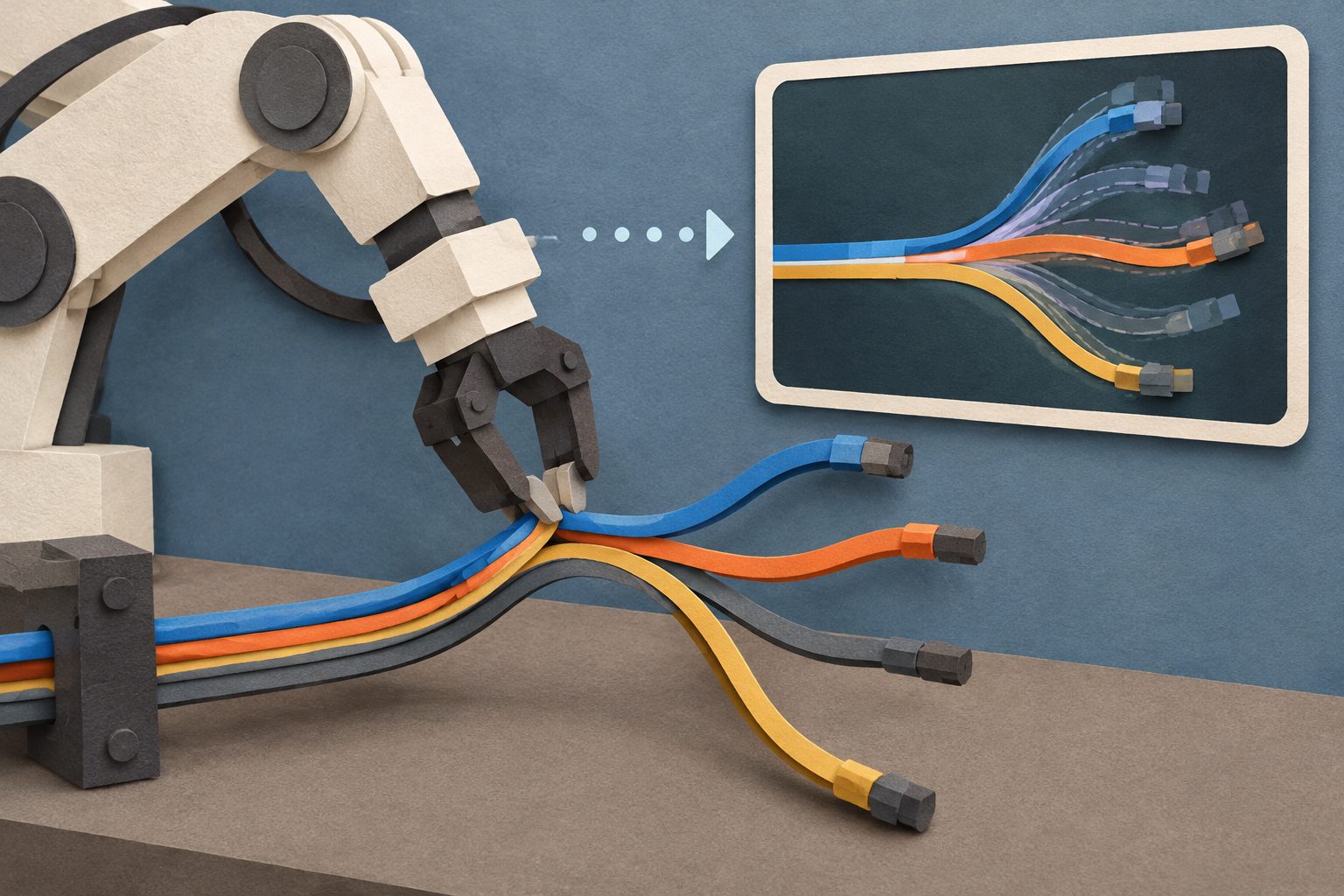
Tests suggest the system could help robots match cable shapes and guide branches into insertion points.
Branching cables are difficult for robots to handle because movement at a junction can link bending, twisting and stretching across several branches. The new system combines a physics-based simulation with machine learning to represent those connections and correct errors that build up during longer predictions.
Across six cable assemblies with different structures and material properties, the same model design was used without being redesigned for each assembly, although its physical and learned parameters were fitted separately. The system was tested in shape matching and in guiding parent and child branches into insertion points.
How well the cable model worked
Over five-second recursive predictions made without repeatedly correcting the model with new observations, the system had root-mean-square errors of 0.93 to 2.14 centimetres across the six tested cable assemblies. It ran at more than 100 hertz, meaning it produced more than 100 updates per second, and outperformed the physics-based and learning-based comparison methods.
In real-world planning tests, it succeeded in 36 of 40 shape-matching trials, 40 of 40 parent-branch insertion trials and 16 of 20 child-branch insertion trials. The researchers also applied the same model formulation and residual graph-neural-network design across all six assemblies without redesigning them for each cable, while fitting physical and learned parameters separately for each one.
Why faster cable predictions matter
Robots need fast predictions of a deformable cable’s future shape to plan movements, particularly when they grasp a branch or a cable junction. By representing how motion is transmitted between branches while also correcting prediction errors, this system combines physical modeling with learning in a form that the experiments show can be used for real-time planning.
The results point to a possible route toward more automated wire-harness manipulation, including matching a cable to a target shape and inserting either a main branch or a side branch. The study demonstrates these capabilities in the tested setups; it does not establish that the system can handle all cable designs or assembly environments.
Evidence and remaining limits
The evidence comes from experiments on six physical branching cable assemblies with different topologies and material properties, comparisons with existing physics-based and learning-based methods, and real-world manipulation trials. The reported prediction errors and success rates apply to those evaluated assemblies and tasks.
The researchers identify remaining limits in computational scalability, sensitivity and robustness, and applicability across different cable materials and geometries. Computation time increases as more branches and cable vertices are added, partly because the model’s junction constraints take more iterations to enforce. The physical and learned parameters were also fitted separately for each tested cable, so the results show reuse of the formulation rather than a single parameter set working across all cables.
// Source
The International Journal of Robotics Research · 2026 · DOI: 10.1177/02783649261503499
Authors: Yizhou Chen, Felicia Sang, Shicheng Peng, Xiaoyue Wu, Yeheng Zong, Yuzhen Chen, Anran Li, Bohao Zhang, Ram Vasudevan
Institutions: University of Michigan