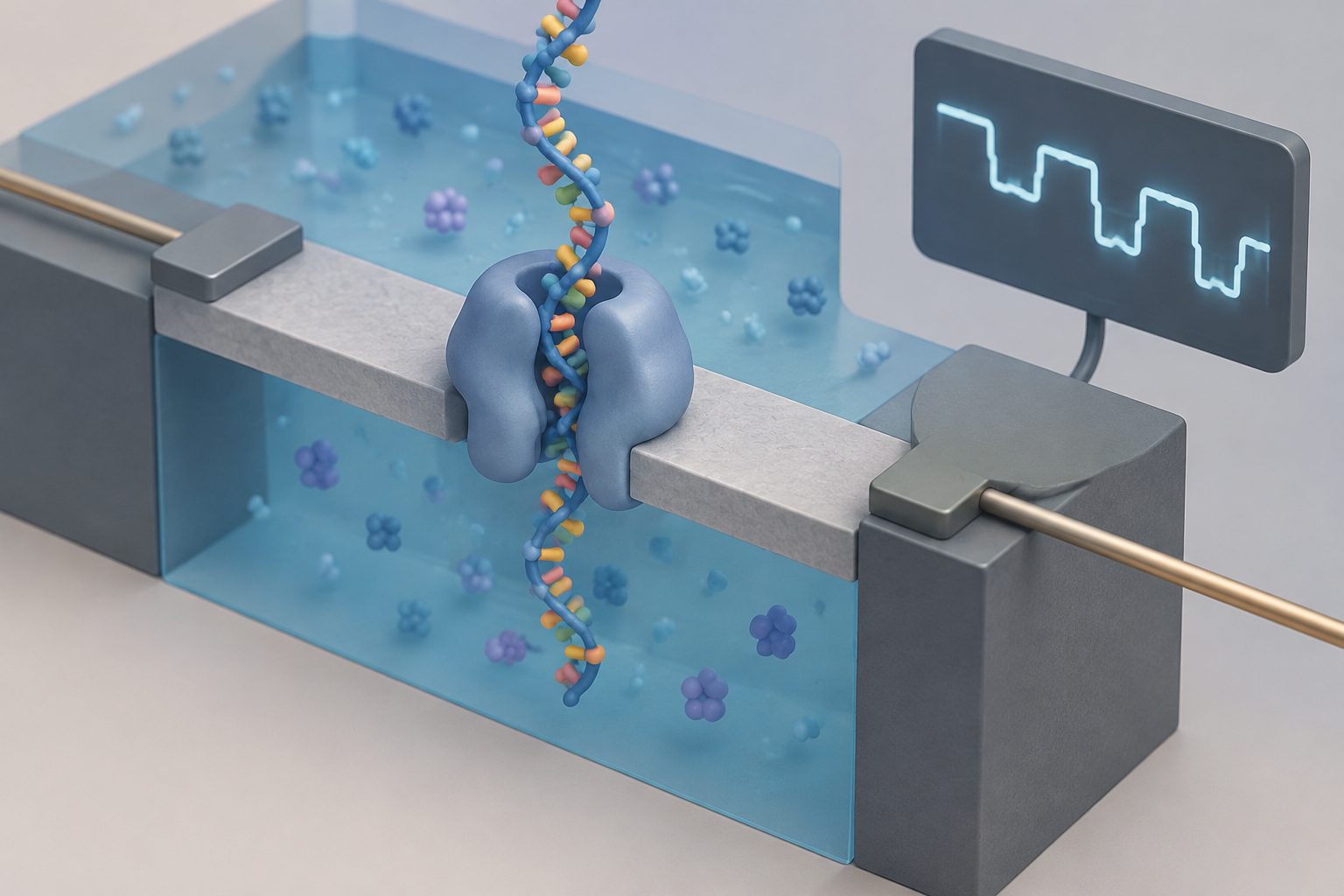
The model accounts for a molecule’s shape and position, including when it sits away from the pore’s center.
Resistive-pulse sensing identifies or counts particles by measuring the drop in ionic current when an object blocks part of a fluid-filled channel. Existing approaches work best when most of the electrical resistance comes from inside a long pore, but ultrathin membranes can also have important resistance in the regions outside the pore, where molecules may partly or entirely sit.
The researchers modeled these outside, or access, regions by dividing them into thin oblate-spheroidal slices and estimating how insulating objects change their conductance. Simulations indicated that the model reproduced blocked-state conductance for two-dimensional and finite-length pores, simple and complex objects, and different positions. They also created a web app that predicts electrical signatures for a range of molecule geometries and pore shapes.
How molecule position changes signals
The model estimates how an insulating object changes conductance in the regions outside a nanopore as well as inside it. According to the study, it accurately estimated blocked-state conductance for two-dimensional and finite-length pores when simple or complex objects were placed at different distances from the pore opening.
It also captured off-axis effects: objects shifted away from the pore’s central axis produced deeper predicted blockages than objects on the axis. The researchers used finite-element electrical simulations to test the model and created a web app for predicting signals from molecules with different shapes moving through differently shaped pores.
A broader way to read nanopore signals
Electrical blockage signals are used to infer the dimensions and properties of molecules passing through nanopores. By including resistance from the regions outside the pore, the model is intended to extend that interpretation to ultrathin membranes and other low-aspect-ratio pores, where those regions cannot be ignored.
The web app gives researchers a way to examine how pore design, molecule shape and molecule position may affect a measured signal before an experiment. The authors say this could help guide future experimental designs and improve the quantitative use of resistive-pulse measurements at the nanoscale.
What the evidence shows
The main evidence comes from finite-element simulations of nanopores and insulating obstructions with specified shapes and positions. The study also compares some model results with experimental data reported in earlier publications, but the excerpts state that these data were either taken from the published text or estimated visually from figures using pixel counts.
The provided material does not describe a new experimental validation across the full range of geometries in the web app. The conclusions therefore primarily concern the model’s performance in simulations and selected comparisons, rather than demonstrating that every predicted molecular signal will occur in a laboratory measurement.
// Source
Physical Review Applied · 2026 · DOI: 10.1103/gqrd-3682
Authors: Martin Charron, Zachary Roelen, Deekshant Wadhwa, Vincent Tabard‐Cossa