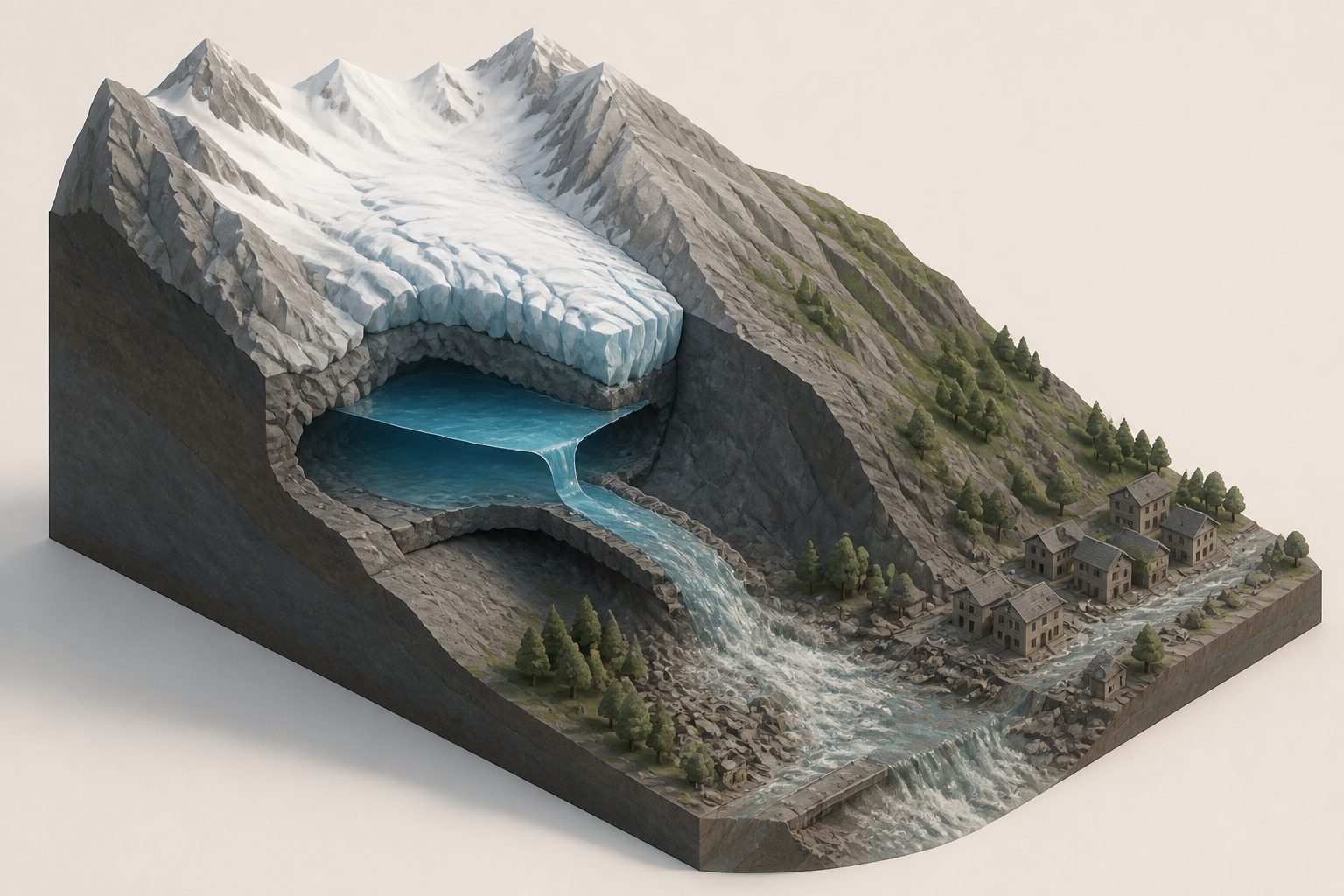
A model suggests the debris-covered Glacier de Bonne Pierre could have stored water below its ice before the damaging flood.
The 20–21 June 2024 flood of the Etançons river was linked to intense rain falling on high-altitude snow and the drainage of a lake on top of Glacier de Bonne Pierre. The new study examines whether additional water might have been stored beneath the glacier in pockets formed by underground hydraulic barriers.
Using the glacier’s surface and bedrock shape, the researchers modelled where water could collect beneath the ice. They estimate that the glacier could theoretically have held water on the order of 10^5 cubic metres, with the largest potential pocket beneath a surface depression that had temporarily contained a lake.
Possible water beneath the glacier
The researchers used a steady-state numerical model to calculate the pressure surface that guides water beneath Glacier de Bonne Pierre. Their results suggest that hydraulic barriers could, in theory, have impounded water volumes on the order of 10^5 cubic metres before the June 2024 flood. The largest modelled pocket was beneath a surface depression that had temporarily hosted a lake on the glacier’s surface.
When the researchers varied uncertainties in the glacier’s surface height, bedrock height and basal water pressure, the spatial pattern of basal water pressure had the largest effect on the estimated pocket volumes. The study does not establish that these pockets were actually present or that they contributed water to the flood.
Model estimates and limits
The study is based on a steady-state numerical calculation using the glacier’s surface and bedrock topography, combined with a stochastic analysis that propagates uncertainties in those measurements and in basal water pressure. There were no direct observations of subglacial water pockets. As a result, the model estimates where water might have been stored and how much could theoretically have accumulated, but it cannot confirm that the pockets existed or determine how much, if any, water entered the 2024 flood.
// Source
Natural hazards and earth system sciences · 2026 · DOI: 10.5194/nhess-26-3901-2026
Authors: Christophe Ogier, Mauro A. Werder, O. Gagliardini, Ilaria Santin, Raphael Moser, Romain Hugonnet, Antoine Blanc, Daniel Farinotti
Institutions: Université Grenoble Alpes, Institut National de Recherche pour l'Agriculture, l'Alimentation et l'Environnement, Centre National de la Recherche Scientifique, ETH Zurich, Institut de Recherche pour le Développement, Institut polytechnique de Grenoble, Swiss Federal Institute for Forest, Snow and Landscape Research, Institut des Géosciences de l'Environnement, University of Alaska Fairbanks, Office National des Forêts