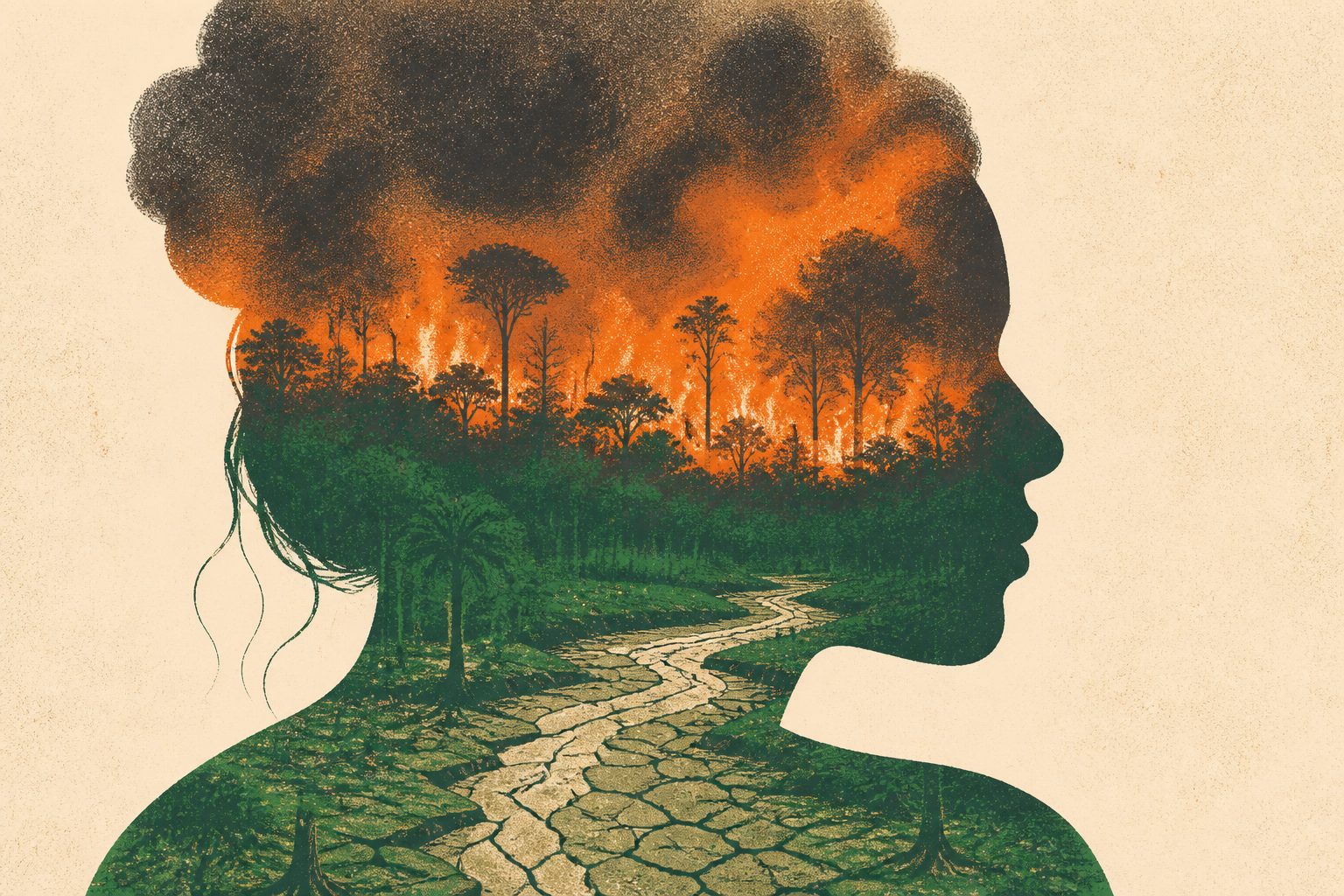
A study estimates that drought years bring larger increases in fire-related fine particles, ozone and premature mortality across the region.
The researchers combined satellite observations of fires with fire-emissions data and an atmospheric chemistry model to examine how droughts and deforestation affected Amazon air quality. They compared simulations with fires included against simulations without fires during the July–November dry season.
In years without drought, fires accounted for about half of regional carbon monoxide and fine-particle pollution and one-third of ozone. During drought years, their estimated contributions rose to 60–80% for carbon monoxide and fine particles and 50% for ozone. Health-risk calculations also indicated larger fire-related increases in premature mortality during drought years.
How drought changed pollution
During non-drought years, biomass burning contributed about 50% of regional carbon monoxide and fine-particle pollution and 33% of ozone during the dry season. During drought years, those contributions increased to 60–80% for carbon monoxide and fine particles and 50% for ozone.
Pollutant levels were significantly correlated with drought intensity. Using an exposure-and-health-risk model, the researchers estimated that fire-related fine-particle exposure was associated with a 6.0% increase in premature mortality in non-drought years and an 8.9% increase in drought years. For ozone, the corresponding estimates were 18.6% and 24.4%. These are modeled estimates of premature mortality, not direct counts of deaths observed in the study.
Evidence and caveats
The study used satellite fire observations, the Global Fire Emissions Database and the GEOS-Chem High Performance atmospheric chemistry model to simulate pollution from 2010 to 2015. It also used the Global Exposure Mortality Model and exposure-response relationships to estimate health effects.
The results are model-based estimates for the six-year study period, rather than direct measurements of premature deaths caused by fires. The abstract reports significant correlations between drought intensity and pollutant levels, but does not establish that every observed association is causal. The abstract also does not provide details on geographic variation, uncertainty ranges or how individual exposure was measured.
// Source
Atmospheric chemistry and physics · 2026 · DOI: 10.5194/acp-26-11835-2026
Authors: Leo T. H. Ng, Jia Mao, Xueying Liu, Shixian Zhai, Dominic Fawcett, Stephen Sitch, Luiz E. O. C. Aragão, Amos P. K. Tai
Institutions: University of Exeter, Chinese University of Hong Kong, Macao Polytechnic University, Swiss Federal Institute for Forest, Snow and Landscape Research, Instituto Nacional de Pesquisas Espaciais, Hong Kong Biotechnology Organization