Trial finds less myopia progression with higher-dose atropine in some children
In children aged 6 to 12 with high myopia, 0.10% atropine was linked with less progression over two years but more reported light sensitivity.
Moderate evidenceHuman studySome caution advised
Medical disclaimer: This article summarizes research findings and is for informational purposes only. It is not medical advice.
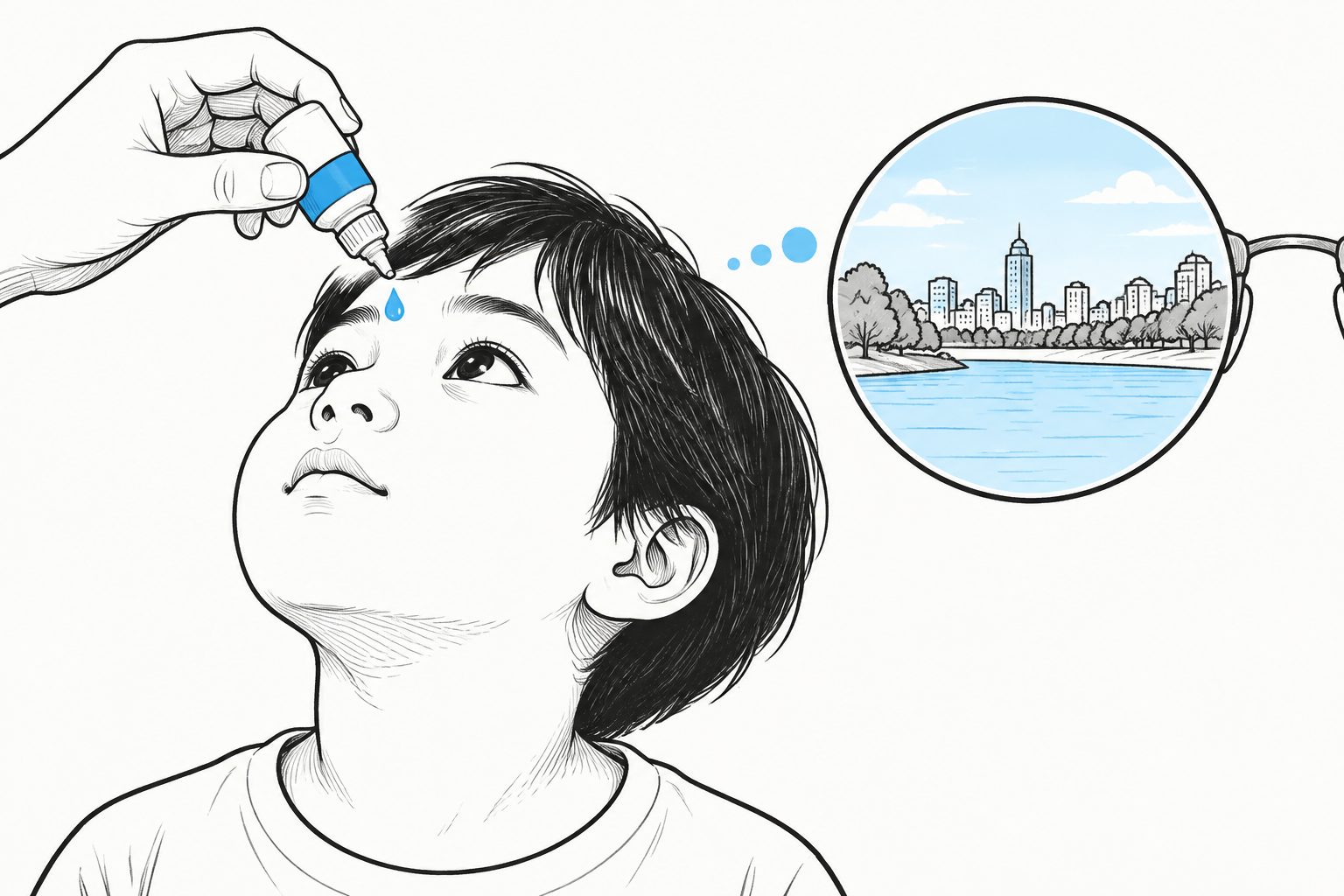
Editorial illustration — not from the study.
Researchers in Shanghai studied 219 children with myopia of at least minus 5.0 diopters. The children were randomly assigned to use 0.01%, 0.04%, or 0.10% atropine eyedrops nightly in both eyes, and neither participants nor study staff knew the assignments during the trial. The study lasted 24 months, although 182 participants completed follow-up.
Average myopia progression after two years was 0.92 diopters in the 0.01% group, 0.78 diopters in the 0.04% group, and 0.56 diopters in the 0.10% group. The difference between 0.10% and 0.01% was statistically significant; the difference between 0.04% and 0.01% was not statistically significant at 24 months. Reported light sensitivity was more common in the 0.10% group.
What was studied
The researchers examined whether different concentrations of atropine eyedrops affected the progression of high myopia and what side effects were reported. This was a multicenter, double-blind, randomized controlled trial at three hospitals in Shanghai. It included 219 children aged 6 to 12 years with myopia of at least minus 5.0 diopters. Participants were randomly assigned to 0.01% atropine (76 children), 0.04% atropine (72), or 0.10% atropine (71), used nightly in both eyes for 24 months. The main outcome was the change in cycloplegic spherical equivalent, a measurement of refractive error after medication temporarily relaxes focusing of the eyes.
Key findings
After 24 months, average myopia progression was minus 0.92 diopters with 0.01% atropine, minus 0.78 diopters with 0.04%, and minus 0.56 diopters with 0.10%. Compared with 0.01%, the 0.10% concentration was associated with 0.35 diopters less progression, with a 95% confidence interval from 0.12 to 0.58 diopters. The 0.04% concentration did not differ significantly from 0.01% at 24 months. At 12 months, both higher concentrations showed statistically significant reductions compared with 0.01%, of 0.16 and 0.30 diopters for 0.04% and 0.10%, respectively. Photophobia, or increased sensitivity to light, was the most commonly reported adverse event: at 24 months it was reported by 7.8% of the 0.01% group, 8.1% of the 0.04% group, and 21.1% of the 0.10% group. These results show differences between the randomized groups; they do not establish that every child would have the same response or side effects.
Who this is relevant to
The findings may be relevant to children aged 6 to 12 with high myopia similar to the participants in this Shanghai trial. They should not automatically be applied to children younger or older than this age range, children with less severe myopia, adults, or people with different eye conditions. The study also does not provide evidence about outcomes beyond two years or about the relative effects of other myopia-control strategies.
Why it matters
High myopia in childhood can be associated with later eye complications, so slowing changes in refractive error is an important research question. This trial provides comparative information about three atropine concentrations in children with substantial myopia and suggests that the highest concentration studied was associated with less progression over two years. The higher rate of reported light sensitivity is relevant when considering the balance of measured effects and side effects. The study does not determine long-term outcomes beyond 24 months, whether the findings apply to children with less severe myopia, or how atropine compares with other myopia-control methods.
Limitations & evidence assessment
The study was relatively small, and 37 of the 219 randomized children did not complete the 24-month follow-up. The abstract says that all 219 randomized cases were analyzed, but it does not explain how missing data were handled or whether loss to follow-up differed between groups. Follow-up lasted two years, so longer-term benefits and risks are unknown. The participants were children aged 6 to 12 with high myopia treated at three hospitals in Shanghai, which may limit how well the findings apply to other ages, levels of myopia, locations, or healthcare settings. The abstract reports photophobia but gives limited information about other adverse events and the full safety assessment.
Why this evidence level: Randomized trial with a smaller detected sample (n≈76).
Evidence levels are editorial estimates derived from study metadata — they are not clinical appraisals.
This systematic review examined randomized human trials of concurrent chemotherapy and radiation for locally advanced head and neck, cervical, esophageal, and non-small-cell lung cancers. Across the included trials, combined treatment was reported to provide better overall survival than radiation alone, but it also caused more severe short-term side effects. The review did not provide enough information in its abstract to show how many trials or patients were included.
Researchers pooled results from seven human studies comparing multiple-staged with single-stage removal and reconstruction of congenital melanocytic nevi, sometimes called congenital moles. Staged surgery was associated with fewer major wound complications and recurrences, as well as slightly shorter and narrower scars, but the studies did not find a clear difference in cosmetic or overall patient satisfaction.
A cluster-randomized human study in 210 adults with recently detected stage 1 hypertension in Uzbekistan compared salt-sensitivity testing followed by assigned medication choices with conventional management. After 12 weeks, more participants in the testing-guided group reached the study's blood pressure target, although the study was small, short, and conducted in only three primary care centers.