Brain scans and an artificial network suggest that people preserve a broad map of social rankings while emphasizing the dimension that matters for the task at hand.
Researchers analyzed functional MRI data from people who learned the relative rankings of 16 faces on competence and popularity. Participants later had to infer rankings they had not been directly taught, switching between the two dimensions according to a context cue.
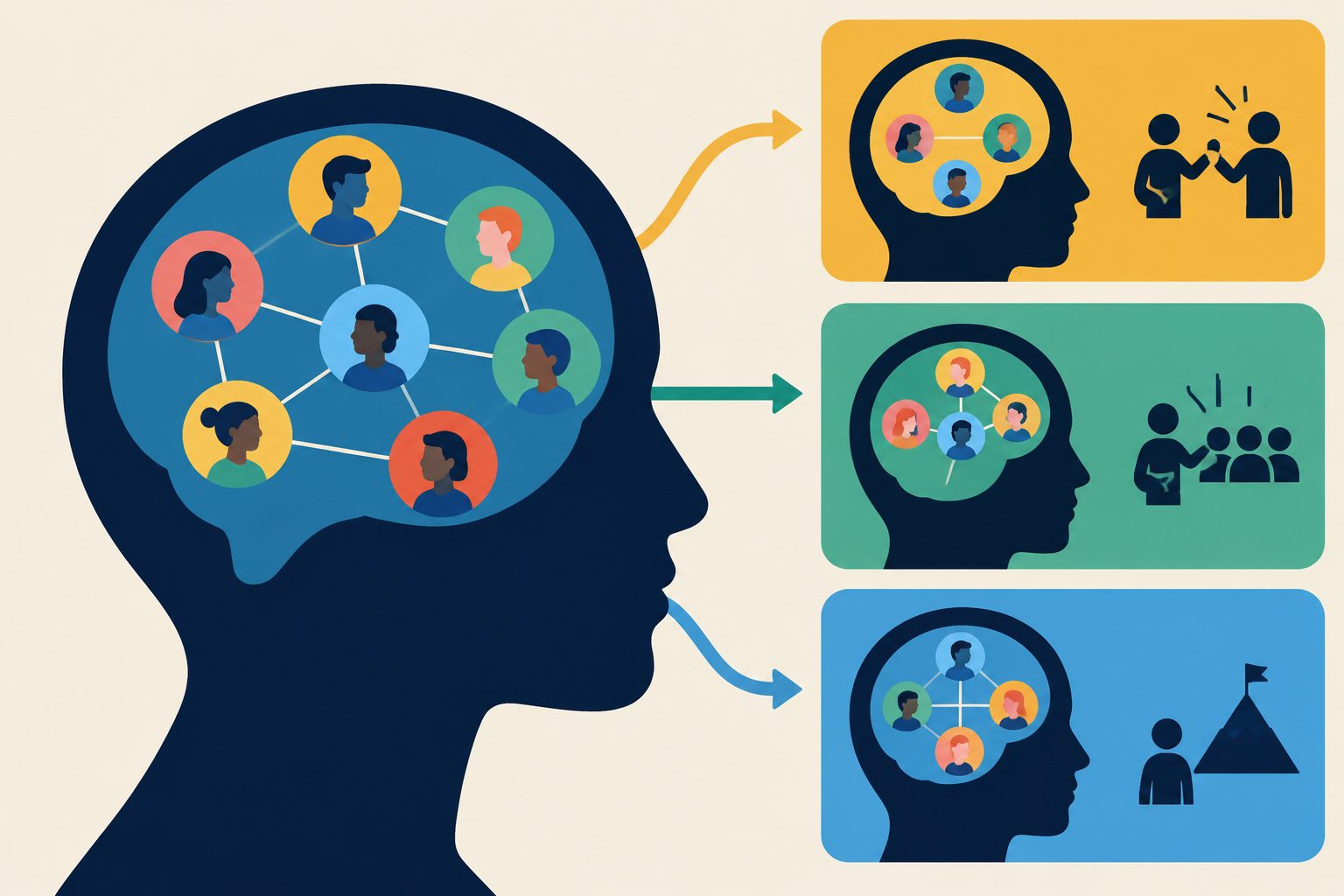
A medial temporal and orbitofrontal network represented both dimensions together in a stable map-like pattern. A frontoparietal network instead formed separate, context-dependent representations that emphasized the relevant dimension. Recurrent neural networks trained on the same task developed similar patterns, with the broad map-like representation appearing earlier in training.
How the brain reshaped the map
The human brain formed a two-dimensional representation of the learned social hierarchy, even though participants were not told that the relationships had this structure or asked to arrange it spatially. Activity in a network including the hippocampus, entorhinal cortex and orbitofrontal or ventromedial prefrontal areas reflected both the task-relevant and task-irrelevant dimensions.
When the task required attention to one dimension, a frontoparietal network represented that dimension while compressing the other. The researchers describe these as complementary forms of organization: a stable map that supports generalization across tasks, and a more selective representation that supports flexible decisions.
When the two dimensions pointed toward conflicting answers, the geometry of participants’ estimated mental maps changed more. The extent of this change was associated with individual differences in cognitive control. Recurrent neural networks trained on the task showed similar representational patterns, with the multidimensional map emerging before the more selective representations.
Evidence and caveats
The study combined functional MRI analyses from 27 analyzed participants with analyses of recurrent neural networks trained on the same task. The human data show relationships between brain activity patterns, task context, conflict and cognitive control; they do not by themselves establish that the identified networks causally produce the changes in mental representations. The network models provide a computational comparison, not a direct model of the human brain.
The participants were young adults aged 19 to 23 and completed an artificial task involving rankings of faces on competence and popularity. Six of the 33 recruited participants were excluded because of head movement or technical failure. The study used previously collected fMRI data, and it was not designed to test sex- or gender-based differences, so the results may not generalize beyond this sample and task.
// Source
Nature Communications · 2026 · DOI: 10.1038/s41467-026-77621-x
Authors: Seongmin A. Park, Maryam Zolfaghar, Jacob Russin, Douglas S. Miller, Randall C. O’Reilly, Erie D. Boorman
Institutions: University of California, Los Angeles, Brown University, Centre National de la Recherche Scientifique, University of California, Davis, Virginia Tech, Institut des Sciences Cognitives