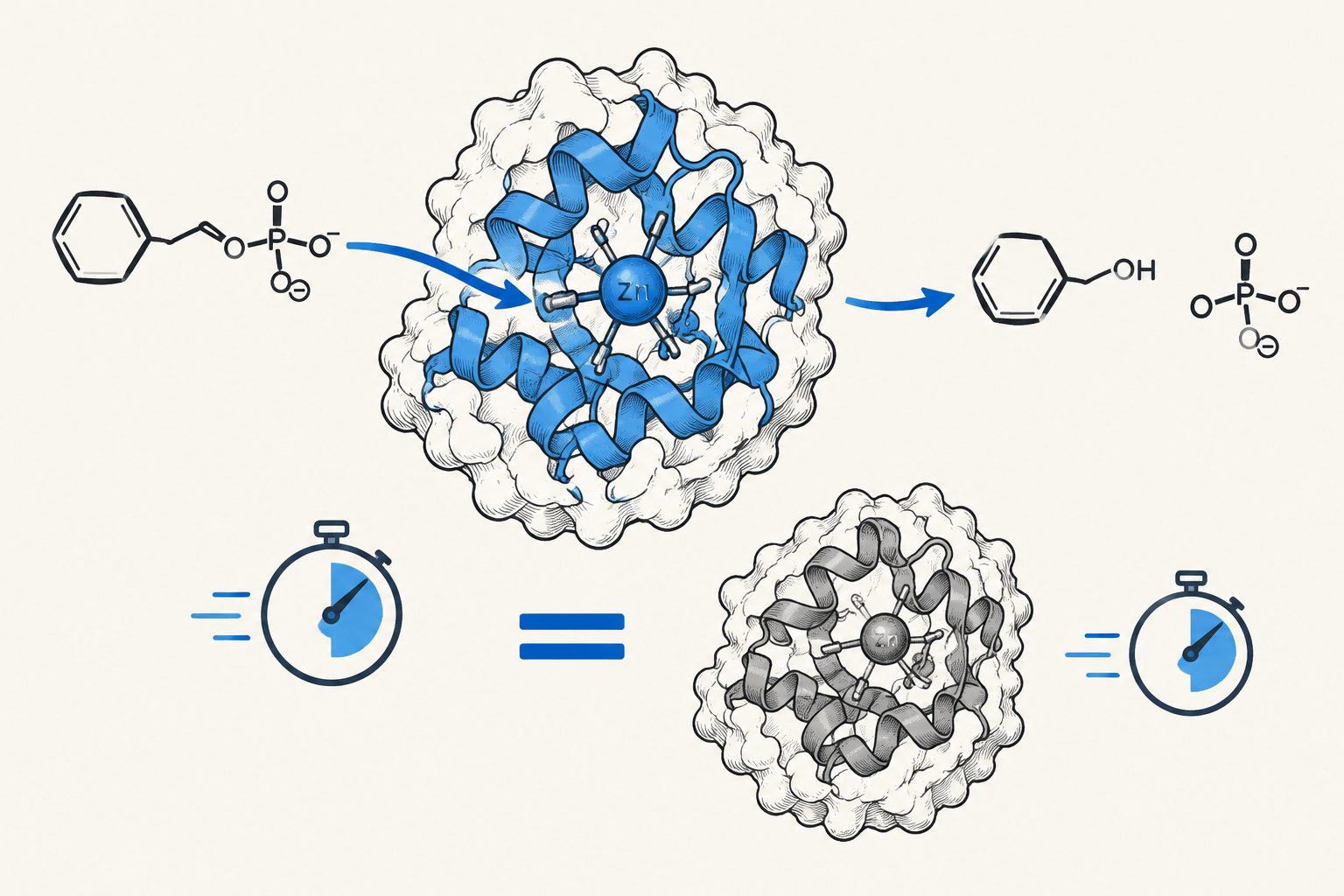
The designed protein uses two zinc atoms to break down two kinds of phosphorus-containing compounds, without copying a natural enzyme.
The researchers developed dEVA, a protein-design system that searches for sequences while balancing several goals, including the arrangement of residues around catalytic metals. They used it in a zero-shot design process, meaning the system did not begin with a natural enzyme structure or a predefined catalytic pattern.
The resulting bi-zinc enzyme had an open active site and acted on two types of phosphorus-containing compounds. Its rate enhancement reached up to 3 × 10^13 relative to the uncatalyzed reactions, a level comparable to characterized natural phosphatases. X-ray crystallography and absorption spectroscopy supported the presence of the designed active site.
What the enzyme does
The researchers produced and characterized a de novo enzyme containing two zinc atoms. It catalyzed the breakdown of both phosphomonoesters and phosphodiesters, showing what the paper describes as promiscuous activity across these two substrate types.
The enzyme’s maximum rate enhancement—defined as its catalytic efficiency relative to the uncatalyzed reaction—was up to 3 × 10^13. The researchers report that this is comparable to characterized natural phosphatases. Structural measurements from X-ray crystallography and absorption spectroscopy supported the proposed, newly designed active site. The design was generated without a natural template, predefined catalytic motif or evolutionary information.
Why a new design route matters
The result shows that a protein with substantial enzyme activity can be designed without restricting the search to structures or catalytic arrangements already found in nature. That expands the range of possible protein designs beyond approaches that copy or preserve known catalytic motifs.
The enzyme is not highly specific: its activity toward two different substrate classes may provide a starting point for later efforts to tune its specificity and catalysis. The work also presents dEVA as a modular way to balance several sequence, structural and chemical design goals at once.
Evidence and caveats
This is a journal article reporting biochemical characterization of a designed enzyme, supported by X-ray crystallography and absorption spectroscopy. The evidence includes measured catalytic activity and structural observations consistent with a de novo active site.
The reported result concerns a single bi-zinc enzyme design, and the abstract does not establish that the method will produce similarly active enzymes for other reactions. The researchers note that dEVA’s success depends on the quality of its training data and on the sensitivity of the models used for its design objectives. The excerpts also describe the enzyme’s broad substrate activity as a possible basis for future engineering, rather than demonstrating that its specificity has already been tailored.
// Source
Science · 2026 · DOI: 10.1126/science.aej3009
Authors: Gina El Nesr, Simon Dürr, Irimpan I. Mathews, Qi Wen Deng, Kewei Zhao, Ritimukta Sarangi, Ursula Röthlisberger, Fanny Sunden, Po‐Ssu Huang
Institutions: University of California, San Francisco, Stanford University, École Polytechnique Fédérale de Lausanne, SLAC National Accelerator Laboratory, Stanford Synchrotron Radiation Lightsource, Gladstone Institutes, HES-SO Valais-Wallis, Institute of Life Sciences, School of Health Sciences - HES-SO Valais-Wallis