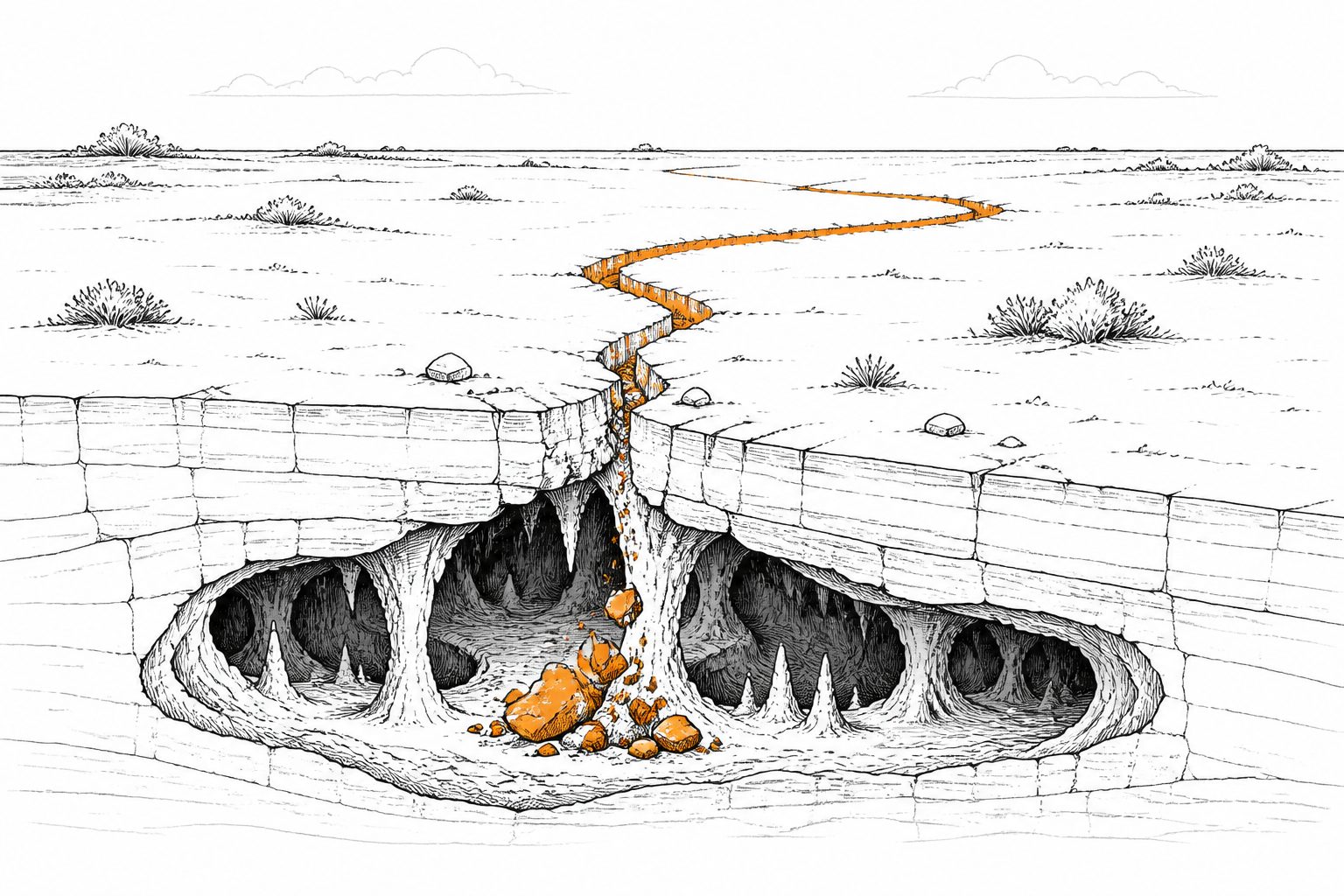
Several kilometre-scale depressions lack signs of rivers and instead align with buried cave systems and collapse features.
The Nullarbor Plain is a long-stable carbonate platform where cave features can be difficult to recognize at the surface. Researchers studied kilometre-scale, sediment-filled trenches using landform measurements, electrical imaging, seismic data, cave records, cliff exposures and sediment analysis.
The trenches had no integrated drainage, downstream sediment transport or sediment evidence of channelized flow. Instead, they coincided with deep low-resistance zones, mapped caves and collapse depressions, and with deformation visible in cliff exposures—evidence that they formed as cave roofs collapsed and the ground above sagged.
What the trenches reveal
The study identified kilometre-scale, shallow, sediment-filled trenches on the Nullarbor Plain as surface expressions of vertically propagated collapse and sagging above deep cave conduits. The depressions lack features expected of river channels, including integrated drainage, downstream sediment transport and sedimentological evidence of channelized flow.
The trenches overlie vertically extensive low-resistivity zones detected by electrical resistivity imaging, align with mapped caves and collapse dolines, and project toward stratal deformation exposed in cliffs. Together, these observations support a connection between the surface trenches and underlying cave systems.
Evidence and limits
The conclusion is based on several independent lines of evidence: landform measurements, electrical resistivity tomography, passive seismic profiling, cave records, cliff exposures and sedimentology. The study focuses on the Nullarbor Plain, a carbonate platform larger than 200,000 square kilometres that has been exposed for more than 14 million years. The abstract supports applying the diagnostic criteria to comparable settings, but it does not establish that every linear depression elsewhere has a cave-collapse origin or describe how well the criteria perform outside this region.
// Source
Communications Earth & Environment · 2026 · DOI: 10.1038/s43247-026-04016-7
Authors: Matej Lipar, Matthias Leopold, John A. Webb, Rok Ciglič, Jure Tičar, Matija Zorn, Uroš Stepišnik, Jelovčan Matej, Milo Barham, Matej Dolenec, Primož Miklavc, Tomislav Popit, Andrej Šmuc, Jian‐xin Zhao, Mateja Ferk
Institutions: The University of Queensland, La Trobe University, Curtin University, The University of Western Australia, University of Ljubljana, Slovenian Academy of Sciences and Arts, Research Centre of the Slovenian Academy of Sciences and Arts