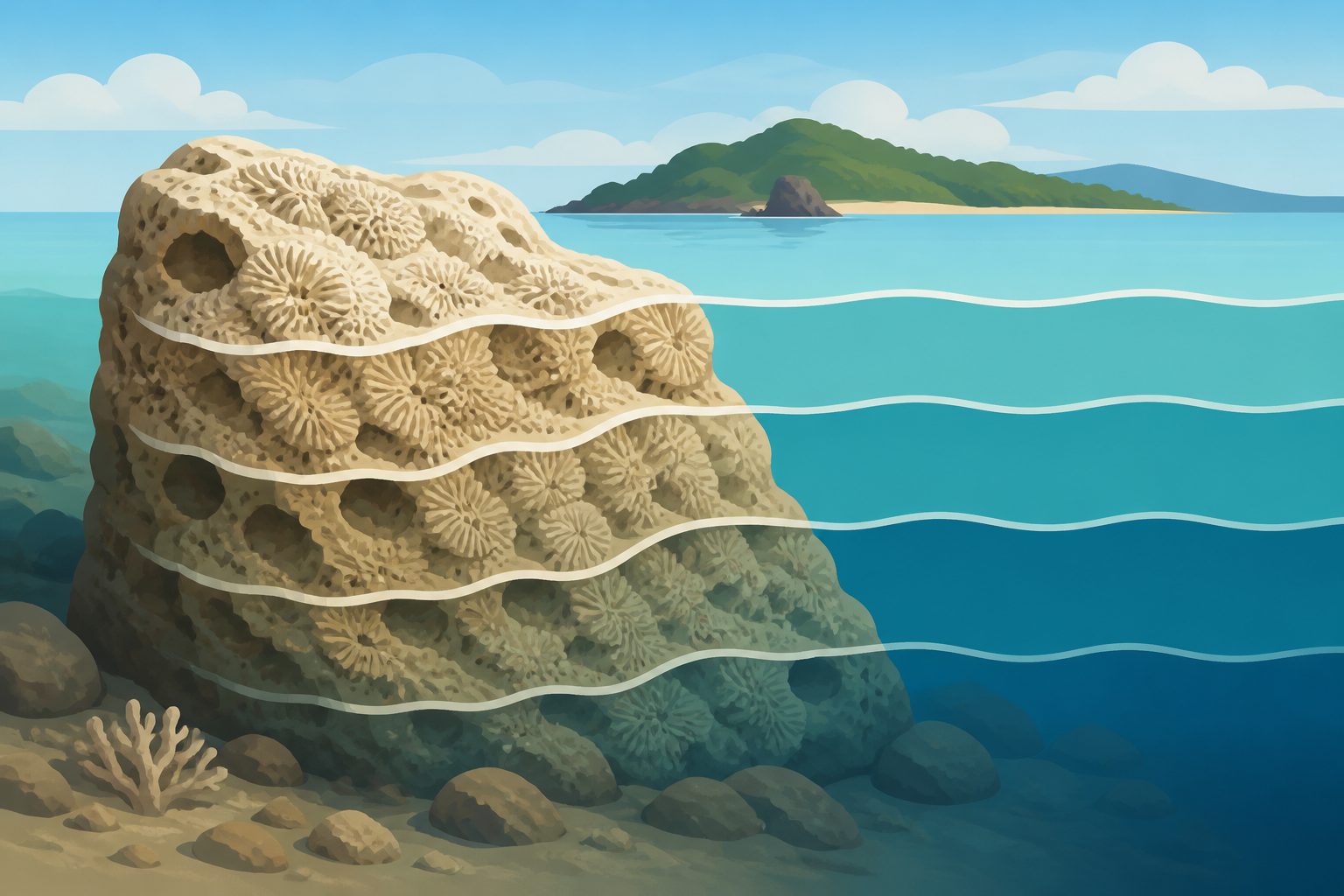
A study of an uplifted reef limestone suggests repeated relative sea-level changes of at least 20 to 30 meters.
Researchers examined fossil corals and the surrounding sediments in the Minatogawa Formation, exposed in a quarry on southern Okinawa Jima and nearby islets. Differences among layers and outcrops showed changes in reef depth, wave exposure and growth through time.
The results suggest that the formation developed during at least four relative sea-level cycles, each with a minimum amplitude of 20 to 30 meters. The reef appears to have begun growing during a sea-level rise, built upward as water levels rose and was eventually exposed when relative sea level fell.
What the fossil reef records
The study identified seven distinct fossil coral assemblages. They indicate environments ranging from very shallow water to reef settings as deep as about 30 meters: assemblage I represents roughly 30 meters, or shallower water where sediment made the water murky; the other assemblages indicate depth ranges from the surface to between 5 and 20 meters.
The coral communities and sediment types varied both across the outcrops and vertically through the formation. In one part of the reef, the sequence records initiation during a marine transgression, upward reef growth as sea level rose and reef decline through exposure during a relative sea-level fall. The researchers also found evidence of a possible additional period of erosion or dissolution within the formation. Overall, they interpret the Minatogawa Formation as recording at least four relative sea-level cycles with minimum amplitudes of 20 to 30 meters.
Why the reef history matters
Fossil reefs can preserve information about past sea levels because corals and reef sediments form within particular depth ranges. This study adds a record from the late Middle Pleistocene, a period for which sea-level and reef-ecology evidence remains incomplete.
The findings also show how coral communities changed as water depth, wave exposure and sediment conditions shifted. That provides a longer-term reference for understanding how reef ecosystems were structured during repeated environmental changes.
Evidence and caveats
The conclusions are based on detailed identification of fossil coral and algal assemblages, their positions in quarry sections, associated sedimentary facies and the stratigraphic relationships among limestone units. The researchers inferred ancient water depths by comparing these fossil communities with the modern distribution of related organisms in the Ryukyu Islands and the wider Indo-Pacific.
The result is a reconstruction of relative sea-level change at this uplifted reef site, not a directly dated global sea-level record. The abstract and excerpts do not provide precise ages for each cycle, and some depth estimates are uncertain because water turbidity and wave energy can cause species to occur outside their usual modern depth ranges.
// Source
Progress in Earth and Planetary Science · 2026 · DOI: 10.1186/s40645-026-00844-5
Authors: Riho Tomatsu, Marc Humblet, Kazuhiko Fujita, Yasufumi Iryu
Institutions: Tohoku University, Nagoya University, University of the Ryukyus