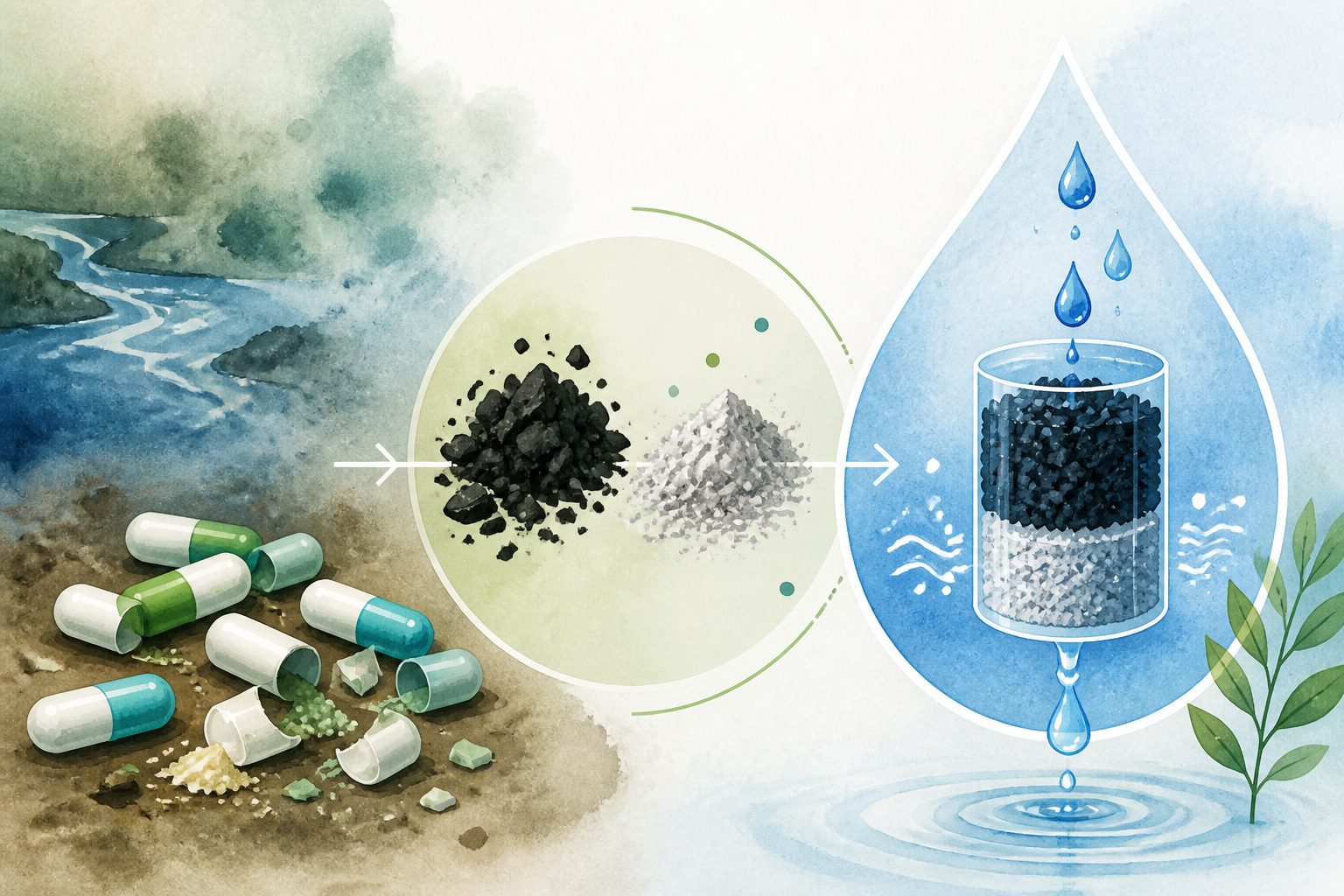
Heating hard and soft gelatin capsules produced porous carbon that trapped pollutants and ash that broke down a dye under ultraviolet light.
The researchers processed hard and soft pharmaceutical capsules by heating them at 700 °C, activating the resulting carbon with carbon dioxide at 850 °C, and then calcining some of the material. This produced porous carbon materials as well as ash containing titanium-rich mineral phases from capsule ingredients.
Carbon made from soft capsules had the largest measured surface area, 675 square metres per gram, and showed the highest reported adsorption capacities for methylene blue, acetaminophen and bisphenol A. Ash made from hard capsules showed photocatalytic activity: under ultraviolet light, it removed about 70% of methylene blue after 350 minutes, while dark controls showed little dye uptake.
What the capsule waste produced
Both hard and soft gelatin capsule waste could be converted into porous activated carbon and inorganic ash. The soft-capsule carbon had a surface area of 675 m² per gram and adsorption capacities of 225 mg per gram for methylene blue, 380 mg per gram for acetaminophen and 112 mg per gram for bisphenol A. The results indicate that the carbon materials trapped these substances through adsorption, with the data showing a range of adsorption sites rather than a single uniform type.
The ash fractions retained inorganic materials, including titanium-containing phases. Under ultraviolet irradiation, ash from the hard-capsule carbon removed approximately 70% of methylene blue after 350 minutes. Because the ash showed negligible dye uptake in dark control tests, the removal under light was predominantly associated with photocatalytic degradation rather than adsorption. The composition of the original capsule—hard or soft—affected the structure and performance of the resulting materials.
Evidence and remaining questions
The evidence comes from laboratory production and characterization of materials made from hard and soft capsule waste, followed by adsorption tests and ultraviolet-light degradation experiments. The researchers also used dark adsorption controls and mathematical equilibrium models to examine how contaminants interacted with the carbon and ash.
The work demonstrates technical feasibility, not practical deployment. The researchers identify the need for further study of energy use, economic viability, possible leaching of inorganic substances and end-of-life management. They also say the materials still need to be tested with real wastewater and on other pharmaceutical or polymer-based waste streams.
// Source
International Journal of Environmental Science and Technology · 2026 · DOI: 10.1007/s13762-026-07429-1
Authors: Amanda S. Giroto, K. Furukawa, B. I. M. Santos, C. I. Portela, C. Cortez, S.F. Valle, R. Borges, A. E. Nogueira, M. Gonçalves
Institutions: Universidade de São Paulo, Instituto de Aeronáutica e Espaço, Universidade Tecnológica Federal do Paraná, Department of Aerospace Science and Technology