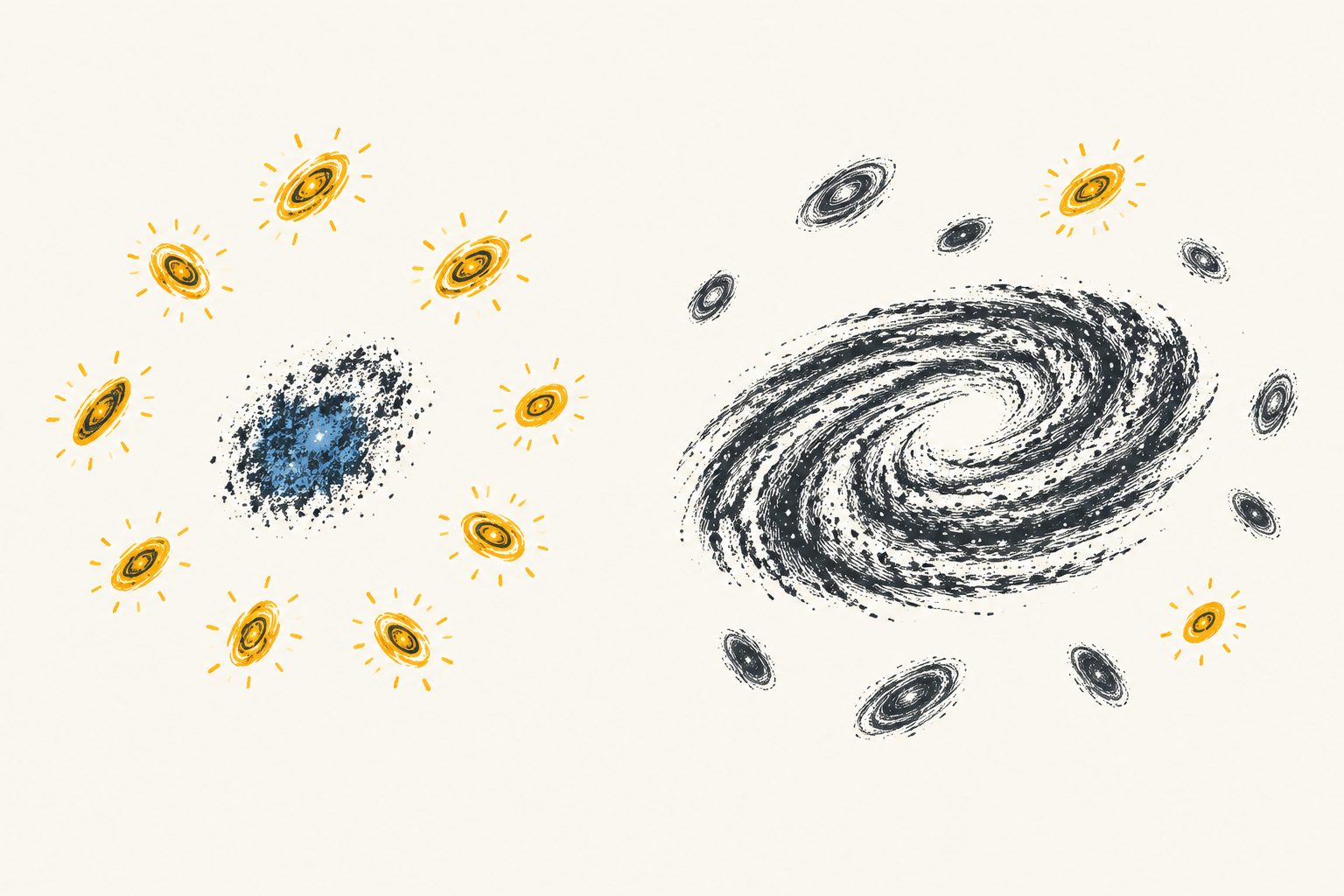
A survey found that 10%–25% of the most massive satellites around low-mass hosts had stopped forming stars, compared with 40%–70% around Milky Way-like galaxies.
The ID-MAGE team followed up satellite candidates around nearby galaxies with masses similar to the Large and Small Magellanic Clouds. Combining new observations with earlier measurements, the researchers identified 25 probable or confirmed satellites, including complete satellite populations for three host galaxies.
For satellites more massive than 10 million Suns, the fraction that had stopped forming stars was 10%–25%. That falls between the fraction for isolated galaxies, below 5%, and the 40%–70% measured for satellites of Milky Way-like hosts in the same mass range.
What the survey found
The researchers measured the velocities of 83 satellite candidates using radio observations of hydrogen gas, optical spectroscopy and data from the Dark Energy Spectroscopic Instrument. Six candidates were identified as probable satellite galaxies, while 77 were classified as background galaxies. Together with 19 satellites confirmed in earlier work, the survey now has a sample of 25 probable or confirmed satellites.
The study includes complete satellite counts for three hosts: two had no identified satellites, while NGC 3432 had four probable satellites. The survey is nearly complete for satellites with stellar masses above 10 million Suns. Among satellites in this mass range, 10%–25% were quenched, meaning they had stopped forming stars. That compares with less than 5% of isolated galaxies and 40%–70% of satellites around Milky Way-like hosts in the stated mass range.
Evidence and caveats
This is an observational study based mainly on velocity measurements, radio measurements of hydrogen gas and optical data. A velocity match identifies a probable satellite, but whether a galaxy is truly bound to its host also depends on its orbit and the host’s mass. The survey is ongoing, and the full candidate list has not yet been followed up.
The sample is nearly complete for the most massive satellites but is less representative at lower masses. The follow-up of lower-mass candidates favored objects with gas or signs of star formation, which can bias conclusions about that group. The quenched-fraction comparison therefore applies most directly to the more massive satellites covered by the study.
// Source
The Astrophysical Journal · 2026 · DOI: 10.3847/1538-4357/aeacd4
Authors: Laura E. Hunter, Burçı̇n Mutlu-Pakdı̇l, Michael B. Farnell, David J. Sand, Kristine Spekkens, Paul Bennet, S. Campana, Heidi Jo Newberg, Denija Crnojević, Amandine Doliva-Dolinsky, Emmanuel Durodola, Michael G. Jones, Donghyeon J. Khim, Laurella C. Marin, Ricardo J. Mendez, Deepthi S. Prabhu, Dennis Zaritsky
Institutions: University of Washington, University of Tampa, University of Arizona, Queen's University, Dartmouth College, University of Surrey, Queens University, Space Telescope Science Institute, Infrared Processing and Analysis Center