A study finds that larger neutrino observatories may probe whether the cosmic neutrino background has its expected density.
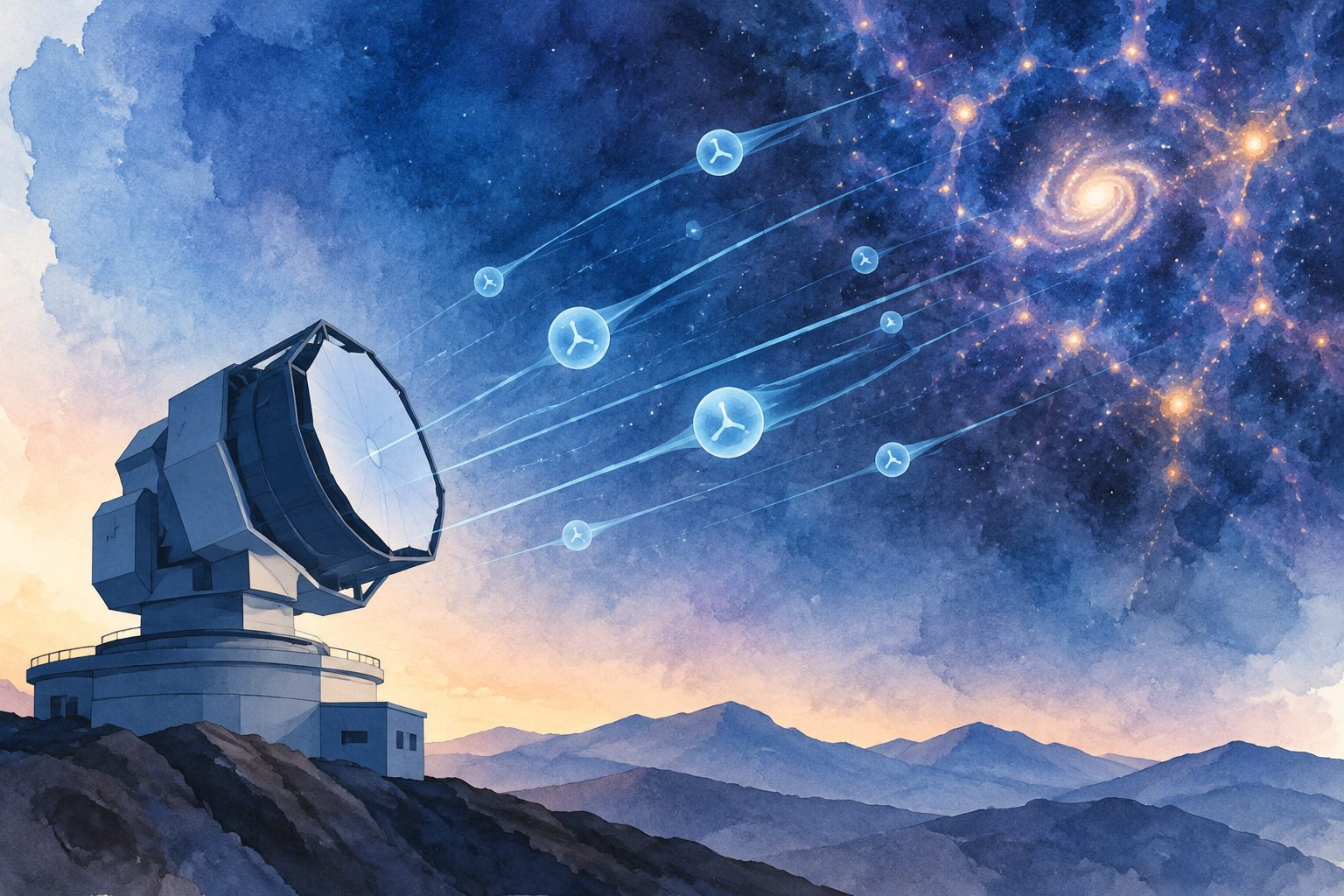
The cosmic neutrino background is a population of relic neutrinos left over from the early universe. Most are too low in energy to detect directly, but the study calculates how collisions with energetic cosmic rays across cosmic history could boost some of them to detectable energies.
Including several types of scattering, the researchers estimate that current IceCube data constrain any excess above the standard cosmic neutrino density to roughly 100–1,000 times that density at a neutrino energy of 10¹⁰ GeV, for a lightest neutrino mass of at least 0.1 electronvolts. They project that IceCube-Gen2 could test excesses of roughly 1–10 times the standard density, while 10 future telescopes with similar sensitivity could test the density expected in the standard cosmological model for a lightest neutrino mass consistent with the KATRIN experiment’s bound.
What the calculations show
The researchers calculated the total diffuse flux of boosted cosmic background neutrinos produced when cosmic-ray protons scatter off relic neutrinos throughout the universe. Their calculation includes both neutral- and charged-current interactions, as well as elastic and deep inelastic scattering, in which the collision can break apart a particle.
They find that existing IceCube observations already limit the cosmic neutrino background’s overdensity—the amount by which it exceeds the standard density—to about 100–1,000 at 10¹⁰ GeV when the lightest neutrino mass is at least 0.1 electronvolts. IceCube-Gen2 could test overdensities of about 1–10. A combination of 10 future neutrino telescopes with similar sensitivity could test the standard cosmological model’s expected background density for a lightest neutrino mass compatible with the KATRIN bound.
Why the test matters
The cosmic neutrino background is a predicted relic of the early universe, but its density is difficult to measure because the neutrinos are generally very low in energy. The study identifies a way to make part of this background accessible to high-energy neutrino telescopes.
If the projected sensitivities are achieved, future observations could test whether the background is close to the density expected in the standard cosmological model, rather than only ruling out very large excesses. The result also links high-energy cosmic-ray interactions with measurements of relic neutrinos and their masses.
Evidence and limits
This is a theoretical calculation of the boosted cosmic neutrino flux, combined with an interpretation of existing IceCube limits and projections for future telescopes. It is not a direct measurement of the cosmic neutrino background’s density.
The projections depend on the assumed cosmic-ray populations, scattering processes, neutrino masses and detector sensitivities. The abstract does not give the projected event counts or uncertainties, and testing the standard density would require a combination of 10 future telescopes with similar sensitivity.
// Source
Physical review. D/Physical review. D. · 2026 · DOI: 10.1103/smzy-dwp5
Authors: Gonzalo Herrera, Shunsaku Horiuchi, Xiaolin Qi, Ian M. Shoemaker