A symmetry-based analysis identifies surface orientations in altermagnets that may allow controlled switching of their magnetic order and generation of spin currents.
The study examines centrosymmetric, collinear antiferromagnets known as altermagnets, whose two magnetic sublattices have opposite spins but no overall magnetization. In the bulk, inversion symmetry prevents the linear current-induced fields needed to select between opposite orientations of the Néel vector, the order describing the two sublattices. The researchers show that an interface can permit such a staggered response, with its form fixed by the surface's symmetry and orientation.
The framework also uses the spin-conductivity tensor to determine which surfaces can produce transverse spin currents through the spin-splitter effect. Together, these rules identify surface orientations in d-wave altermagnets that could serve as electrically switchable spin-current sources, while remaining valid when responses are averaged over statistically equivalent surface facets and equilibrium roughness.
What the surface rules show
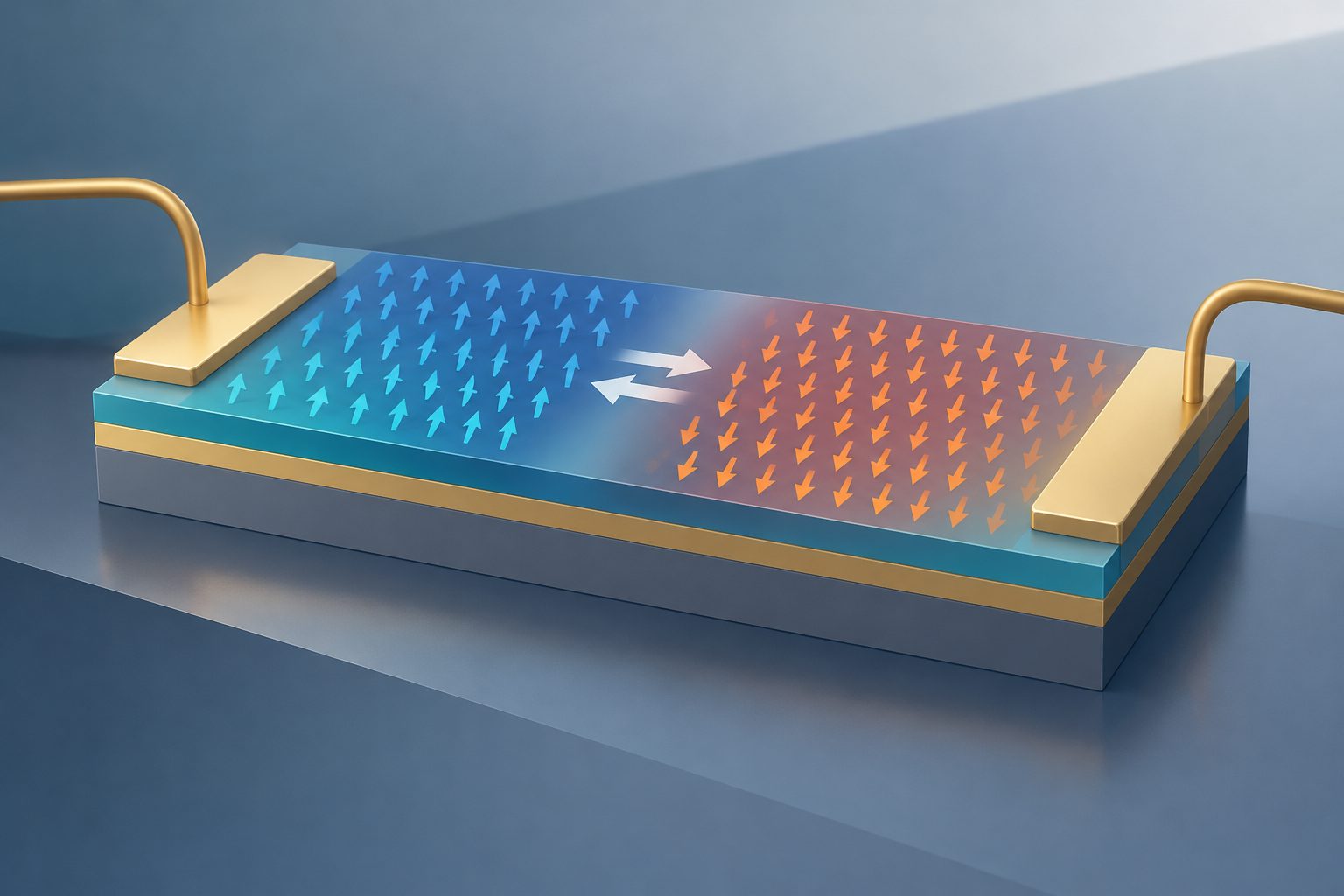
The researchers developed a surface antisymmetry-group framework for determining whether an altermagnetic film can be switched between opposite Néel-vector states by an electrical current. The key requirement is a staggered effective field: a current-induced response that has opposite signs on the two magnetic sublattices and can therefore distinguish between the two opposite Néel-vector directions. Although this response is forbidden in the bulk of centrosymmetric altermagnets, the analysis shows that it can occur as a macroscopic interfacial response through sublattice-odd spin-orbit coupling.
The surface antisymmetry group determines which components of this response are allowed and which electric-field direction is needed to switch them. The study separately identifies surface orientations that permit transverse spin-current generation through the spin-splitter effect. For a surface to function as a deterministically switchable spin-current source, the required staggered response and transverse spin current must both be allowed; the easy axis of the magnetic order must also be oriented appropriately, which the study identifies as material-specific. The symmetry rules remain applicable after averaging over equivalent surface terminations and equilibrium roughness.
Why the surface matters
Electrical initialization could allow an altermagnetic layer to both store information in its magnetic order and control another magnetic layer through spin currents. The study provides a way to select promising surface orientations before designing a spin-torque heterostructure, rather than relying only on trial-and-error.
The results also separate two requirements that are sometimes considered together: selecting the sign of the Néel vector and producing a useful transverse spin current. That distinction shows why a surface may allow switching of some components of the magnetic order but not others, and why the magnetic easy-axis direction remains important for a working device.
Evidence and caveats
This is a theoretical symmetry analysis based on response tensors and surface antisymmetry groups, not an experimental demonstration of switching in a fabricated device. Its construction assumes a single-crystalline film with bipartite magnetic ordering, a well-defined surface orientation, and statistically symmetry-preserving surface roughness. The top and bottom interfaces are treated as inequivalent, as is generally expected for a heterostructure.
The rules identify responses that symmetry allows; they do not show that every allowed response will be large enough for a device. In particular, the required easy-axis anisotropy is material-specific, and strong surface magnetization may affect spin-current transmission. The framework is also aimed at the stated class of bipartite antiferromagnets and requires the symmetry analysis to be adjusted if strain lowers the crystal symmetry.
// Source
Physical review. B./Physical review. B · 2026 · DOI: 10.1103/y1yx-t941
Authors: K. D. Belashchenko