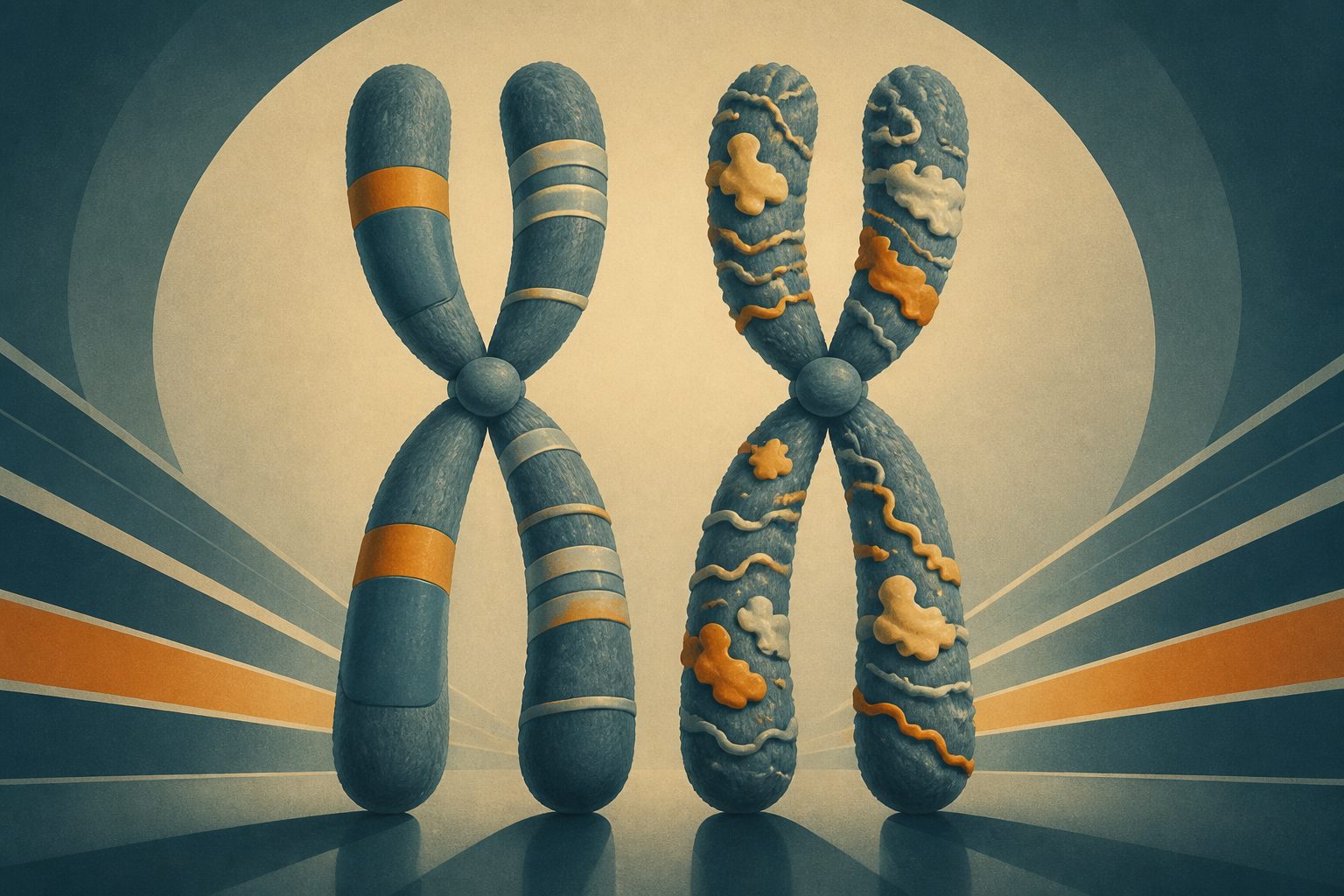
A study finds a consistent shift in how the two genetically identical DNA copies line up in three dimensions.
After DNA is copied, each chromosome produces two genetically identical sister chromatids. Using methods that can distinguish between the two copies, researchers found that they are consistently offset from one another along the direction of the inherited DNA strands across the genome.
The offset remained when loop formation was removed but disappeared when the sister copies were no longer held together. Computer simulations suggest that a small misalignment—about 100,000 DNA building blocks—between the protein complexes that maintain cohesion could produce the observed pattern. The researchers propose two possible ways this asymmetry might arise during DNA replication.
How sister copies differ
The researchers used sister-chromatid-sensitive Hi-C, which measures contacts between regions of DNA, strand-specific fluorescence imaging, and polymer modeling. Across the genome, sister chromatids showed a consistent difference in their alignment, biased along the 5′-3′ direction of the DNA strands inherited from the parent cells.
This shift persisted when loop extrusion—the process by which cohesin proteins form DNA loops—was removed, but it was lost when cohesion between the sister chromatids was disrupted. Simulations indicated that a modest misalignment of cohesive cohesin complexes, around 100 kilobases, could account for the asymmetry. The study proposes that replication may dislocate cohesin, or that cohesin pairs may become anchored asymmetrically and then slide randomly.
Why the shift matters
The findings show that genetically identical sister chromatids can differ in their chromosome-scale three-dimensional organization because of how DNA replication proceeds. That organization may matter during homology search, when a cell looks for matching DNA sequences to help repair damage.
The study therefore connects the unequal mechanics of leading- and lagging-strand replication with the later spatial arrangement of the copied chromosomes. The abstract does not establish how this asymmetry affects repair outcomes, but it identifies a structural feature that could influence the process.
Evidence and open questions
The evidence combines genome-wide chromosome-contact measurements, strand-specific fluorescence imaging, and polymer simulations. The experiments link the displacement to cohesion and show that it does not require loop extrusion, while the simulations support a possible scale and mechanism for the effect.
The abstract does not provide details about the number or types of cells examined, nor does it report a direct effect on DNA-repair outcomes. The two explanations for how replication creates the displacement are proposed models rather than a single established mechanism.
// Source
Science · 2026 · DOI: 10.1126/science.aea4611
Authors: Flavia Corsi, Sofia Kolesnikova, Thomas L. Steinacker, Zsuzsanna Takács, Paul Batty, Michael Mitter, Daniel W. Gerlich, Anton Goloborodko
Institutions: Medical University of Vienna, Austrian Academy of Sciences, Vienna Biocenter, Institute of Molecular Biotechnology