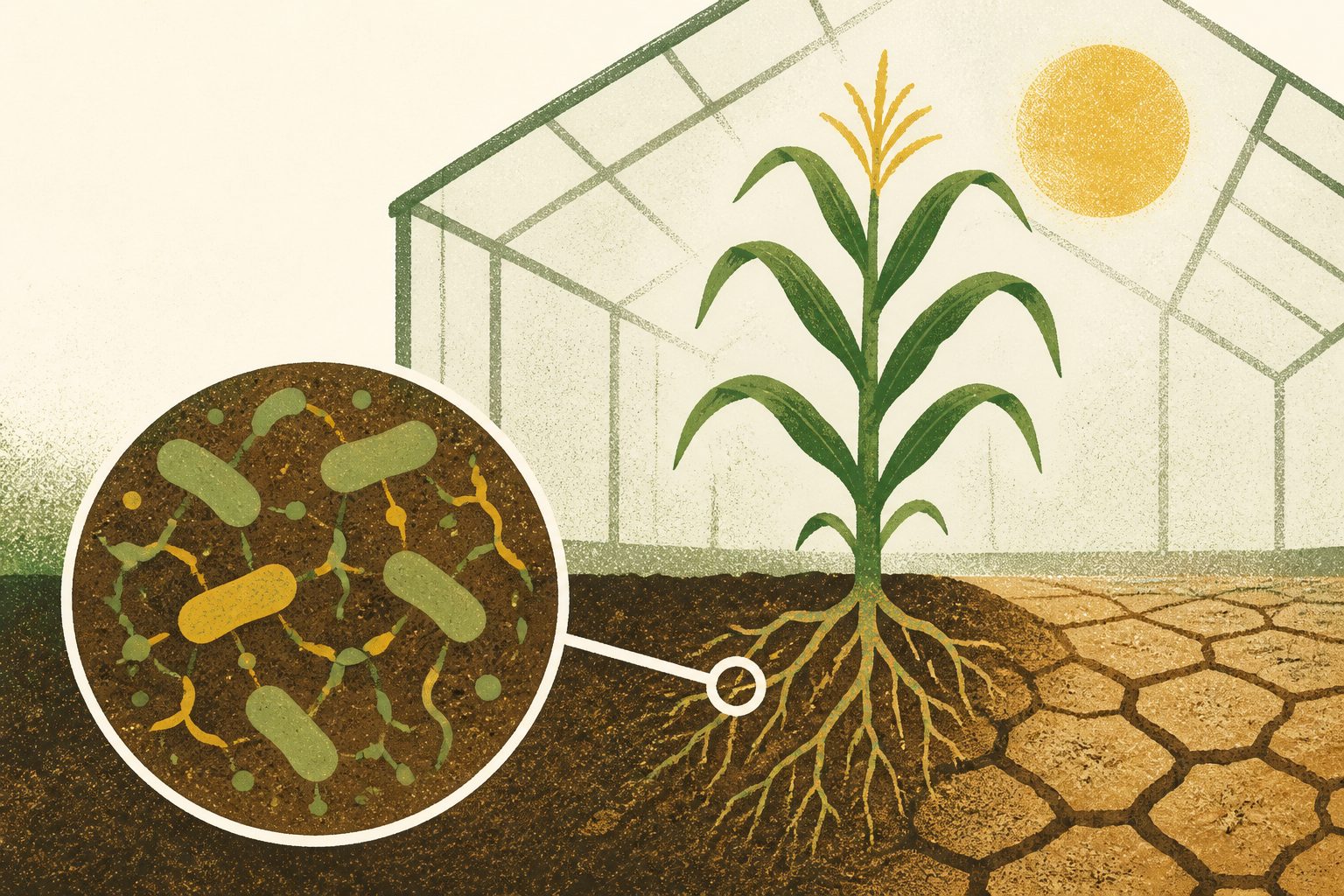
Four Streptomyces isolates stayed active in water stress, while three improved different measures of maize growth in a controlled greenhouse test.
Researchers tested four Streptomyces isolates—CLV16, CLV100, CLV115 and CLV179—in laboratory water-stress tests and in greenhouse-grown maize. The bacteria retained several traits linked to plant growth, including phosphate solubilization and siderophore production, under reduced water availability.
Maize treated with the bacteria was grown for 25 days at 30% of soil field capacity, compared with well-watered plants at 100% field capacity. CLV100 and CLV115 increased plant biomass and shoot growth under drought, while CLV179 also increased root length in stressed plants.
How the bacteria affected maize
All four isolates remained metabolically active at water potentials down to -1.0 MPa. Under the most severe tested stress, CLV100 grew three times more in culture than the other isolates, CLV115 produced 8.9 times more indolic compounds, and CLV179 produced three times more ammonia. CLV16 showed the lowest levels of the tested traits.
In the greenhouse, plants were grown at 30% field capacity, with soil moisture ranging from 5.4% to 12.8%, for 25 days after emergence. CLV100 and CLV115 increased maize biomass and shoot growth under drought. CLV179 increased root length by 22% in stressed plants compared with non-bacterized stressed plants, and the study also reported greater root elongation and biomass accumulation in Streptomyces-colonized plants than in well-watered controls.
Why the result matters
The results indicate that selected Streptomyces isolates can maintain several plant-growth-related activities during water stress and can improve some measures of maize vegetative growth in a greenhouse. The effects differed by isolate, with CLV179 identified by the researchers as a candidate for further development because of its consistent bacterial traits and effects on root development.
If the results hold under broader conditions, these bacteria could be investigated as microbial treatments for maize establishment and root growth where water is limited. The study does not yet show whether they improve grain yield or performance in agricultural fields.
Evidence and open questions
The evidence comes from laboratory tests of bacterial activity and a controlled greenhouse experiment using maize grown in pots with a soil, sand and vermiculite mixture. The plant experiment used eight replicates per treatment, no added fertilizer, one maize seed type, and measurements of vegetative growth after 55 days of germination.
The study did not test the isolates in field conditions, across different maize genotypes or soil types, or under naturally occurring drought. It also did not measure grain yield, plant water status, photosynthesis or nutrient uptake. The researchers say these tests, as well as work on formulation, shelf life, biosafety and regulatory requirements, are needed before practical deployment.