The researchers examined coalbursts linked to thrust-fault movement using field monitoring, physical analog experiments, numerical simulations and laboratory tests on hollow coal samples designed to represent underground roadways. They found that, as mining approaches a fault, its upper and lower sections can slip in opposite directions rather than moving as one unit.
Engineering & Technology1 week ago
Shifting fault segments can squeeze coal into bursts underground
As mining advances toward a fault, different sections can slip in opposite directions, concentrating stress in nearby coal and helping trigger sudden failure.
How fault movement loads coal
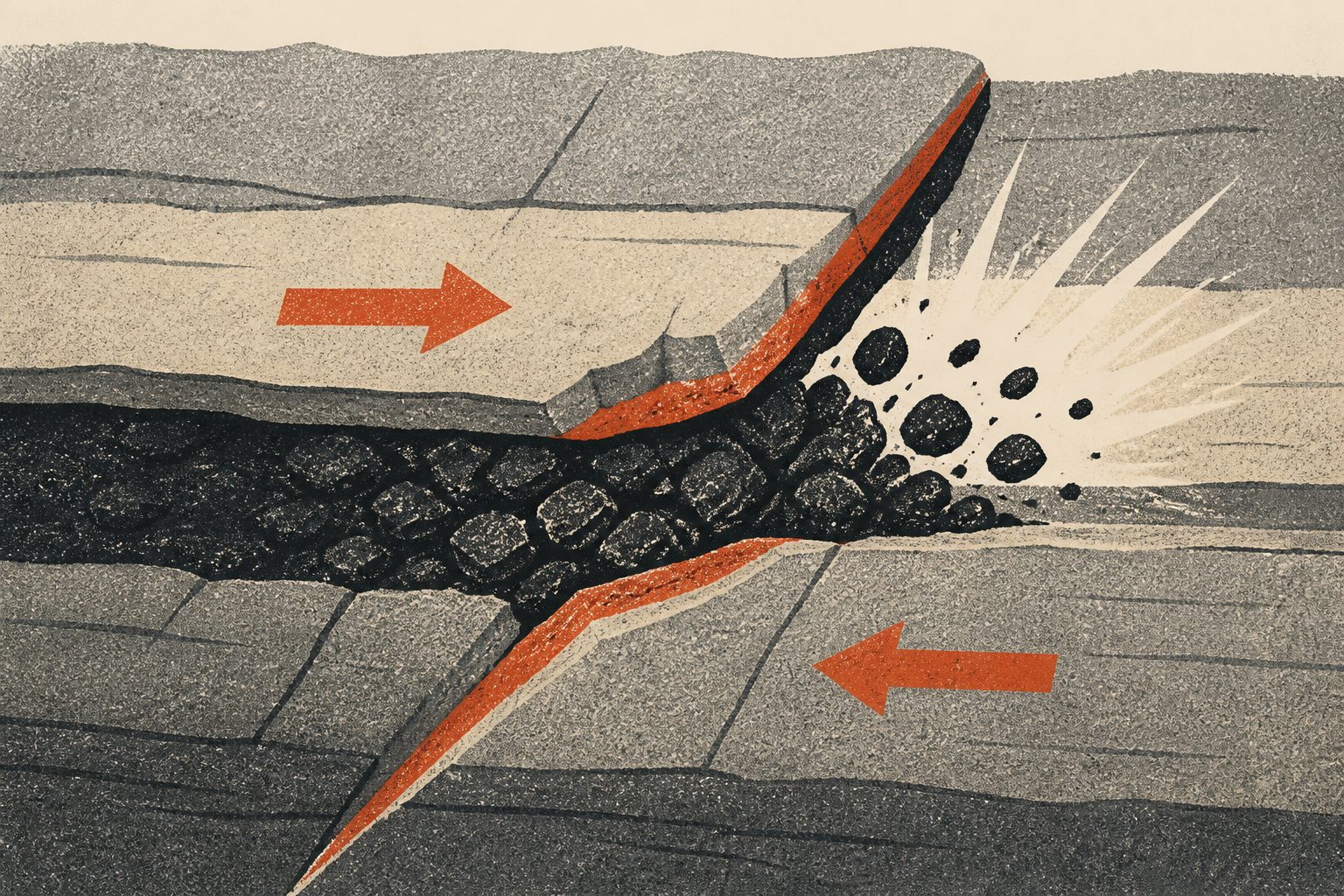
The study reports that the upper section of the fault slips anticlockwise while the lower section slips clockwise as mining advances toward it. This segmented movement creates a clamping effect that concentrates stress in the coal between the mining area and the fault. Coal under high static stress is especially vulnerable to unstable failure when dynamic stress is added. The researchers also conclude that stress waves reflected from roadway surfaces can break surrounding rock, producing coalbursts along with sidewall spalling and floor heave. They identify segmented fault slip and the resulting clamping effect as the two core factors in these events.
Why the mechanism matters
Coalbursts linked to thrust-fault slip can severely damage underground roadways and cause personnel casualties. By connecting the fault’s segmented movement with stress concentration and the later response of highly stressed coal, the study provides a more detailed explanation of how these events develop. The authors say this mechanism offers a theoretical basis for understanding such disasters; the abstract does not report a tested prevention or warning system.
Evidence and caveats
The conclusions draw on field monitoring, physical analog simulation, numerical simulation and laboratory coupled static-and-dynamic loading tests on hollow coal specimens. This combination links observed fault movement with modeled stress changes and experimentally observed coal damage. However, the provided abstract does not give the number of monitored sites, experiments or specimens, nor does it report how accurately the mechanism predicts coalbursts across different mines or geological settings. The findings therefore describe a proposed mechanism supported by several lines of evidence, rather than a validated forecasting method.
// Source
Bulletin of Engineering Geology and the Environment · 2026 · DOI: 10.1007/s10064-026-05302-6
Authors: Ningbo Zhang, Zong‐Xian Zhang, Zhenhua Ouyang, Yang Liu, Yunpeng Li, Qianhai Xu, Jian Liu, Qingwen Shi
Institutions: Ministry of Education of the People's Republic of China, China Coal Research Institute (China), China University of Mining and Technology, University of Oulu, Taiyuan University of Science and Technology, Shanxi University