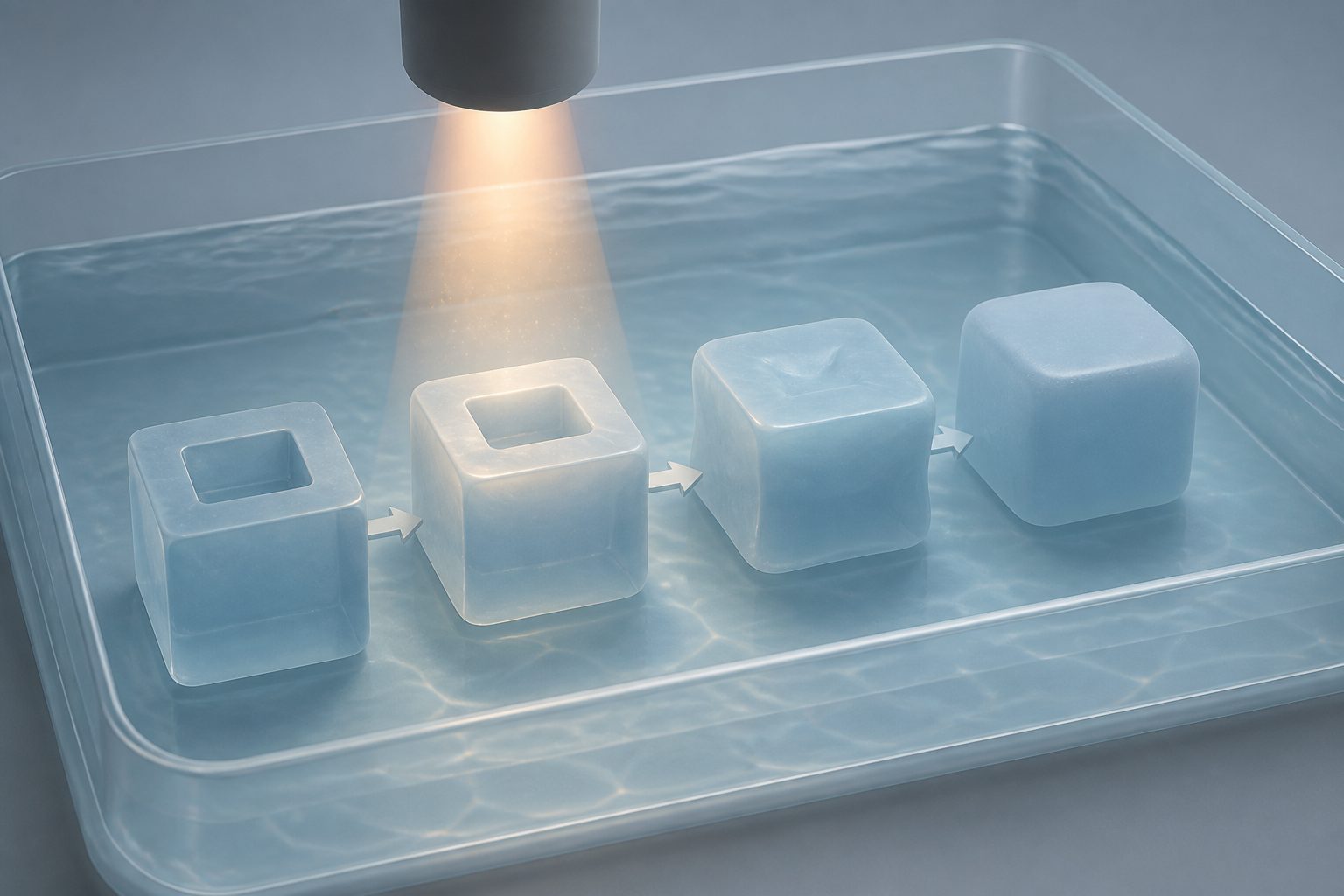
Azopolymer particles embedded in a soft gel let small structures change shape repeatedly under polarized light.
The composites combine light-responsive azopolymer nanoparticles with a hydrogel matrix. The particles provide directional movement, while the gel helps carry that movement through the whole structure and provides restoring forces that allow later changes to overwrite earlier ones.
In tests described by the researchers, sequential illumination with two perpendicular polarizations produced alternating linear deformations in hydrogel cubes. The changes occurred with illumination intervals as short as five seconds, and the team also demonstrated polarization-controlled microwells that could close completely in water.
Evidence and open questions
This is a research article reporting material fabrication and demonstrations of light-driven deformation. The abstract gives the reported deformation, timing and microwell results, but does not provide details such as the full experimental conditions, durability over repeated cycles, operating scale beyond the described microstructures, or performance in biotechnology, microfluidics or drug-release applications. Those applications therefore remain potential uses rather than demonstrated outcomes here.
// Source
Light Science & Applications · 2026 · DOI: 10.1038/s41377-026-02411-5
Authors: David Urban, Ryota Toyohara, Marcel Rey, Daniele Martella, Dag Roar Hjelme, Andrea Alessandrini, Toshiro OHASHI, Emiliano Descrovi
Institutions: Hokkaido University, University of Münster, University of Florence, Politecnico di Torino, SINTEF, University of Modena and Reggio Emilia, Norwegian University of Science and Technology, Istituto Nanoscienze