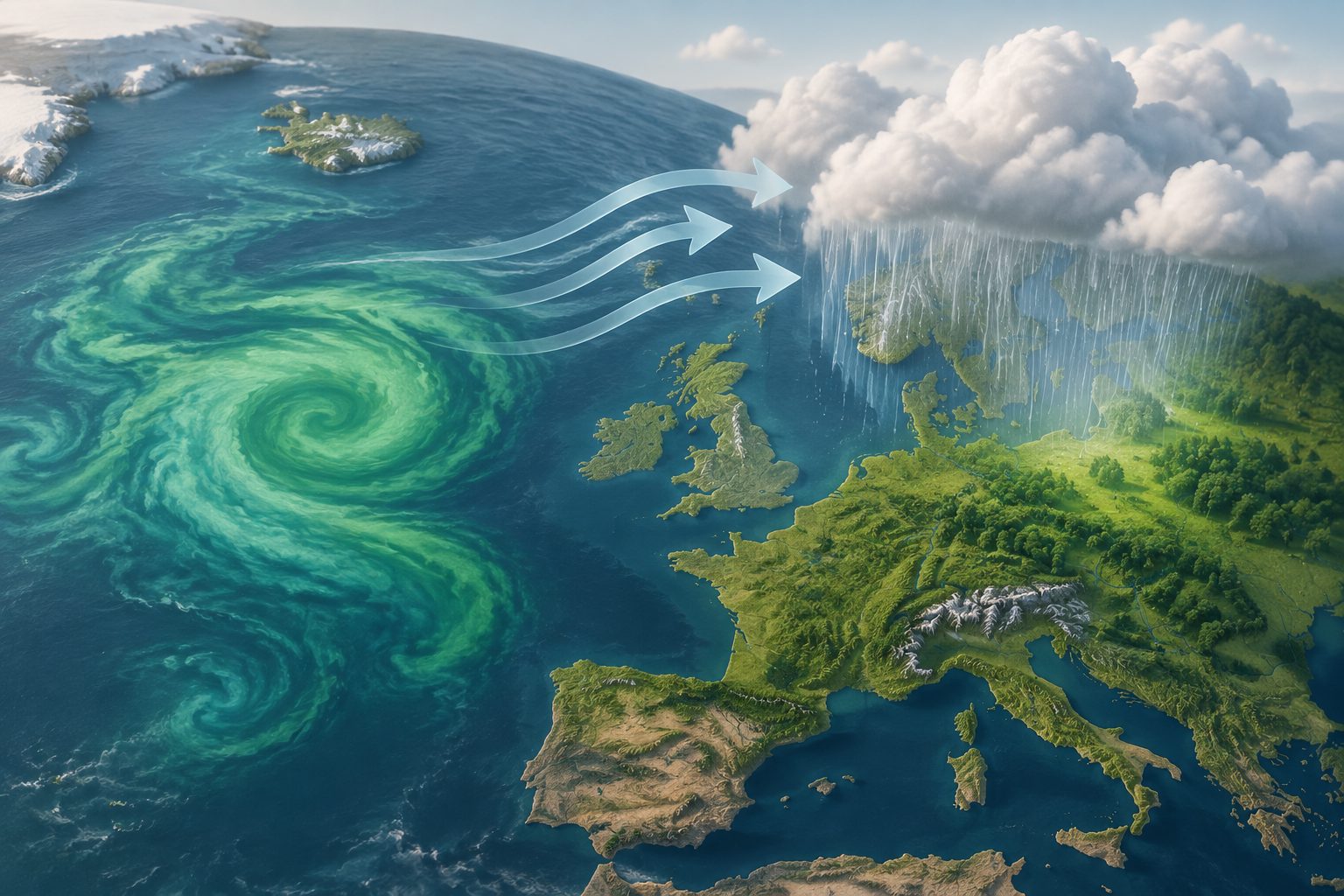
North Atlantic phytoplankton blooms linked to wetter Europe and faster plant growth
The blooms warmed the ocean and strengthened winds carrying moisture into central Europe, where plant productivity rose during the growing season.
Editorial illustration — not from the study.
Researchers combined satellite observations, ocean and atmospheric reanalyses, model experiments and historical climate simulations to examine whether changes in ocean biology can affect plant growth on land. They identified a sequence in which increased chlorophyll in the shallow late-summer ocean mixed layer absorbed more sunlight, contributing to warmer sea-surface temperatures and changes in air pressure.
Those atmospheric changes strengthened west-to-east winds that carried moisture toward Europe. During bloom years, central Europe was wetter and its gross primary productivity—the amount of carbon vegetation takes up through photosynthesis—rose by roughly 15–20% during the growing season.
How blooms affect Europe
Higher chlorophyll concentrations in the high-latitude North Atlantic were associated with warmer sea-surface temperatures, higher pressure near the bloom region, lower pressure over Europe and stronger westerly winds. These changes were linked to increased precipitation and soil moisture across central Europe, where gross primary productivity rose by roughly 15–20% during the growing season.
The model experiments supported an active role for chlorophyll. When chlorophyll was held at its usual average rather than allowed to vary from year to year, sea-surface temperature anomalies still developed, but the European productivity response was largely absent. The researchers therefore identify marine ecosystem variability as one pathway connecting the North Atlantic to plant growth on land.
Why ocean biology matters
The findings indicate that ocean biology can be connected to conditions affecting vegetation far inland, rather than marine and terrestrial ecosystems behaving as fully separate parts of the carbon cycle. Changes in North Atlantic phytoplankton may therefore help shape European rainfall, soil moisture and plant productivity through linked ocean, atmosphere and land processes.
The result is relevant to understanding year-to-year changes in European ecosystems and water availability. It concerns increased plant productivity, however, not necessarily greater long-term carbon storage, which also depends on how much carbon ecosystems release through respiration.
Evidence and caveats
The study draws on satellite ocean-colour observations, atmospheric and ocean reanalyses, an Earth system model with interactive chlorophyll, experiments that altered chlorophyll variability, historical climate simulations and country-level crop records. The agreement among observational analyses and different model approaches supports the proposed link, while the chlorophyll-fixed experiment indicates that chlorophyll was not merely a passive marker of favorable ocean conditions.
The observed sea-surface temperature changes probably also reflect other processes, including atmospheric circulation, surface heat exchange and earlier climate variability. The study documents the mechanism in the present climate; it does not establish how it will change in the future. Its productivity result is gross primary productivity, not net ecosystem carbon storage, and the latter could also be affected by changes in ecosystem respiration.
High-resolution drone maps detected early crop water stress before changes appeared in other plant measurements. The approach tracked evapotranspiration—the movement of water from soil and plants into the air—across sugar beet, potato and winter wheat fields.
A pilot-scale system removed long-chain PFAS, including PFOS and PFOA, from municipal wastewater and concentrated the compounds in a small volume of foam. Under the best-performing conditions, a subsequent treatment destroyed and removed more than 99% of measured PFAS in that concentrated foam.
Humpback whales in Monterey Bay fed more frequently when California sea lions were present. The whales appeared to spend less time searching and approaching prey, while the effort and movement of individual lunges showed no detectable increase.