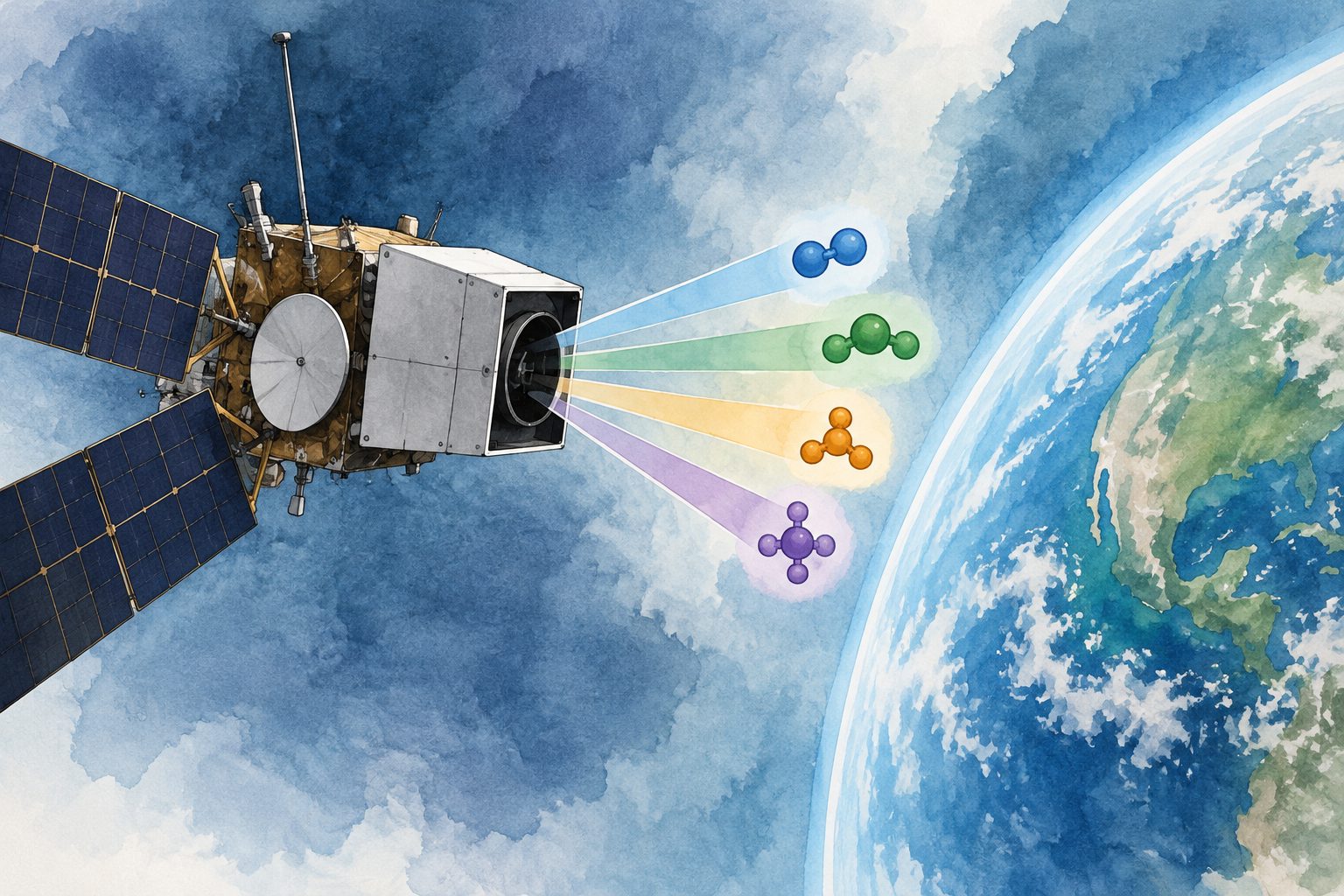
The spacecraft’s infrared spectrometer matched measurements from another satellite and showed sensitivity to methane, ozone and two other gases.
Researchers assessed MAJIS using infrared observations collected over tropical parts of the Pacific Ocean during JUICE’s lunar and Earth gravity assist in August 2024. They compared the data with measurements from the Infrared Atmospheric Sounding Interferometer, or IASI, over the wavelength range shared by the instruments: 3.6 to 5.56 micrometres.
After removing observations affected by clouds or reflected light from the ocean, the instruments showed an excellent match in their measured infrared brightness. Comparisons with computer-generated atmospheric spectra also revealed signals associated with methane, nitrous oxide, ozone and carbon monoxide.
What the instrument detected
The comparison suggests that MAJIS’s infrared measurements are calibrated to better than 10%, with accuracy declining to about 15% between 5.25 and 5.56 micrometres. The researchers identified a small wavelength offset of about 4 nanometres beyond 4 micrometres. They estimated a signal-to-noise ratio of 200–300, in line with the instrument’s expected performance, and found that its spectra were sensitive to methane, nitrous oxide, ozone and carbon monoxide.
// Source
Annales Geophysicae · 2026 · DOI: 10.5194/angeo-44-1281-2026
Authors: Sandrine Guerlet, R. Armante, Ninon Lauzanne, François Poulet, Y. Langevin, Sébastien Rodriguez, Leigh N. Fletcher, Thierry Fouchet, Giuseppe Piccioni, A. Migliorini
Institutions: Université Paris Cité, Sorbonne Université, Centre National de la Recherche Scientifique, Université Paris-Saclay, Université Paris Sciences et Lettres, Institut de physique du globe de Paris, University of Leicester, Observatoire de Paris, Osservatorio Astronomico di Padova, Institute for Space Astrophysics and Planetology, National Institute for Astrophysics, Laboratoire de Météorologie Dynamique, Institut d'Astrophysique Spatiale, Institut Polytechnique de Paris, Institut Pierre-Simon Laplace, LIRA - Laboratoire d'instrumentation et de recherche en astrophysique